
Lecture
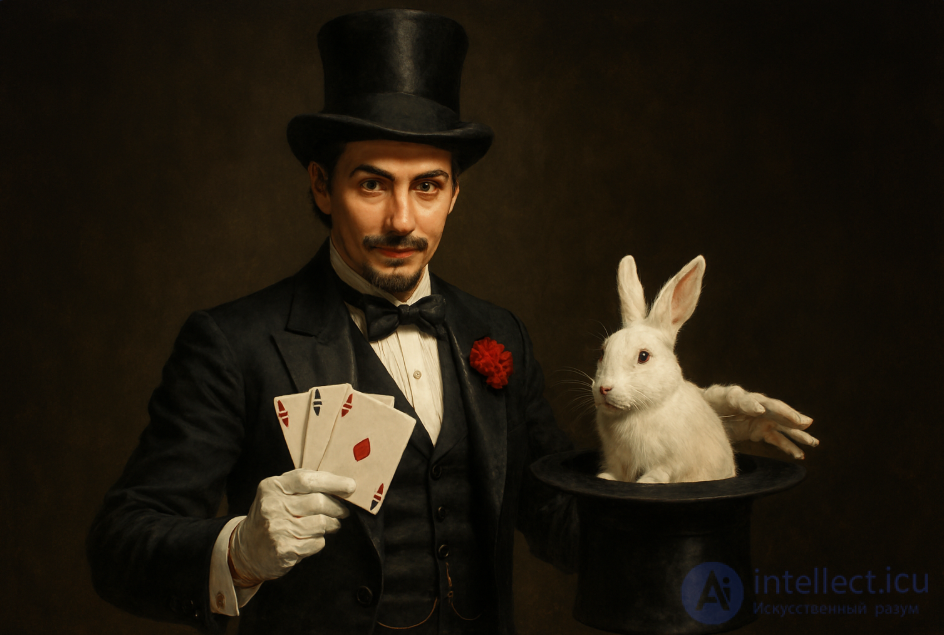
An illusionist is an artist who performs magic tricks and stunts based on physical and psychological phenomena. Their goal is to create the impression of the impossible in the audience, using sleight of hand, props, and the audience's attention.
Good vision and motor coordination.
Endurance: Long rehearsals and performances require physical fitness.
No serious nervous system or musculoskeletal disorders.
High stress tolerance: able to work in public and under pressure.
Developed attention and quick reactions.
Artistry and the ability to manage audience emotions.
Creativity and the ability to improvise.
There are no specialized universities, but training is possible at circus schools, theater studios, and with professionals.
Stage speech, acting, and perceptual psychology skills are essential.
Continuous self-education: developing new tricks, studying technical devices.
Country Average income (approximate)
USA 3,500–5,000
China 1,200–1,500
Russia 600–800
Ukraine 400–600
India 250–400
South Africa 700–900
Egypt 300–500
Israel 3,200–3,500
Magicians' incomes depend on their popularity, the number of performances, and the level of the show. In developed countries, above-average earnings are possible.
Visual impairment (from constant eye strain).
Joint and spinal problems (fine motor skills, long performances).
Psycho-emotional burnout due to constant contact with the public.
History of the Illusionist (Magician) Profession
Antiquity
Illusionism is one of the oldest professions associated with entertainment and the psychology of perception. As early as Ancient Egypt (c. 2500 BC), priests and street performers demonstrated "miracles" using sleight of hand, hidden mechanisms, and knowledge of human attention. The Westcar Papyrus describes tricks involving severed and "resurrected" animal heads.
Antiquity and the Middle Ages
In Ancient Greece and Rome, magicians performed at markets and festivals. Their tricks often blended with philosophy, mysticism, and religion.
In the Middle Ages, illusionists came under suspicion: magic tricks were often considered witchcraft. Many performers performed secretly or disguised as jugglers and jesters at the courts of the nobility.
Modern Period (17th–19th Centuries)
With the development of science, illusionism gradually separated from magic and mysticism.
In the 18th–19th centuries, magicians began to use:
optics,
mechanics,
electricity,
mirrors, and complex sets.
The illusionist became a stage performer, and magic tricks became a form of theater.
20th Century
Illusionism reached a new level:
large stages,
television,
touring,
creation of the artist's image.
The magician became not just a master of tricks, but a showman, actor, and director.
Outstanding Illusionists
Harry Houdini (1874–1926)
A legend of illusionism.
Famous for his escapes from:
chains,
prisons,
water chambers.
He debunked myths about the supernatural and proved that miracles are a matter of skill and preparation.
Georges Méliès
Magician and film pioneer. He used illusions in the first special effects in cinema, combining magic and technology.
David Copperfield
The most commercially successful illusionist in history.
Famous for his tricks:
the disappearance of the Statue of Liberty,
"passing" through the Great Wall of China.
Dai Vernon
Master of card magic, "a magician's magician." Influenced professional standards of illusionism.
David Blaine
Modern street illusionist. He emphasized:
psychology,
endurance,
minimalism,
bringing magic closer to the viewer.
Illusionists and Technology
Illusionists have always used the cutting-edge technologies of their time:
mechanisms,
light,
lasers,
video screens,
augmented reality.
Essentially, illusionism is the art of attention management, not just technology.
The Future of the Profession, Considering the Development of AI
What AI Can Do
Artificial intelligence is already capable of:
creating visual illusions,
generating "magic" videos,
simulating tricks in virtual reality,
automating special effects.
Will the profession disappear?
No, the profession will not disappear, but it will change.
Reasons:
An illusion is valuable not for its effect, but for its live contact.
The audience values emotion, charisma, risk, and story.
People want to see a human being, not an algorithm.
How the Profession is Transforming
The illusionist of the future:
will use AI as a tool,
combine magic tricks with VR and AR,
create interactive shows,
work at the intersection of theater, technology, and psychology.
New trends
digital illusionist,
VR magician,
neuroillusionist (working with perception and attention),
interactive online shows.
Related professions
Circus performer.
Clown.
Hypnotist.
Stuntman.
Theater and film actor.
Showman and event host.
Conclusion
The profession of illusionist combines artistry, psychology, and physical fitness. It requires constant self-improvement and the ability to amaze an audience. Despite health risks and income instability, illusionists remain in demand thanks to
due to the uniqueness of their art.
Illusionism is a profession that:
has evolved from priests to digital shows,
has always adapted to technology,
is based on human emotions and perception.
AI will not destroy illusionism, but will make it even more complex, spectacular, and intelligent.
The miracle of the future is the union of man and technology.

Comments
To leave a comment
Professions and specialties
Terms: Professions and specialties