
Lecture
Solubility is the ability of a substance to dissolve in water, forming a homogeneous solution.
If a substance is soluble, it dissociates completely (or almost completely) into ions and does not form a precipitate.
If a substance is slightly soluble, it dissolves poorly and may form a precipitate.
If a substance is insoluble, it practically does not dissolve — almost all of it remains as a precipitate.
Acids — substances that yield H⁺ ions in solution. Example: HCl, H₂SO₄.
Bases — substances that yield OH⁻ ions in solution. Example: NaOH, Ca(OH)₂.
Salts — compounds of metals with acid residues. Example: NaCl, BaSO₄.
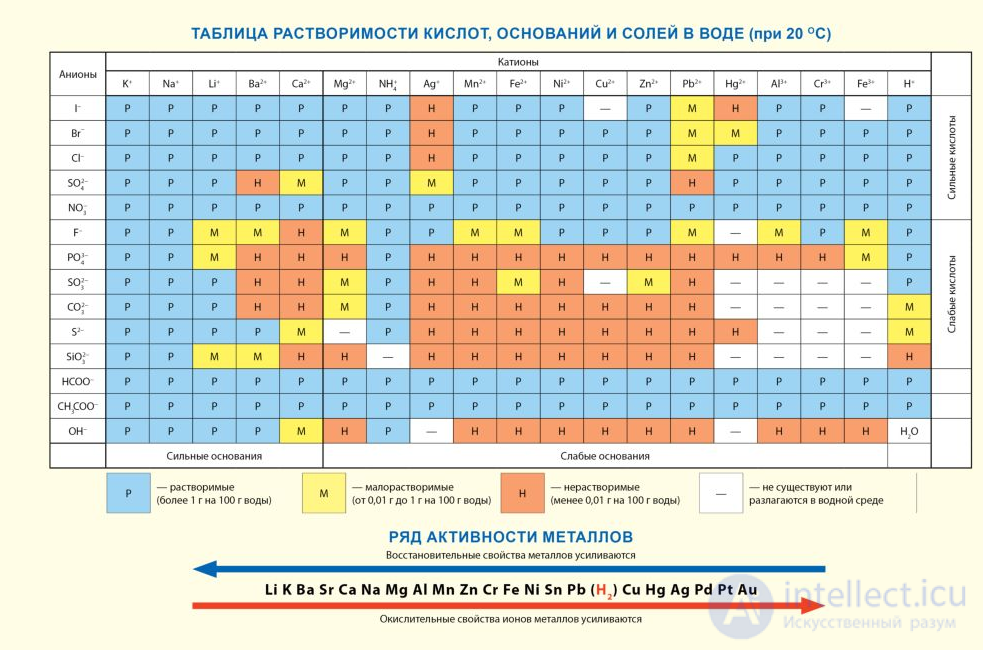
The solubility table shows whether particular salts and bases are soluble in water. It is usually presented as a large grid, with cations (positive ions) listed by row and anions (negative ions) listed by column. At the intersection is indicated:
Р — soluble (forms a solution)
М — slightly soluble (a precipitate partially forms)
Н — insoluble (a precipitate forms)
— or blank — the compound does not exist or is not formed
Find the cation Ba²⁺ along the vertical (row).
Find the anion SO₄²⁻ along the horizontal (column).
At the intersection there will be, for example, Н — meaning BaSO₄ is insoluble and forms a precipitate.
Cation: Na⁺
Anion: CO₃²⁻
At the intersection — Р
This means Na₂CO₃ is soluble in water.
To predict whether a precipitate will form in a reaction (for example, in an exchange reaction).
To understand the properties of substances — soluble substances more often participate in ionic equations.
To check the correctness of reactions — if a substance is insoluble, it remains as a precipitate rather than dissolving.

Comments