
Lecture
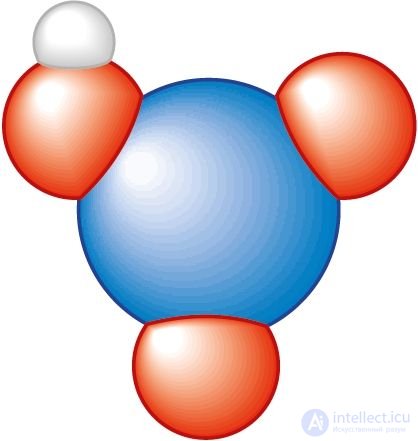
Fig. 95. Scale model of the nitric acid molecule
Nitrogen forms several acids, the most important of which is nitric acid HNO3. It corresponds to an oxide with nitrogen atoms in the +5 oxidation state:  .
.
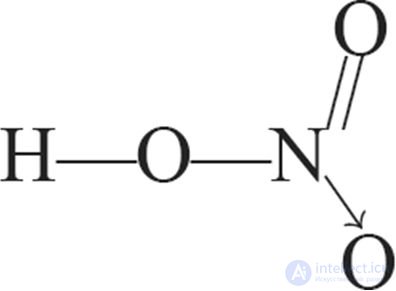
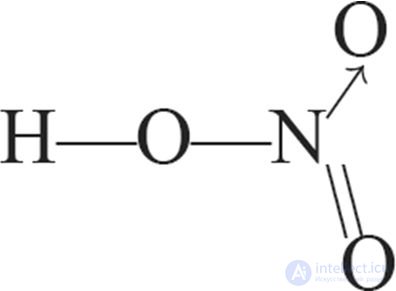
In the acid molecule, the nitrogen atom forms four covalent bonds: three of them by the exchange mechanism, and one by the donor-acceptor mechanism (see p. 86).
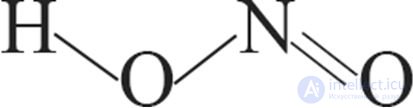
In accordance with this, the structural formula of the nitric acid molecule has the form:
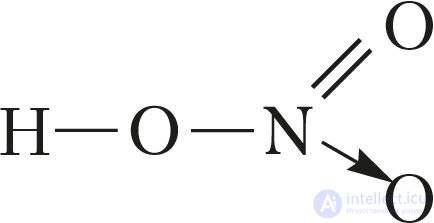 or
or 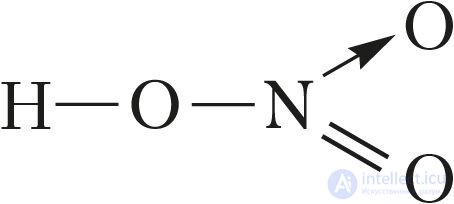
Here the nitrogen atom has a valence of IV, while its oxidation state is +5. A scale model of the molecule is shown in Figure 95.
The industrial production of nitric acid is based on the sequential oxidation reactions of ammonia, which can be represented by the scheme:
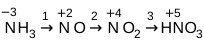
and expressed by the reaction equations:
1) catalytic oxidation of ammonia:
 ;
;
2) spontaneous oxidation of nitrogen(II) oxide:
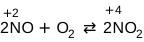 ;
;
3) absorption of nitrogen(IV) oxide by water in the presence of oxygen:
 ,
,
as well as
 .
.
In the laboratory, nitric acid can be obtained by the reaction of a solid salt (saltpeter — sodium or potassium nitrate) with concentrated sulfuric acid:
 .
.
This method was proposed back in the 17th century by the German chemist and apothecary Rudolph Glauber, who named the resulting acid "spiritus nitri" — "spirit of saltpeter."
Nitric acid is a liquid in the temperature range from ‒41.6 to +82.6 °C. It has a sharp, choking odor. Its density is 1.51 g/cm3 (lower than that of sulfuric acid, but higher than that of hydrochloric acid). It is miscible with water in all proportions (unlimited solubility). On storage it may become slightly colored brown owing to decomposition with the formation of brown NO2 gas:
4HNO3 = 4NO2↑ + 2H2O + O2↑.
HNO3 is a strong monobasic acid; it displays the general properties of acids, due to the hydrogen ion, while its oxidizing properties arise from the nitrogen atom being in the fairly high +5 oxidation state.
I. General chemical properties. The general chemical properties of nitric acid include its action on indicators and the formation of salts. The color change of indicators occurs owing to hydrogen ions Н+ formed on dissociation of the acid:
 .
.
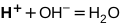
Salts (nitrates) are formed on reaction with basic and amphoteric oxides (1), metal hydroxides (2), and other salts (3):
| 1 |  |
 |
 |
 |
|
| 2 |  |
 |
 |
 |
|
| 3 |  |
 |
II. Oxidizing properties of nitric acid. HNO3 displays these properties in reactions with metals, nonmetals, and organic substances.
It oxidizes metals located in the activity series both before and after hydrogen, except for gold and platinum. Thus, in the reaction of concentrated nitric acid with copper and other low-activity metals (Ag, Hg, etc.), the reduction product is nitrogen(IV) oxide — a brown gas:
 ,
,
while with dilute nitric acid the product is nitrogen(II) oxide:
 .
.
The composition of the resulting products depends both on the concentration of the nitric acid and on the activity of the metal. The lower the concentration of nitric acid and the higher the activity of the metal, the more strongly the nitrogen is reduced.
With more active metals, the reduction products may be N2O, NO, NO2, N2, NH4NO3. In general form, the reaction of nitric acid with metals can be represented by the scheme:
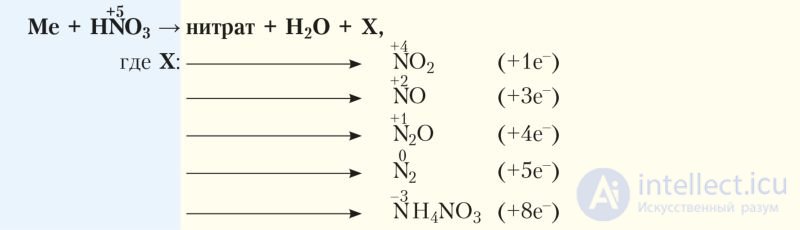
As a rule, the reaction produces a mixture of reduction products with a predominance of certain ones.
Recall also (grade 9) that concentrated nitric acid does not react with iron, chromium, aluminum, or cobalt at low temperatures — it passivates them. Besides metals, nitric acid oxidizes many nonmetals (C, S, P). Organic substances in the concentrated acid may ignite (amines, turpentine).
Nitric acid is used to obtain nitrates, for example:

It is widely used in organic synthesis.

Nitration of hydrocarbons produces nitro compounds (nitrobenzene — the starting material for the synthesis of aniline and dyes based on it):

Reaction with organic substances containing OH groups (glycerol, cellulose) yields nitro esters:

Nitroglycerin (a nitro ester) is used in medicine and for the production of certain grades of smokeless powder.
All salts of nitric acid without exception are highly soluble in water. The most important chemical property of nitrates is their ability to decompose on heating with the release of oxygen. The composition of the resulting products depends on the activity of the metal.
1. Nitrates of alkali and alkaline earth metals form a nitrite and oxygen:
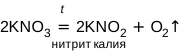 .
.
2. Nitrates of metals located in the activity series from magnesium to copper decompose to form a metal oxide, nitrogen(IV) oxide, and oxygen:
 .
.
3. Nitrates of metals located in the activity series after copper, on decomposition, form the metal, nitrogen(IV) oxide, and oxygen:
 .
.
The thermal decomposition of nitrates can be represented by the scheme:

The release of oxygen during decomposition allows a nitrate to be detected by "the flash of a solid salt on a glowing coal" (Appendix 3).
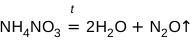
It should be noted that ammonium nitrate, decomposing at a temperature not exceeding 200 °C, does not form oxygen:
 .
.
Uses of nitrates. Sodium, potassium, calcium, and ammonium nitrates (NaNO3, КNO3, Са(NO3)2, NH4NO3) are called saltpeters and are used as fertilizers. Another important area of nitrate use is pyrotechnics: nitrates decompose on heating with the release of oxygen, which is a strong oxidizer, especially at the moment of release. The oxygen thereby serves as the oxidizer for other components of the powder.
The decomposition of sodium nitrate can be used in the laboratory to obtain oxygen:
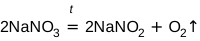
(the products — oxygen and sodium nitrite — a salt of a weak nitrous acid).
Silver(I) nitrate — the main component of lunar caustic — is used for medical purposes. In the food industry, sodium nitrate and nitrite are used as preservatives (E251, E250) for cheeses and sausage products. These salts give meat products a bright pink-red color. These salts were already used by the ancient Greeks and Egyptians.
Nitric acid is produced industrially from ammonia. It oxidizes all metals except gold and platinum. In the reaction of copper with concentrated nitric acid, besides salt and water, nitrogen(IV) oxide NO2 is formed, while with dilute acid, nitrogen(II) oxide is formed.
Nitrates are used as nitrogen fertilizers. The use of many nitrates in pyrotechnics is based on their ability to decompose with the release of oxygen.
1. Write out eight nitrate formulas from the text of the section.
2. List the most important physical properties of nitric acid.
3. Indicate the color of a nitric acid solution on addition of:
4. Write the formulas of the nitrates of magnesium, lithium, iron(III), and barium.
5. Analyze the possibility of reactions occurring in solution between nitric acid and the following salts: potassium chloride, potassium carbonate, sodium sulfide, sodium sulfate.
6. Write the molecular and ionic equations for the reactions between nitric acid and the substances with the formulas: Fe2O3, Са(ОН)2, МgСО3.
7. Calculate the mass of salt that can be obtained from the reaction of copper with 50 g of a solution with a nitric acid mass fraction of 60% (concentrated acid).
8. Using the electron balance method, assign the coefficients in the equations of the reactions involving nitric acid:
9. Write the reaction equations according to the scheme:
 ;
; .
.10. What is the minimum volume of a nitric acid solution with a mass fraction of 80% and a density of 1.45 g/cm3 needed to dissolve 4.32 g of silver? The reaction proceeds according to the scheme:
Ag + HNO3 → AgNO3 + NO2↑ + H2O.
1. Structural formulas of nitric acid:
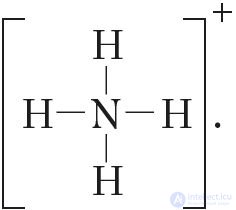
2. The correct statements regarding nitric acid are:
3. The products of the reaction of dilute nitric acid with copper are:
4. Nitric acid enters into exchange reactions with:
5. Both salts in the series are called saltpeters:

Comments