
Lecture
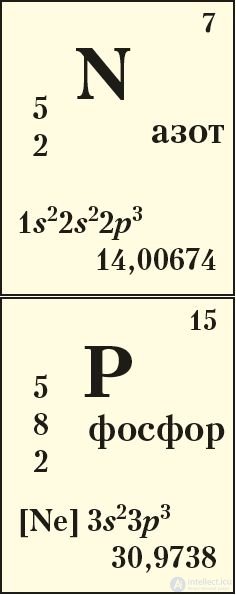
The Group VA elements nitrogen 7N and phosphorus 15P form elemental substances that are nonmetals. This same group of the periodic table also includes arsenic 33As, antimony 51Sb, and bismuth 83Bi. In their outer electron shell, whose general configuration is ns2np3, their atoms have 5 electrons each, three of which are unpaired in the p-sublevel:
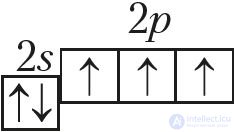
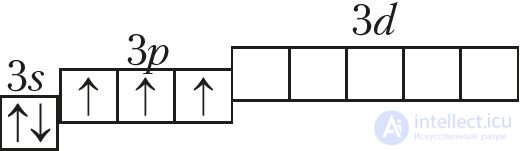
Their lowest oxidation state is ‒3 and their highest is +5; phosphorus most often exhibits the positive oxidation states +3 and +5, while nitrogen forms fairly stable compounds with oxidation states +1, +2, +3, +4, and +5. Nitrogen is the third most electronegative element after oxygen and fluorine, while phosphorus is only slightly less electronegative than hydrogen (see § 11, Table 7, p. 60).
Among the Group VA elements, phosphorus is the most abundant on Earth, with a mass fraction of 0.1%. Nitrogen is much less abundant overall, but it predominates in the atmosphere — a volume fraction of 78% and a mass fraction of 75.5%. Of the relatively few nitrogen minerals, the most significant are the nitrates (saltpeters): NaNO3 — sodium nitrate (Chile saltpeter) and KNO3 — potassium nitrate.
Phosphorus occurs on Earth exclusively in the form of compounds and is found in phosphorites and apatites (whose main component is calcium phosphate Ca3(PO4)2), as well as fluorapatites Ca5[PO4]3F.
Compounds of nitrogen and phosphorus are important for living organisms: nitrogen as a component of amino acids and proteins, phosphorus as a component of nucleic acids, ATP (adenosine triphosphate), enzymes, and the skeletal system. For humans, the daily requirement for phosphorus is fairly high — from 1 g to 3.8 g depending on age and physiological state. Under physical exertion the requirement increases 1.5–2 times. The richest sources of phosphorus are pumpkin and sunflower seed kernels, as well as cocoa, liver, fish, hard cheeses, and other dairy products. Plants often experience a deficiency of nitrogen and phosphorus. For cultivated crops, this problem is solved by applying fertilizers.
Nitrogen as an elemental substance consists of diatomic N2 molecules; the graphical formula of the nitrogen molecule is  . Nitrogen atoms are joined by three covalent nonpolar bonds, one of which is a σ-bond and two are π-bonds (Fig. 87).
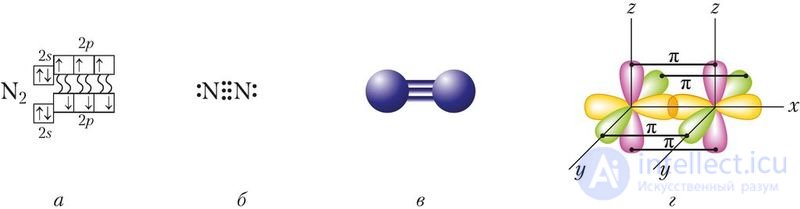
Fig. 87. Structure of the nitrogen molecule: a — electron-graphical scheme, b — electron formula, c — ball-and-stick model, d — diagram of electron cloud overlap
The bond energy in the nitrogen molecule is very high, at 945 kJ/mol (for comparison: O2 — 494 kJ/mol, Cl2 — 243 kJ/mol), which indicates the strength of the bonds and, consequently, the substance's great chemical inertness. Indeed, the overwhelming majority of reactions involving nitrogen proceed only under "harsh conditions" (at very high temperatures and pressures).
Physical properties. The small relative molecular mass (Mr(N2) = 28) and the absence of polarity in nitrogen molecules account for the low boiling and melting points of –196 °C and –210 °C. Nitrogen is a gas (under standard conditions) that is colorless and odorless, and is nearly insoluble in water.
Chemical properties. Nitrogen behaves as a reducing agent in reactions with oxygen and fluorine, and as an oxidizing agent with metals and hydrogen.
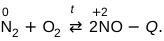
1. Nitrogen as a reducing agent. The reaction of nitrogen with oxygen proceeds at a temperature of about 3000 °C — in an electric arc or a lightning discharge. The reaction is endothermic. It produces nitrogen(II) oxide:
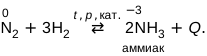
2. Nitrogen as an oxidizing agent. The reaction of nitrogen with hydrogen proceeds at high temperature and pressure, even in the presence of catalysts:
Reacting with metals (at elevated temperature), nitrogen forms binary compounds called nitrides:
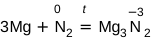 (magnesium nitride).
With lithium, nitrogen reacts without heating:
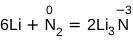 (lithium nitride).
Nitrides are readily decomposed by water, forming ammonia and metal hydroxides:

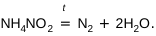
Nitrogen is produced industrially from liquefied air; in the laboratory, it is obtained in small quantities by the decomposition of ammonium nitrite:
Applications. The main application of nitrogen is the production of ammonia. It is also used to create an inert atmosphere for storing food products, works of art, and manuscripts, in fire suppression, and in laser cutting of metals. Its range of applications in medicine and cosmetology is expanding, for example in cell cryopreservation and cryotherapy (removal of papillomas and hemangiomas).
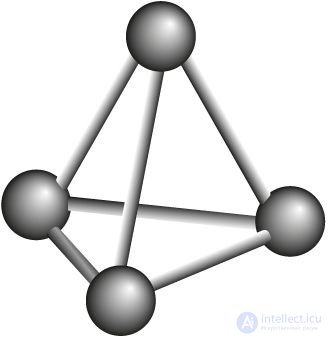
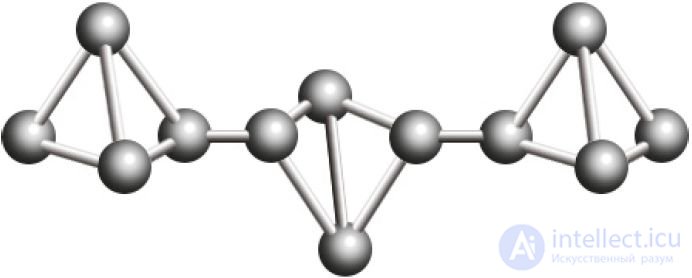
Phosphorus, being a Group VA element like nitrogen, is capable of forming a molecule of composition P2. However, unlike the nitrogen molecule, the diatomic phosphorus molecule is unstable. For this reason phosphorus exists as several allotropic modifications, in which only single P—P bonds occur: white, red, black, and other forms of phosphorus (Table 29).
Table 29. Structure and Physical Properties of the Allotropic Modifications of Phosphorus
| Allotropic modification of phosphorus | Structure | Melting point | Boiling point |
|
P4 white phosphorus
|
Ball-and-stick model of the P4 molecule |
44 °C | 281 °C |
|
P red phosphorus
|
Fragment of the structure of red phosphorus |
260 °C | ‒ Sublimes at a temperature of about 400 °C |
|
* P black phosphorus  |
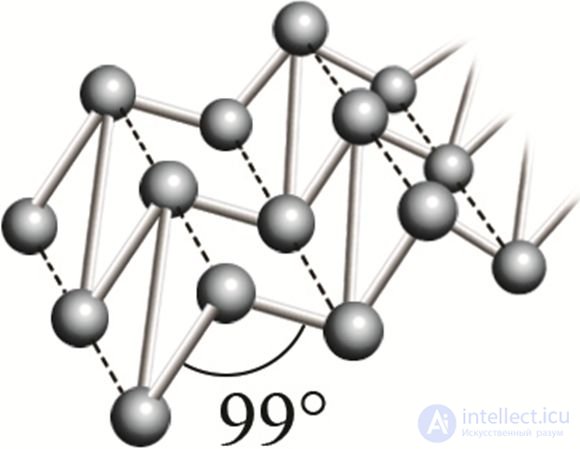
Fragment of the crystal lattice of black phosphorus |
On heating (at atmospheric pressure) it converts into red phosphorus | 1000 °C (at 1.8 ∙ 106 atm) |
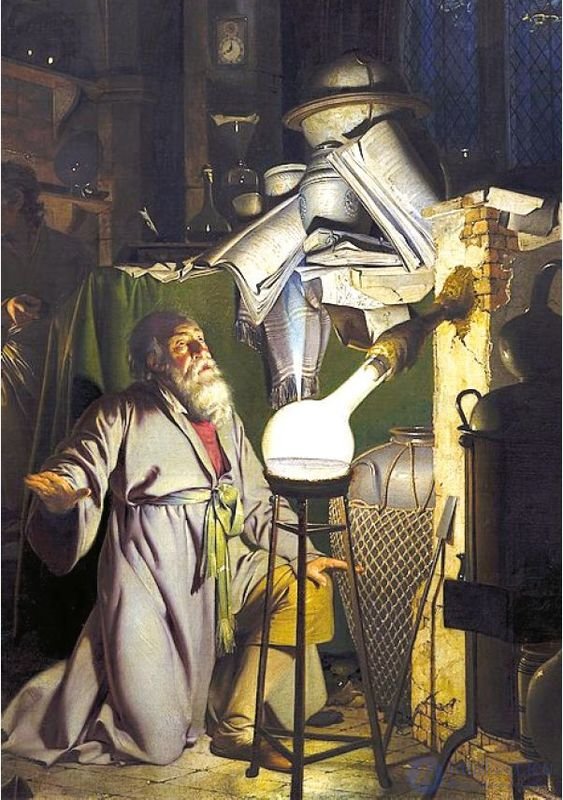
Fig. 88. Fragment of a painting by the English artist Joseph Wright, "The Alchemist Discovering Phosphorus"
Physical properties. White phosphorus P4 is a waxy substance with a garlic-like odor, and is poisonous. In the dark, it glows a greenish-yellow color in air as a result of a slow chemical oxidation reaction (chemiluminescence (Fig. 88)).
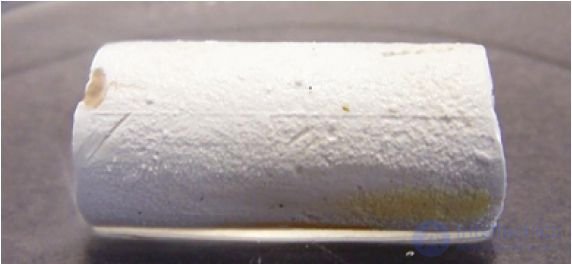
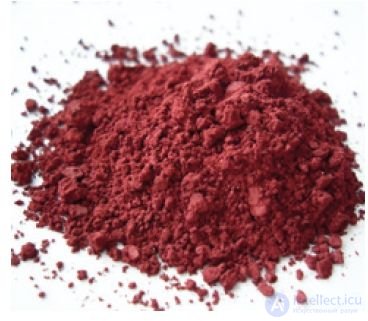
Red phosphorus is an amorphous substance of polymeric structure; it is odorless and has low toxicity.
Interconversions between the allotropic modifications of phosphorus are possible, occurring at certain temperatures and pressures.
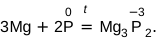
Chemical properties. As an oxidizing agent, phosphorus reacts with metals on heating, forming phosphides:
Phosphorus does not react with hydrogen.
As a reducing agent, phosphorus reacts with oxygen and other strong oxidizing agents. In pure oxygen and in air, phosphorus burns with a dazzling flame, producing white smoke (particles of solid phosphorus oxides):
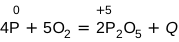 (phosphorus(V) oxide, in excess oxygen);
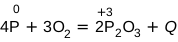 (phosphorus(III) oxide, with insufficient oxygen).
White phosphorus can ignite spontaneously in air, whereas red phosphorus ignites only when a flame is applied; this is explained by the differing strength of the chemical bonds between phosphorus atoms in the allotropic modifications.
Phosphorus is produced by roasting (calcining) a mixture of calcium phosphate with sand and coal:

Although it does not react with hydrogen directly, phosphorus nonetheless forms hydrogen compounds. For example, phosphine can be obtained indirectly, for instance from phosphides, which are decomposed by both water and acids: Mg3P2 + 6H2O = 3Mg(OH)2↓ + 2PH3↑.
Phosphine PH3 is a gas with a garlic-like odor.
In nature, hydrogen compounds of phosphorus occur wherever the intensive decomposition of protein substances takes place.
Applications. White phosphorus is used for the production of phosphoric acids and their derivatives, and in metallurgy as a component of certain heat-resistant alloys. Red phosphorus is used in the production of matches and in organic synthesis (pharmaceuticals, agrochemicals). Samples of phosphorus containing the nuclide 32P (a "labeled atom") with a half-life of 14.22 days are used in research work.
The lowest oxidation state of nitrogen and phosphorus is –3, and the highest is +5.
The inertness of elemental nitrogen is due to the presence of a triple bond in the N2 molecule.
Phosphorus exists as several allotropic modifications: white, red, and others.
Nitrogen and phosphorus exhibit both reducing and oxidizing properties. Phosphorus does not react with hydrogen.
1. Name:
2. Write the symbols of the Group VA elements and the general formula of their electron configuration.
3. Describe the electronic structure of the atoms of nitrogen and phosphorus.
4. Describe the physical properties of nitrogen and the allotropic modifications of phosphorus.
5. Fill in the table for the reagents oxygen, hydrogen, lithium, and magnesium (write the equations for the possible reactions in your notebook).
| Reagent | N2 | P |
Draw conclusions about the similarities and differences between the properties of nitrogen and phosphorus.
6. When 0.9 g of calcium reacted with nitrogen, 1.11 g of a compound was obtained. Determine the chemical formula of the compound.
7. Phosphorus is oxidized by chlorine, nitric acid, and sulfuric acid. Balance the coefficients using the electron-balance method in the schemes of these reactions:
8. Calculate the mass of white phosphorus that can be obtained by roasting, with sand and coal, a phosphorite containing 6.2 t of calcium phosphate, if the product yield is 92%. The reaction proceeds according to the equation on p. 201.
9. How does an increase in temperature and pressure affect the shift of equilibrium in the reactions:
 ;
; ?
?10. Hydrogen in an amount of 6 mol and nitrogen in an amount of 4 mol were placed in a sealed vessel and heated to 450 °C in the presence of a catalyst. Determine the volume fraction of ammonia in the final mixture if the fraction of nitrogen that reacted is 15%.
1. A triple bond is present in the molecule:
2. Phosphorus as an element is characterized by the statements:
3. Phosphorus does not react even on heating with:
4. Nitrogen has a positive oxidation state in the compounds:
5. Phosphorus acts as an oxidizing agent when reacting with:

Comments