
Lecture
According to the rules for filling atomic orbitals, the chromium atom should have the electron configuration 3d44s2. However, owing to the stability of the d5 state, it is energetically more favorable for one electron to shift from the 4s sublevel to the 3d sublevel. Therefore the electron configuration of the chromium atom is [Ar]3d54s1.
Accordingly, chromium is permitted oxidation states from 0 to +6 in compounds with other elements. Of these, +3 and +6 are stable, with the +3 oxidation state being the most stable.
The stability of precisely these oxidation states is evidenced by the composition of chromium's natural compounds: chrome iron ore (chromite)  , crocoite
  , chrome ochre
  . They serve as sources for the industrial production of chromium.
Metallic chromium is obtained by two methods: metallothermic reduction and electrolysis.
The metallothermic method is based on the reduction of Сr2О3 by aluminum or silicon:
Cr2O3 + 2Al  Al2O3 + 2Cr + Q.
Chromium is a silvery-white lustrous metal with a high melting point.
Under normal conditions, chromium is chemically extremely stable. Its low chemical activity is explained by the formation, on the surface of the bulk metal, of a thin dense oxide film that hinders the action of chemical reagents.
The activity of chromium increases on heating. At temperatures above 400 °C it burns in oxygen to form Cr2O3.
Since chromium is positioned before hydrogen in the activity series of metals, it dissolves in dilute acid solutions. In this process chromium forms salts in which it is in the +3 oxidation state:
2Cr + 3H2SО4(dil.) = Cr2(SО4)3 + 3Н2↑.
In nitric acid and concentrated sulfuric acid, chromium is passivated and dissolves only on heating:
2Cr + 6H2SО4(conc.) Cr2(SО4)3 + 3SО2↑ + 6Н2О.
Chromium(III) hydroxide has amphoteric properties and dissolves in acids to form chromium salts. In alkalis, it forms an emerald-green solution of hexahydroxochromate:

In its highest oxidation state (+6), chromium forms the oxide CrO3, which, as noted above, corresponds to two acids — chromic acid Н2CrO4 and dichromic acid H2Cr2O7. They exist only in solution.
In the +6 oxidation state, chromium forms two types of salts — chromates (with the anion  ) and dichromates (with the anion
  ). In acidic solutions, dichromates predominate and color the solutions orange, while in alkaline solutions chromates predominate, coloring the solutions yellow (Fig. 118.1).
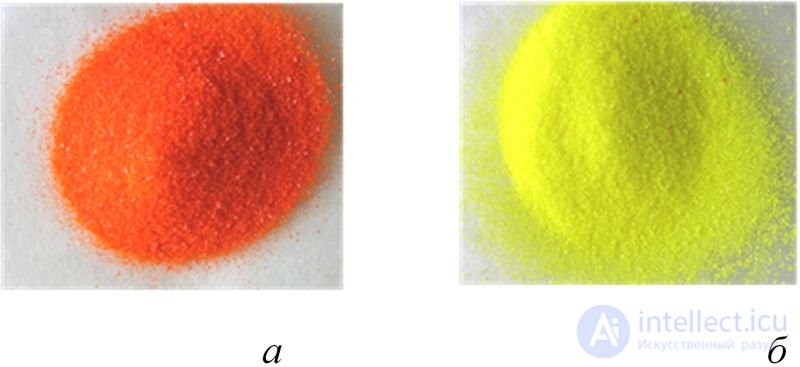
Fig. 118.1. Potassium dichromate (a) and potassium chromate (b)
Compounds in which chromium is in lower oxidation states act as reducing agents, in the highest oxidation state as oxidizing agents, and in intermediate oxidation states as both reducing and oxidizing agents.
The product of the reduction of chromium compounds in the highest oxidation state (+6) depends on the pH of the medium. In an acidic medium, Cr(VI) is reduced to the +3 oxidation state with the formation of salts:
4CrO3 + C2H5OH + 6H2SO4 = 2Cr2(SO4)3 + 2CO2 + 9H2O.
In a neutral medium, Cr2O3 is formed:
4CrO3 + C2H5OH = 2Cr2O3 + 2CO2 + 3H2O.
Chromium is a d-element with the valence-shell electron configuration 3d54s1. As a simple substance it exhibits metallic properties and is resistant to the action of oxidizers.
In its compounds, chromium exhibits various oxidation states, of which +3 and +6 are the most stable. In the +2 oxidation state, chromium is a strong reducing agent; in the +6 oxidation state, it is a strong oxidizing agent.
As the oxidation state increases in chromium oxides and hydroxides, acidic properties strengthen while basic properties weaken.
In the +6 oxidation state, chromium forms two acids, H2CrO4 and H2Cr2O7, which exist only in solution. They correspond to salts — chromates (with the anion  ) and dichromates (with the anion
  ), which are strong oxidizing agents.
Cr(OH)3 has an amphoteric character.
Questions, assignments, problems
1. Using the diagram for the filling of chromium's atomic orbitals by electrons, explain the structure of the ions  and
and  .
.
2. Metallic chromium is obtained from chromite FeCr2O4. First, the chromite is oxidized in air in a molten soda (Na2CO3) mixture, which leads to the formation of sodium chromate Na2CrО4. The chromium is converted to dichromate by the action of sulfuric acid. It is isolated from the solution and reduced on heating with carbon to the oxide Cr2O3. Chromium is then reduced from this oxide by aluminum. Write the chemical equations of the reactions occurring at each of the indicated stages of chromium production.
3. Explain the cause of passivation of metallic chromium at room temperature under the action of air or nitric acid. Why can the passivation of chromium be removed by mechanical cleaning of the surface?
4. Chromium can be dissolved after being fused with an oxidizing-alkaline mixture consisting of KNO3 and KOH. Give the equation of the corresponding chemical reaction. Take into account that K2CrO4 is formed in the process.
5. Why, when metallic chromium is dissolved in hydrochloric or dilute sulfuric acid, do solutions of different colors form depending on whether the reaction is carried out in contact with air or in a nitrogen atmosphere?
6. Balance the coefficients in the chemical reaction equations for the following transformations:
CrCl3 + Cl2 + KOH → K2CrO4 + KCl + H2O;
K2Cr2O7 + KI + H2SO4 → I2 + Cr2(SO)4 + K2SO4 + H2O.
7. Write the chemical reaction equations for the following transformations:
Cr2O3 → CrCl3 → Cr(OH)3 → Na3[Cr(OH)6] → CrCl3.
8. The chromium-plating process involves depositing chromium onto the surface of metal articles by electrolysis. The electrolyte solution is prepared from chromium(VI) oxide and a sulfuric acid solution. Suggest which processes should occur at the electrodes in this case. Give the equations of the electrode processes.
9. Determine the volume of chlorine (STP) evolved during the reaction of 14.7 g of potassium dichromate with excess concentrated hydrochloric acid.
10. The decomposition reaction of ammonium dichromate is used as a demonstration experiment called the "chemical volcano." The scheme of this reaction is as follows:
(NH4)2Cr2О7 → Cr2О3 + N2 + Н2О.
Calculate the volume of nitrogen released during the decomposition of 125 g of ammonium dichromate.
Self-check
1. Chromium's natural compounds include:
2. The main product of chromium combustion in oxygen (at temperatures above 400 °C):
3. Amphoteric properties are exhibited by the compounds:
4. Acidic solutions of chromium(VI) salts:
;5. For salt formation and reduction, respectively, according to the reaction equation
K2Cr2O7 + 14HCl(conc.) = 2KCl + 2CrCl3 + 3Cl2 + 7H2O,
the amount of hydrochloric acid consumed (mol) is:

Comments