
Lecture
Reagents: zinc; copper(II) oxide; solutions of sulfuric acid, sodium hydroxide, sodium carbonate; indicators — phenolphthalein, litmus.
1. Pour 1 cm3 of sulfuric acid solution into a test tube and test it with the litmus indicator.
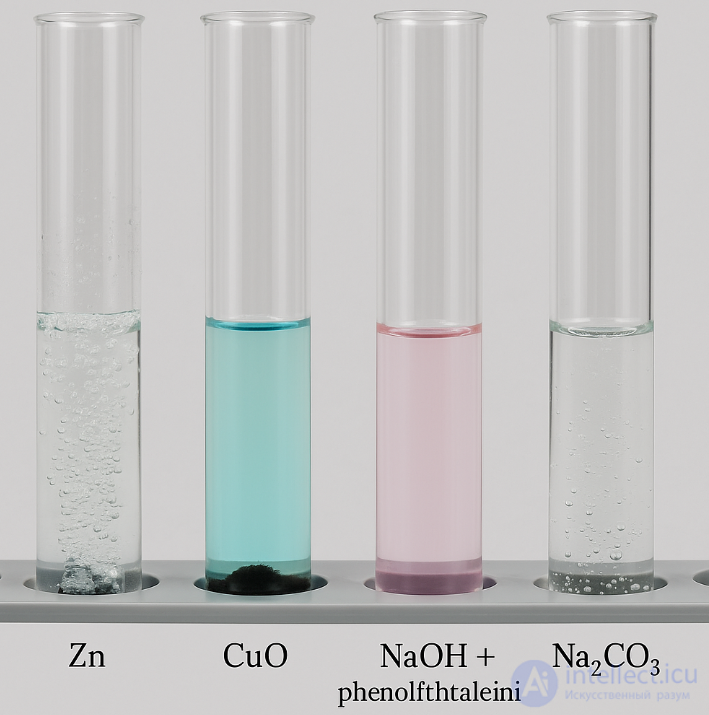
2. Place into four test tubes: zinc (2 granules), copper(II) oxide (on the tip of a spatula), sodium hydroxide solution (1 cm3) with one drop of phenolphthalein, sodium carbonate solution (1 cm3).
3. Add a small amount of sulfuric acid solution to each of the test tubes. Note the signs of the reactions.
The test tube with copper(II) oxide can be gently heated, or you can wait a few minutes for signs of reaction to appear.
Draw a conclusion about the properties of dilute sulfuric acid.
Purpose of the experiment:
To study the chemical properties of dilute sulfuric acid in its interaction with various substances.
Reagents and materials:
Zinc (Zn)
Copper(II) oxide (CuO)
Sulfuric acid solution (H₂SO₄, dilute)
Sodium hydroxide solution (NaOH)
Sodium carbonate solution (Na₂CO₃)
Indicators: litmus, phenolphthalein
Test tubes, spatula, pipette, test tube holder, spirit lamp (as needed)
1. Determination of the acidic properties of the sulfuric acid solution using an indicator:
1 cm³ of dilute sulfuric acid solution was poured into a test tube, and a drop of litmus was added.
Observation: the litmus turned red.
Conclusion: sulfuric acid exhibits acidic properties, since it changes the color of litmus toward the acidic range.
2. Interaction of sulfuric acid with various substances:
a) Zinc (Zn):
2 granules of zinc were placed in a test tube, and a small amount of sulfuric acid solution was added.
Observation: gas bubbles (hydrogen) are released, and the metal slowly dissolves.
Reaction equation:
Zn+H2SO4→ZnSO4+H2↑
Conclusion: the acid reacts with the metal with the release of hydrogen — a characteristic reaction of acids.
b) Copper(II) oxide (CuO):
A small amount of black CuO powder was placed in a test tube, and acid solution was added. The test tube was gently heated.
Observation: the black precipitate dissolves, and the solution turns blue.
Reaction equation:
CuO+H2SO4→CuSO4+H2O
Conclusion: the acid reacts with the basic oxide, forming a salt and water.
c) Sodium hydroxide solution (NaOH) with phenolphthalein:
The test tube contains alkali and phenolphthalein (pink color). After adding sulfuric acid:
Observation: the pink color disappears, and the solution becomes colorless.
Reaction equation:
NaOH+H2SO4→NaHSO4+H2O (or Na₂SO₄ depending on the amount of acid)
Conclusion: neutralization of the acid and the alkali occurs.
d) Sodium carbonate solution (Na₂CO₃):
Acid was added to the test tube.
Observation: gas bubbles (carbon dioxide) are released.
Reaction equation:
Na2CO3+H2SO4→Na2SO4+CO2↑+H2O
Conclusion: the acid reacts with salts of weak acids (carbonates), displacing carbon dioxide.
Dilute sulfuric acid exhibits the typical properties of acids:
changes the color of indicators (litmus, phenolphthalein);
reacts with metals with the release of hydrogen;
enters into reactions with basic oxides and bases, forming salts and water;
reacts with salts of weak acids, displacing volatile products (for example, CO₂).
Thus, dilute H₂SO₄ is a typical representative of strong acids.

Comments