
Lecture
The considerable chemical activity of metals is the reason why, as noted earlier, they exist in the Earth's crust mainly in the form of compounds — minerals.
Rocks (accumulations of minerals) from which it is technologically possible and economically profitable to extract a metal in bulk are called ore. Ore practically never contains the metal compound in pure form; it always contains admixtures of other minerals, called gangue. Therefore, the problem is not only developing technology for extracting metals from minerals, but also finding ways to separate minerals from gangue. Modern technologies make it economically profitable to extract iron from ores in which its content is 30–55 %; zinc — 2–6 %; tin — 0.2–2 %; gold — 0.00002–0.0002 %.
The field of science and technology, and the branch of industry, associated with extracting metals from ores and obtaining them in a form suitable for use, is called metallurgy.
Metallurgical processes are usually divided into three stages.
The first stage is preliminary ore treatment. At this stage, ore beneficiation is carried out — separating all valuable minerals from the gangue. If the ore consists of metal sulfides (CuFeS2, PbS, ZnS, etc.), such ore is first roasted in the presence of oxygen to convert the metals into oxides:


The second stage is the reduction of metals from their compounds: oxides or salts. Reduction methods can be divided into three large groups: pyrometallurgical, electrochemical, and hydrometallurgical.
At the third stage, metal purification — refining — is carried out.
The method for obtaining a metal from its ore is chosen taking into account the properties of the metal's compounds and its chemical activity.
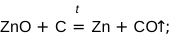
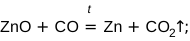
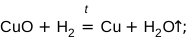
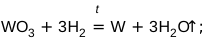
Pyrometallurgical methods of obtaining metals are based on reducing metals from their ores at high temperature using various substances with reducing properties. The most common reducing agents are coal, carbon(II) oxide, hydrogen, and aluminum. As examples, we give the reduction reactions used to obtain metals both in industry and in the laboratory: zinc reduction with coal and carbon(II) oxide, copper and tungsten reduction with hydrogen, and iron and chromium reduction with aluminum:


Let us examine in more detail the process of obtaining iron as part of its alloys — cast iron and steel.
The main source of iron is ores containing minerals such as magnetite (Fe3O4) and hematite (Fe2О3). Useful impurities that improve the quality of iron smelted from ore are compounds of Mn, Ni, Co, Сr, В, V. They are called alloying additives. Compounds of As, P, S, Pb, Zn are harmful impurities that degrade the properties of iron.
Currently, two main methods are used in steel production.
According to the first, traditional method, steel production is carried out in two stages. In the first stage, cast iron is obtained, which in the second stage is processed into steel.
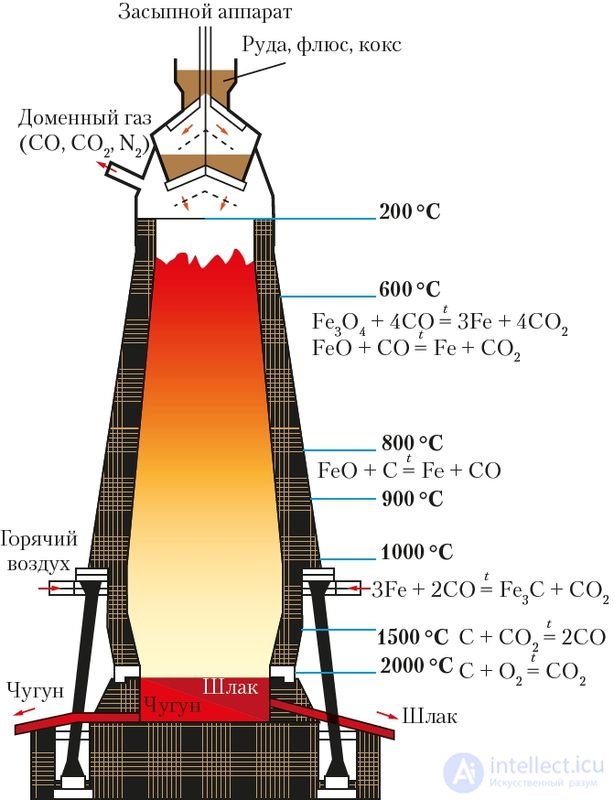
Charging apparatus
To obtain cast iron, iron is reduced by carbon and carbon monoxide, which is formed by the incomplete combustion of coal. A mixture of iron ore, specially treated coal called coke, is loaded into the blast furnace, and limestone is added to lower the melting temperature. This mixture, called the charge, is fed into the blast furnace from the top, from where it moves down into the higher-temperature heating zone, where the temperature rises to 1600 °C and the mixture melts.
Air blown from below into the blast furnace ensures the combustion of carbon with the release of a large amount of heat and the formation of carbon monoxide, which reduces iron from its oxides. The reduced iron, already at a temperature of about 1000 °C, becomes carburized, forming an alloy called cast iron. Besides iron, it contains graphite and cementite — iron carbide Fe3C — with a total carbon content of approximately 2 to 6 %.
The molten cast iron is periodically tapped off, isolating it from the slag. The chemical processes occurring in different zones of the blast furnace are shown in the figure.
During the processing of cast iron into steel, at the second stage of the process, excess carbon, and often other impurities such as silicon, phosphorus, and sulfur, are oxidized at high temperature by oxygen from the air. Various units are used for this — open-hearth furnaces, converters, electric furnaces. The resulting nonmetal oxides float up as slag or evaporate. Along with the oxidation of impurities, partial oxidation of iron also occurs, forming iron(II) oxide, which dissolves in the melts of cast iron and steel. Iron(II) oxide is reduced by adding silicon, manganese, or aluminum to the melt as reducing agents. The resulting slag consisting of oxides is separated from the molten iron.
The second method of steel production is single-stage and is called direct. In it, the cast-iron production stage is absent, and less carbon dioxide is released into the atmosphere. Being more economical, it is gradually replacing the first method. To obtain steel, iron ore is crushed and then roasted with a relatively small amount of coke in rotary kilns. The resulting iron-ore pellets, containing iron oxides, are subjected to the action of a gaseous reducing agent in special reactors.
A mixture of methane, carbon(II) oxide, and hydrogen is used as the reducing agent. Hydrogen and carbon(II) oxide are formed from methane by its oxidation with oxygen in the presence of a catalyst in special apparatus according to the reaction:
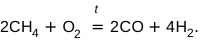
The formation of metallic iron can be represented by the reaction equations:


The sponge iron (pellets) obtained by reduction is subjected to remelting in electric arc furnaces. In doing so, by introducing the necessary additives, the iron is alloyed to obtain one or another grade of high-quality steel — corrosion-resistant, tool, structural, electrical, heat-resistant, and others.
The electrochemical method of obtaining metals (electrometallurgy) involves extracting metals from ores by electrolysis. Electrolysis is a redox process that occurs under the action of direct electric current passing through a solution or melt of an electrolyte. It differs from ordinary redox reactions in that the oxidation and reduction processes are separated in space and occur at electrodes placed in the electrolyte solution or melt.
The process of obtaining metals by electrolysis is carried out in apparatus called electrolyzers. They contain a power source connected to electrodes, which are immersed in a bath with a conductive aqueous solution or a molten metal salt.
The choice of electrolysis conditions and electrolyte composition is determined by the metal's position in the activity series. Electrolysis of an aqueous solution can extract only those metals that are located in the activity series to the right of aluminum (for example, Zn, Ni, Sn, Cr, Pb, Co, Cu, Ag, Au, Pd, etc.). Aluminum, magnesium, alkali and alkaline earth metals, and titanium are extracted by electrolysis of melts of their oxides or chlorides.
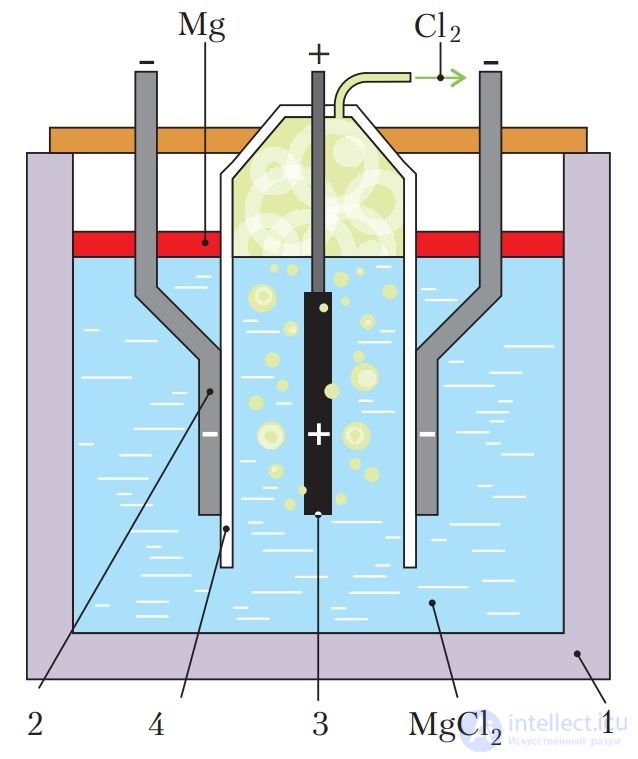
Fig. 108. Diagram of an electrolyzer
Let us consider the electrolysis process using the example of obtaining magnesium from its chloride (Fig. 108).
The electrolyzer bath (1) is filled with molten MgCl2. To lower its melting temperature and increase the conductivity of the melt, NаСl, СаСl2, КСl, and small amounts of NaF and СаF2 are added to it. The temperature is maintained within the range of 720 °C. Under these conditions, magnesium chloride and other salts dissociate into ions:
MgCl2 → Mg2+ + 2Cl–.
At the cathode — the electrode connected to the negative terminal of the direct-current source (2) — reduction processes occur: electrons are transferred from the cathode to magnesium cations:
Mg2+ + 2e– = Mg0.
Other metals are not reduced under the given electrolysis conditions because the concentration of their ions is low.
The metallic magnesium released at the cathode floats up in the cathode space to the surface of the electrolyte, since the density of magnesium is lower than the density of the molten electrolyte. Magnesium is periodically removed using a vacuum ladle.
At the anode — the electrode connected to the positive terminal of the direct-current source (3) — oxidation processes occur: electrons pass from anions to the electrode:
2Cl– – 2e– =  ↑.
↑.
The cathode and anode spaces of the electrolyte are separated by a partition (4), so that the released chlorine does not oxidize the magnesium and is removed from the electrolyzer.
Hydrometallurgy is the extraction of metals from ores, concentrates, and production waste using aqueous solutions of certain substances (chemical reagents).
First, the metals are converted into soluble compounds. They are then reduced using either chemical reactions with strong reducing agents, or processes of displacing metals from solutions of their salts by more active metals, or electrochemical reduction from solutions.
For example, copper is extracted by the hydrometallurgical method from solutions of its salts using iron:
CuSO4 + Fe = Cu↓ + FeSO4.
Silver and gold are reduced from solutions of these metals' salts using zinc. Nickel and zinc coatings are obtained by electrolysis of solutions of their salts.
The processes of extracting gold from low-grade ores can be described by the following reaction equations:
4Au + 8KCN + O2 + 2H2O = 4K[Au(CN)2] + 4KOH;
2K[Au(CN)2] + Zn = K2[Zn(CN)4] + 2Au.
Enterprises process various scrap and waste containing precious metals (Fig. 108.1), extracting them by dissolution in a mixture of 1 volume of concentrated nitric acid and 3 volumes of concentrated sulfuric acid. Such a mixture is called "aqua regia." The dissolution of gold can be described by the reaction equation
Au + HNO3 + 3HCl = AuCl3 + NO↑ + 2H2O↑.
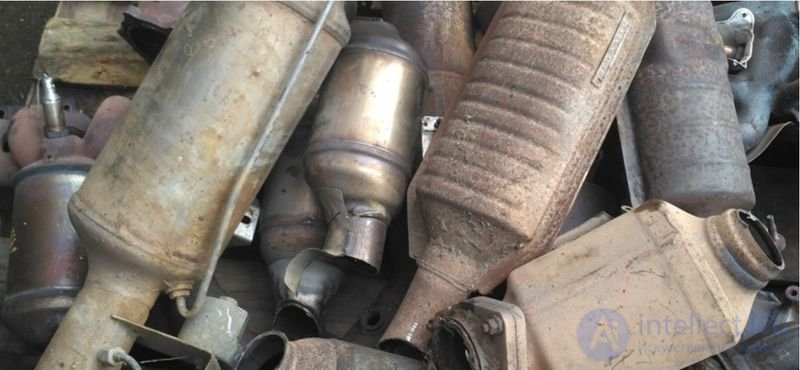
Fig. 108.1. Spent automotive catalytic converters, handed in as scrap for the extraction of precious metals
Metallurgy is a field of science and a branch of industry associated with extracting metals from ores and obtaining them in a form suitable for use. Metals are obtained by reduction from their compounds:

Microchip

1. The following statements are true:
2. Reduction of iron is possible in the case of interaction of:
3. In obtaining metals by electrolysis, the cathode processes are:
4. The following process can be classified as a hydrometallurgical method of obtaining metals:
 .
.5. The mass fraction of iron in cast iron is 94 %. The carbon content in it is:

Comments