
Lecture
By studying the material of the first chapter, you will systematize your knowledge of the basic concepts and laws of chemistry, the physical quantities used, and the classification of inorganic compounds, which will help you build a system of chemical knowledge and the experience of applying it.
The most important concepts of the topic: substance, atom, molecule, chemical element, simple and complex substance, molecular and non-molecular structure of a substance, formula unit, chemical formula, amount of substance, mass fraction of a substance in a mixture, volume fraction of a gas in a gas mixture, molar volume of a gas.
Inorganic chemistry is a branch of chemistry concerned with the study of the structure, reactivity, and properties of all chemical elements and their inorganic compounds. This field covers all chemical compounds except organic substances (a class of compounds that include carbon, with the exception of a few simplest compounds usually classified as inorganic ). The distinctions between organic and inorganic compounds containing carbon are, according to some views, arbitrary . Inorganic chemistry studies chemical elements and the simple and complex substances they form (except organic compounds). It underpins the creation of materials for cutting-edge technology. The number of known inorganic substances as of 2013 is approaching 500 thousand.
The theoretical foundation of inorganic chemistry is the periodic law and the periodic system of D. I. Mendeleev based on it. The most important task of inorganic chemistry is to develop and provide scientific justification for methods of creating new materials with the properties required by modern technology.
Historically, the name "inorganic chemistry" comes from the notion of the branch of chemistry concerned with the study of elements, compounds, and reactions of substances that are not formed by living organisms. However, since the synthesis of urea from the inorganic compound ammonium cyanate (NH4OCN), performed in 1828 by the outstanding German chemist Friedrich Wöhler, the boundaries between substances of inanimate and living nature have been blurring. Thus, living organisms produce many inorganic substances. On the other hand, almost all organic compounds can be synthesized in the laboratory. Nevertheless, the division into different branches of chemistry remains relevant and necessary, as before, since the reaction mechanisms and the structure of substances in inorganic and organic chemistry differ. This makes it easier to systematize the methods and approaches of research in each branch.
The Periodic System of Chemical Elements (Mendeleev's table) is a classification of chemical elements establishing the dependence of the various properties of elements on the charge of the atomic nucleus. The system is a graphical expression of the periodic law established by the Russian chemist D. I. Mendeleev in 1869. Its original version was developed by D. I. Mendeleev in 1869–1871 and established the dependence of the properties of elements on their atomic weight (in modern terms, on atomic mass). In total, several hundred ] variants of depicting the periodic system have been proposed (analytical curves, tables, geometric figures, and so on). In the modern version of the system, the elements are arranged in a two-dimensional table, in which each column (group) determines the basic physicochemical properties, and the rows represent periods, which are to a certain extent similar to one another.
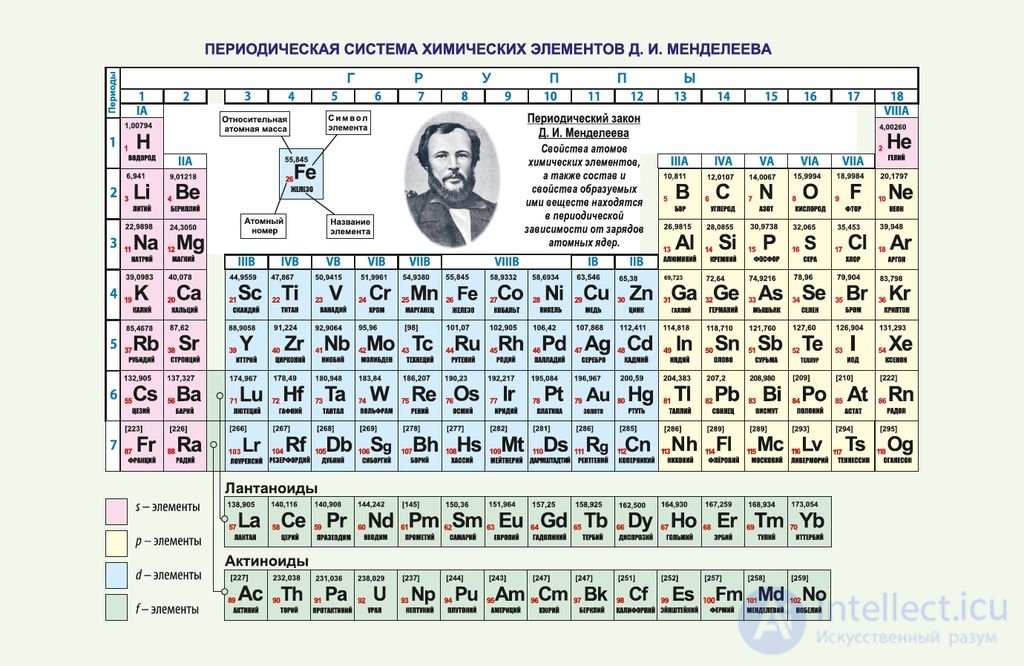
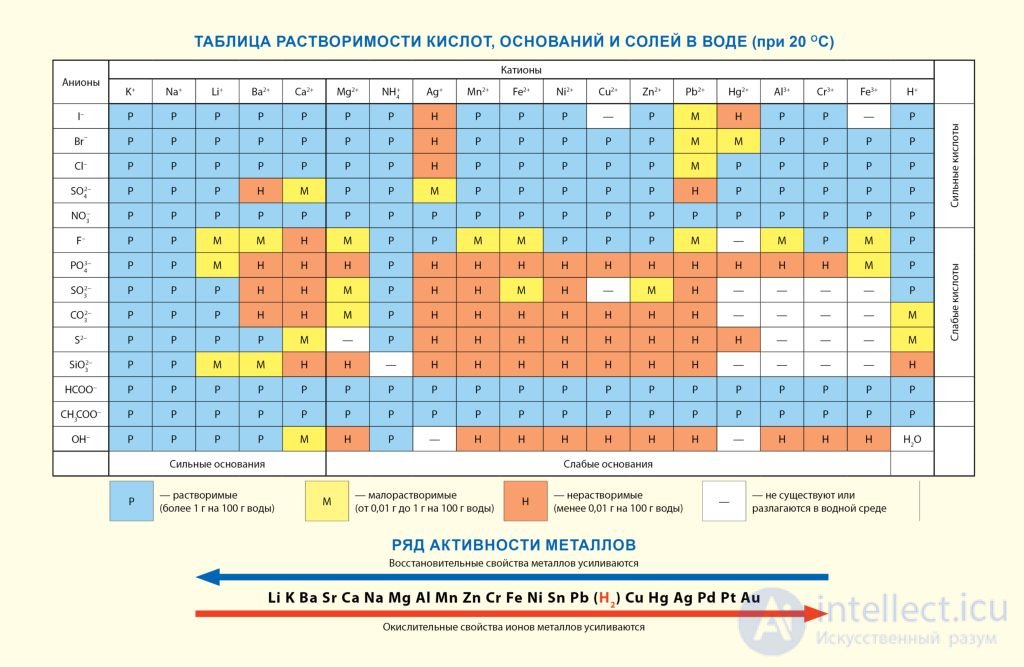
Simple substances consist of atoms of a single chemical element (they are the form of its existence in the free state). Depending on the nature of the chemical bond between the atoms, all simple substances in inorganic chemistry are divided into two main groups: metals and nonmetals. The former are characterized by a metallic bond, and the latter by a covalent bond. It should be noted, however, that the above-mentioned simple substances do not have radical or substantial differences from one another. Two adjoining groups are also distinguished — metal-like and nonmetal-like substances. There is a phenomenon known as allotropy, which consists in the possibility of forming several types of simple substances from atoms of the same element; each of these types is called an allotropic modification. If this phenomenon is due to a different molecular composition, it is defined as allotropy of composition; if it is due to the way molecules and atoms are arranged in crystals, it is defined as allotropy of form.
Metals (from the Latin metallum — mine, pit) are a group of elements possessing characteristic metallic properties, such as high thermal and electrical conductivity, a positive temperature coefficient of resistance, high ductility, and metallic luster. Of the 118 chemical elements discovered to date (not all of which are officially recognized), the following are classified as metals:
Thus, 96 of all discovered elements are classified as metals.
Due to the peculiarities of the metallic atomic bond (namely, its unsaturability and non-directionality), metals are characterized by the most densely packed coordination lattices. The most typical for them are the face-centered cubic, body-centered cubic, and hexagonal crystal lattices. In addition, because of the energetic proximity of the lattices, many metals exhibit polymorphism.
Nonmetals are chemical elements with typically nonmetallic properties that occupy the upper right corner of the Periodic System. In molecular form, as simple substances, nitrogen, oxygen, and sulfur are found in nature. More often nonmetals occur in a chemically bound form: these are water, minerals, rocks, various silicates, phosphates, and borates. Nonmetals differ significantly in their abundance in the Earth's crust. The most abundant are oxygen, silicon, and hydrogen; the rarest are arsenic, selenium, and iodine. A characteristic feature of nonmetals is the greater (compared to metals) number of electrons in the outer energy level of their atoms. This determines their greater ability to accept additional electrons and to display higher oxidizing activity than metals. Hydrogen and helium are also classified as nonmetals.
By the number of elements making up a substance, binary, three-element compounds, and so on are distinguished.
Binary compounds are compounds consisting of atoms of two elements. Their classification is also carried out on the basis of the type of chemical bond; ionic, covalent, metallic compounds, as well as those characterized by a mixed type of bond, are distinguished. Their chemical properties vary depending on the chemical nature of the specific elements: compounds containing metallic elements are characterized by basic properties, while compounds of nonmetallic elements exhibit acidic properties.
Three-element compounds are the simplest in composition compounds, which are typically formed by the interaction of binary compounds that differ substantially from each other in chemical nature. In terms of chemical bonding, they are subdivided into ionic, covalent, and ionic-covalent. Depending on the stability of the ions in their outer sphere, the stability of the anionic complexes varies, which in turn affects the properties of the compound and the degree of its resemblance to a binary compound.
If, however, the interacting compounds differ little from one another in chemical nature, special varieties of substances arise as a result: mixed compounds, solid solutions, and eutectics. The first of these are polymers, which are the product of the interaction of compounds of elements equally prone to complex formation (for example, aluminum oxide and magnesium oxide); the second are formed if electropositive elements can form similar structural units (that is, having no fundamental differences in structure, size, and stability); and the third are the result of the interaction of compounds of elements that are chemically close to each other but differ in the structure or size of their atoms. In the latter case, strictly speaking, no chemical interaction occurs at all — a mechanical conglomerate of crystals arises.
Most complex inorganic substances (that is, consisting of two or more chemical elements) can be divided into the following groups:
An oxide is a binary compound of a chemical element with oxygen in an oxidation state of −2, in which oxygen itself is bonded only to a less electronegative element. Oxygen is the second most electronegative element after fluorine, so almost all compounds of chemical elements with oxygen are classified as oxides. Exceptions include, for example, oxygen difluoride OF2. Oxides are a very common type of compound found in the Earth's crust and in the Universe in general. Examples of such compounds are rust, water, sand, carbon dioxide, and a number of dyes. Oxides are also the name of a class of minerals that are compounds of a metal with oxygen.
Depending on their chemical properties, the following are distinguished:
Salts are a class of chemical compounds that includes substances consisting of metal cations (or ammonium cations NH4+ ; phosphonium salts
  or hydroxonium salts
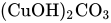
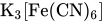
  are also known) and anions of the acid residue. Types of salts:
 ,
,  .
. ,
,  .
. .
. .
. .
. .
. ,
,  .
.A special group is made up of salts of organic acids, whose properties differ significantly from those of mineral salts. Some of them can be classified as a special class of organic salts, so-called ionic liquids, also known as "liquid salts" — organic salts with a melting point below 100 °C.
Bases are a class of chemical compounds:
Acids are complex substances that usually contain hydrogen atoms capable of being replaced by metal atoms, and an acid residue. Aqueous solutions of acids have a sour taste, an irritating effect, are able to change the color of indicators, and are distinguished by a number of common chemical properties.
In addition to the division into Lewis acids and Brønsted acids, the latter are usually classified according to various formal criteria:
The following groups of inorganic substances can also be distinguished: carbides, nitrides, hydrides, intermetallics, and others that do not fit into the classification given above (for more details see Inorganic Substance).
Carbides are compounds of metals and nonmetals with carbon. Traditionally, carbides include compounds in which carbon has greater electronegativity than the second element (thus compounds of carbon such as oxides, halides, and the like are excluded from carbides). Carbides are refractory solid substances: the carbides of boron and silicon (В4С and SiC), titanium, tungsten, and zirconium (TiC, WC, and ZrC respectively) have high hardness, heat resistance, and chemical inertness.
Carbides are subdivided into the following types: salt-like (CaC2, Al4C3); covalent (carborundum SiC); metal-like (having a non-stoichiometric composition, for example, cementite (Fe3C)).
Nitrides are compounds of nitrogen with less electronegative elements, for example, with metals (AlN;TiNx;Na3N;Ca3N2;Zn3N2; etc.) and with a number of nonmetals (NH3, BN, Si3N4). Compounds of nitrogen with metals are most often refractory substances stable at high temperatures, for example, elbor. Nitride coatings give products hardness and corrosion resistance; they are used in power engineering and space technology.
Hydrides are compounds of hydrogen with metals and with nonmetals that have a lower electronegativity than hydrogen. Sometimes compounds of all elements with hydrogen are classified as hydrides[source not specified for 1797 days]. The most common are binary hydrides. They are divided into three types depending on the nature of the bond in the compound: ionic (hydrogen and an alkali or alkaline earth metal), metallic (hydrides of transition metals or rare-earth elements), and covalent (molecular) (hydrides of nonmetals or Al, Be, Sn, Sb, As, Te, Ge) .
Metallic compounds, or intermetallics, are one of four basic types of interaction between metals (the other three being a complete absence of any influence, mutual dissolution in the liquid state and formation of a eutectic in the solid state, and the formation of both liquid and solid solutions of any composition). Unlike, for example, solid solutions, intermetallics are characterized by a complex crystal structure unlike the structure of the starting substances; similarly, they may exhibit physical or chemical features not characteristic of their components in pure form. In general, intermetallics are characterized by a wide variety of crystal structures and types of chemical bonding, which in turn is the reason for the broad spectrum of their possible physical and chemical properties.
Intermetallics, like other chemical compounds, have a fixed ratio between components. Intermetallics generally have high hardness and high chemical resistance. Intermetallics very often have a higher melting point than the starting metals. Almost all intermetallics are brittle, since the bond between atoms in the lattice becomes covalent or ionic (for example, in cesium auride CsAu) rather than metallic. Some of them have semiconductor properties, and the closer the ratio of elements is to stoichiometry, the higher the electrical resistance. Titanium nickelide, known by the brand name "nitinol," has shape memory — after quenching, a product can be mechanically deformed but will return to its original shape upon slight heating.
Until the beginning of the 20th century, it was considered axiomatic that the composition of a given substance is constant, a position first put forward and formulated a century earlier. This statement was accordingly named the law of constancy of composition, and the corresponding property of substances was called stoichiometry. Subsequently, research carried out by the scientist N. S. Kurnakov showed that there also exist compounds of variable composition, that is, non-stoichiometric compounds, and that they are characterized by a fairly high degree of prevalence in nature. N. S. Kurnakov also proposed calling compounds of constant composition daltonides, and those of variable composition berthollides.
To one degree or another, variable composition is characteristic of those substances that have either an atomic or an ionic structure. In such a case, various kinds of defects can arise in the crystal — either a deficiency of atoms at certain sites, or an excess of them in the interstices between sites. For example, pronounced non-stoichiometry is characteristic of iron(II) oxide and sulfate. There are certain limits within which deviations from stoichiometric composition are considered acceptable; the corresponding range is called the homogeneity range. In turn, substances with a molecular structure have a constant composition; it should be noted, however, that up to 95% of inorganic substances do not have this type of structure and are therefore non-stoichiometric. The long-standing prevalence of ideas about the constancy of composition is explained by the fact that changes are often insufficiently significant to be detected in the course of chemical analysis.

Comments