
Lecture
Salts — are complex substances consisting of metal atoms and acid residues.
From the standpoint of the theory of electrolytic dissociation, salts are complex substances whose dissociation produces metal cations and anions of acid residues. Salts also include inorganic compounds containing an ammonium ion and an acid residue: NH4Cl, (NH4)2SO4.
Classification and nomenclature
Depending on the completeness of substitution of hydrogen atoms in acids or hydroxo groups in bases, normal (neutral), acid, and basic salts are distinguished. Acid salts can be formed only by polybasic acids (Н2SO4, Н2СO3, Н2S, Н3РO4), while basic salts can be formed only by polyacidic bases (Mg(OH)2, Cu(OH)2, Al(OH)3).
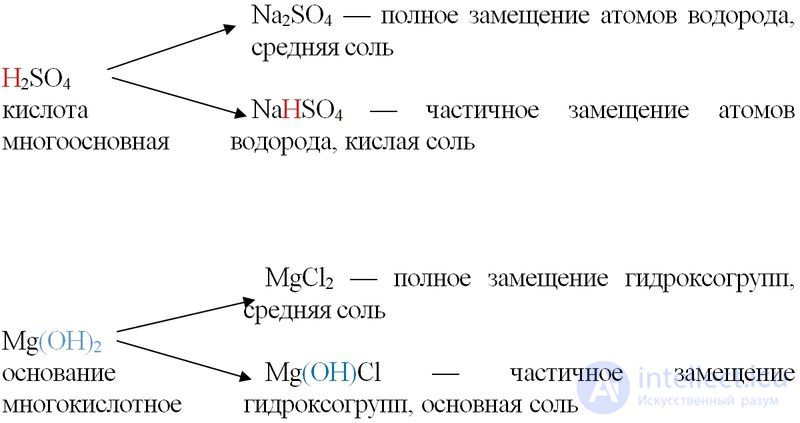
The systematic names of salts are based on the names of the acid residues: MgSO4 — magnesium sulfate, Fe2(SO4)3 — iron(III) sulfate. In the names of basic salts, the word "hydroxo" is added before the name of the metal: Mg(OH)Cl — hydroxomagnesium chloride, (СuOH)2CO3 — hydroxocopper(II) carbonate (malachite). Acid salts are named by adding the prefix "hydro-" before the name of the acid residue: NaHCO3 — sodium hydrogen carbonate (baking soda).
Solid salts often contain water in their composition, in which case they are called crystalline hydrates: FeSO4 ∙ 7H2O, Na2СO3 ∙ 10H2O. Their names indicate the number of water molecules per formula unit of the anhydrous salt: CuSO4 ∙ 5H2O — copper(II) sulfate pentahydrate, Na2SO4 ∙ 10H2O — sodium sulfate decahydrate. Their common names are blue vitriol and mirabilite (Glauber's salt).
A separate group of salts is formed by complex compounds. In the school curriculum you will encounter a small number of such compounds, containing complex, coordination, ions. Most often, a complex ion consists of a metal cation bound to anions or molecules. When writing chemical formulas, such ions are enclosed in square brackets. This emphasizes the especially strong bonds between the atoms in the complex ion. Examples include:
In the organic chemistry course you became acquainted with salts of carboxylic acids (sodium acetate СН3СООNa, potassium stearate C17H35COOK (liquid soap)) and salts of amines (methylammonium chloride СН3NH3Cl, phenylammonium hydrogen sulfate С6Н5NH3HSO4).
Physical properties
Salts are solid crystalline substances. The color of salts can be caused by both the metal ions and the anions of the acid residue (Fig. 6.4).

Fig. 6.4. Samples of salts: a — potassium permanganate KMnO4, b — potassium dichromate K2Cr2O7, c — potassium chloride KCl, d — hydroxocopper(II) carbonate, or malachite, (СuOH)2CO3, e — sodium carbonate decahydrate Na2CO3 ∙ 10H2O
Depending on their composition, salts have different solubility in water. The most basic information about it is given in the "Solubility Table of Salts, Acids, and Bases" (see the textbook's endpaper).
In aqueous solution, the dissociation of salts produces metal cations and anions of the acid residue:
Na2SO4 → 2Na+ +  (normal salt);
NaHCO3 → Na+ +  (acid salt of a weak acid);
NaHSO4 → Na+ + H+ + (acid salt of a strong acid);
Na2[Zn(OH)4] → 2Na+ + [Zn(OH)4]2− (complex salt).
Chemical properties of salts
The general chemical properties of salts include their reactions with acids, alkalis, other salts, and metals.
| Reagent and reaction equation | Features of the reaction |
|---|---|
| 1. Acid: Na2CO3 + 2HCl = 2NaCl + CO2↑ + H2O |
A stronger acid displaces a weaker acid from its salt |
| 2. Alkali: CuCl2 + 2KOH = Cu(OH)2↓ + 2KCl |
An insoluble base and a new salt are formed (strong bases displace weak ones) |
| 3. Salt: BaCl2 + K2SO4 = BaSO4↓ + 2KCl |
Two new salts are formed, one of which is insoluble |
| 4. Metal: CuSO4 + Fe = FeSO4 + Cu↓ |
A more active metal displaces a less active one from a solution of its salt |
| 5. Non-metal: Na2S + Cl2 = 2NaCl + S↓ |
A more active non-metal displaces a less active one from a solution of its salt |
| 6. Acidic (amphoteric) oxide: Na2CO3 + SiO2  Na2SiO3 + CO2↑ Na2SiO3 + CO2↑ |
Upon fusion, a new salt and a volatile oxide are formed |
| 7. Thermal decomposition: CaCO3 CaO + CO2↑;2Cu(NO3)2 2CuO + 4NO2↑ + O2↑ |
On heating, mainly carbonates and nitrates decompose |
Reactions of salt solutions with metals also have other features besides those noted above. Indeed, more active metals displace less active ones. But if the more active metal is an alkali or alkaline earth metal (Ca, Sr, Ba, Ra), then in solution it primarily reacts with water first, and the resulting alkali may then react with the salt. For example, when a piece of sodium is dropped into a solution of copper(II) sulfate, the following reactions are possible:
2Na + 2H2O = 2NaOH + H2↑,
2NaOH + CuSO4 = Cu(OH)2↓ + Na2SO4,
that is, an exchange reaction occurs between the salt and the alkali that has formed.
As a result of the significant amount of heat released, the hydroxide formed decomposes to the oxide, and the hydrogen partially reduces the oxide:
Cu(OH)2 CuO + 2H2O;
CuO + H2 Cu + H2O.
Additionally, one can note the reactions of salts of oxygen-free acids with non-metals, of salts of oxygen-containing acids with acidic and amphoteric oxides, as well as the thermal decomposition of certain salts.
In Chapter IV you will consider another important property of many salts — the ability to undergo hydrolysis.
Preparation of salts
The methods for preparing salts are numerous and varied, and they reflect the chemical properties of oxides, acids, and bases. For example, some of the most important methods can be represented as reactions between substances of different classes. This is clearly illustrated by the reaction equations given below.
| Reagents | Reaction equation |
|---|---|
| Metal and non-metal | Cu + Cl2 = CuCl2 |
| Basic and acidic oxides | MgO + SiO2 MgSiO3 |
| Basic oxide and acid | FeO + H2SO4 = FeSO4 + H2O |
| Acidic oxide and base | CO2 + Ca(OH)2 = CaCO3↓ + H2O |
| Acid and base | HCl + NaOH = NaCl + H2O |
| Acid and salt | 2HCl + CaCO3 = CaCl2 + H2O + CO2↑ |
| Alkali and salt | 3NaOH + FeCl3 = Fe(OH)3↓ + 3NaCl |
| Metal and acid | Mg + 2HCl = MgCl2 + H2↑ |
| Metal and salt | Fe + CuSO4 = FeSO4 + Cu |
| Non-metal and salt | Сl2 + 2KBr = 2KCl + Br2 |
Questions, assignments, problems
1. Write out the formulas of the salts: NaOH, Na2SO4, Na2O, Cu(OH)2, CuCl2, Cu(NO3)2.
2. Write the formulas of the salts: Mg(OH)NO3, (CuOH)2CO3, NaHCO3, KH2PO4, (NH4)2HPO4. Underline the formulas of the acid salts.
3. Name the salts: FeCl2, MgSO4, CaCO3, NaHCO3, Mg(OH)Cl, NaH2PO4.
4. Write the formulas of the salts:
5. Write the equations of the possible reactions of a solution of iron(II) nitrate with the substances whose formulas are: Cu, Na, NaOH, Na2SO4, KNO3, HCl.
6. In each row, indicate the metal capable of entering into a displacement reaction with an aqueous solution of the salt CuCl2:
Write the equations of the corresponding reactions.
7. Determine the mass fraction of the salt in the solution obtained by dissolving 25 g of blue vitriol (copper sulfate) in:
8. Determine the molar concentration of sodium nitrate in a solution:
9. Propose five methods for obtaining the salt:
10. After calcining 9.4 g of copper(II) nitrate, the mass of the solid residue was 5.08 g. Determine the mass of the undecomposed nitrate.
Self-check
1. The salts are the substances whose formulas are:
2. Salts of metals that decompose upon moderate heating are:
3. Iron(II) chloride can react with:
4. A salt is not formed in the reaction:
5. To prepare 0.5 dm3 of a copper(II) sulfate solution with a molar concentration of 0.01 mol/dm3, one must weigh out blue vitriol with a mass of:
Prepare a report. Oxides and salts in a jewelry store.

Comments