
Lecture
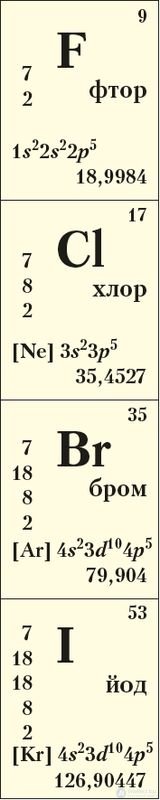
The halogens are the five elements of group VIIA of the periodic table: fluorine F, chlorine Cl, bromine Br, iodine I and astatine At.
Halogen atoms contain 7 electrons in their outer electron shell, with the general electron configuration ns2np5, meaning that halogens are p-elements (Appendix 1). The electron-graphical diagrams of the outer electron shell of fluorine and chlorine atoms are as follows:
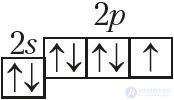
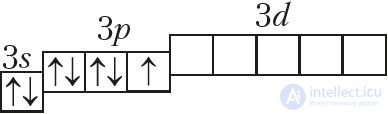
The outer electron shell of the fluorine atom has four orbitals, while atoms of the other halogens also contain five additional unfilled d-orbitals.
Fluorine, being the most electronegative element, exhibits only the negative oxidation state –1 in its compounds. The oxidation states characteristic of the other elements (–1, +1, +3, +5, +7) can be explained by the possibility of unpairing electrons in the outer electron shell. For chlorine atoms this looks as follows:
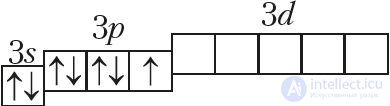
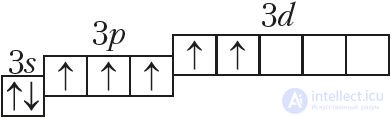
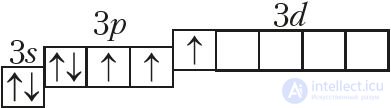
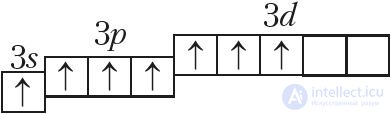
Examples of compounds with various chlorine oxidation states are substances familiar to you:  (halite),
  (Berthollet's salt),
  (perchloric acid).
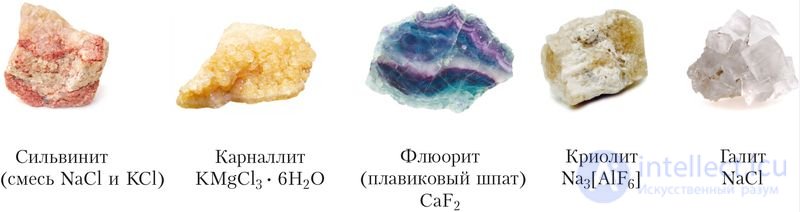
In nature, halogens exist in the form of compounds with other elements (Table 21, Fig. 68). Fluorine and chlorine are among the twenty most abundant elements in the Earth's crust.
Table 21. Halogen chemical elements
| Element | Atomic radius, nm | χ | Oxidation states | Natural compounds |
| Fluorine 9F | 0.071 | 4.0 | –1, 0 | CaF2 (fluorite, fluorspar); Na3[AlF6] (cryolite); Са5[РО4]3F (fluorapatite) |
| Chlorine 17Cl | 0.099 | 3.0 | –1, 0, +1, +3, +5, +7 | NaCl (rock salt, halite); KCl (sylvite); Mixture of NaCl and KCl (sylvinite); KMgCl3 · 6H2O (carnallite) |
| Bromine 35Br | 0.114 | 2.8 | –1, 0, +1, +3, +5, +7 | NaBr, KBr, MgBr2 — in chloride deposits; in sea water in the form of bromide ions |
| Iodine 53I | 0.133 | 2.5 | –1, 0, +1, +3, +5, +7 | KIO3 (potassium iodate) — in Chilean saltpetre deposits, in underground well waters, in seaweed |
Structure of the elemental substances. The elemental substances of the halogens consist of diatomic molecules, the atoms of which are joined by a nonpolar covalent σ-bond (Fig. 69).
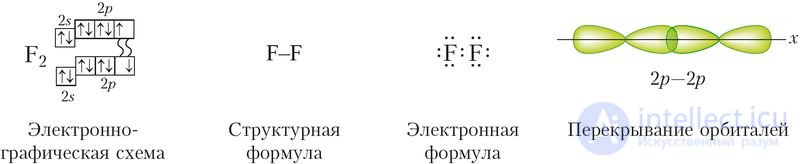
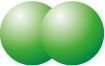
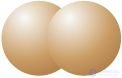
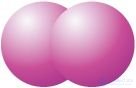
In the series of halogens F2 — Cl2 — Br2 — I2, as molecular size increases, the forces of intermolecular interaction increase, so within the group the melting and boiling points of the elemental halogens rise with increasing atomic number. Thus, at room temperature fluorine and chlorine are gases, bromine is a liquid, and iodine is a solid (Table 22).
Table 22. Physical properties of the halogens
| Substance | Fluorine F2 | Chlorine Cl2 | Bromine Вr2 | Iodine I2 |
| Scale models of molecules |  |
 |
 |
 |
| Tmelt., °С | –220 | ‒101 | ‒7 | +113.5 |
| Tboil., °С | –188 | ‒34 | +58 | +184 |
| State of matter at room temperature | Gas | Gas | Liquid | Solid |
| Color | Pale yellow | Yellow-green | Red-brown | Dark grey |
| Odor | Sharp, irritating | Sharp, suffocating | Sharp, foul | Sharp |
The solubility of chlorine, bromine and iodine in water is moderate. Their aqueous solutions, used in laboratory practice, are called chlorine water, bromine water and iodine water. The solubility of the halogens is considerably higher in nonpolar and weakly polar organic solvents — benzene С6Н6, carbon tetrachloride ССl4, ethanol С2Н5ОН.
Chemical properties
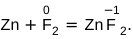
1. Reactions with metals. Fluorine is the most active of the halogens. Even at room temperature it reacts with most metals:
Chlorine, when heated, reacts with silver, gold, platinum and other metals:
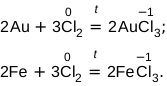
To achieve an appreciable reaction rate with metals, the other halogens likewise usually require the metal to be preheated.

Note that the elemental substances chlorine and bromine, owing to their high oxidizing power, form the compounds  ,
,  with iron, whereas the action of hydrochloric acid on iron leads to the formation of
  .
.
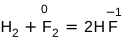
2. Reactions with hydrogen:
 ;
;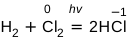 ;
;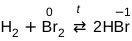 , the reaction is reversible;
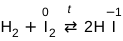 .
.Thus, reactivity toward hydrogen decreases in the series of halogens F2 — Cl2 — Br2 — I2.
3. Reactions with solutions of salts of hydrohalic acids. In aqueous solutions of hydrohalic acids and their salts, a more electronegative halogen displaces a less electronegative one. Thus chlorine displaces bromine and iodine, for example:
 .
.
Bromine displaces only iodine from solutions of iodides:
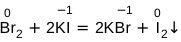 .
.
The ability of more active halogens to displace less active ones from their compounds is used in practice. For example, bromine and iodine are obtained by the action of chlorine on their compounds.
For fluorine, the displacement reaction with less active halogens from solutions is not characteristic, since fluorine reacts with water instead.
Fluorine reacts with water, oxidizing the oxygen atoms in the water molecules:
2F2 + 2H2O = 4HF + O2↑.
When chlorine dissolves in water, a reversible reaction takes place:  . The resulting solution is called chlorine water. Bromine and iodine dissolve in water in a similar way, but the equilibrium concentrations of the products decrease in the series Cl2 — Br2 — I2.
4. Reactions with organic substances. Halogenation of organic compounds most often occurs via substitution reactions (saturated and aromatic hydrocarbons) or addition reactions (unsaturated and aromatic hydrocarbons). For example:
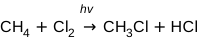 (substitution reaction);
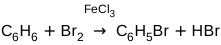 ;
;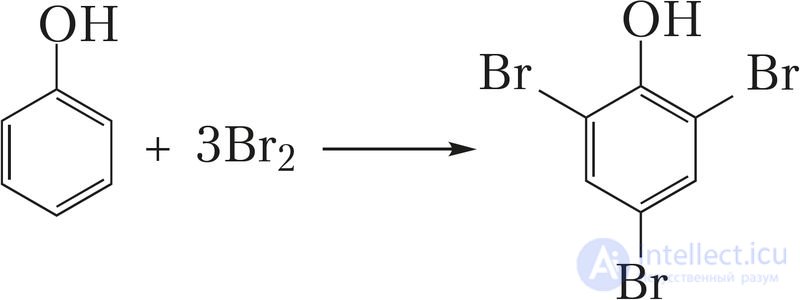 + 3HBr (substitution reaction);
 (addition reaction).
From your courses in biology and organic chemistry you also know that iodine reacts with starch solution, forming a blue-colored compound, while bromine water is used as a reagent for alkenes, phenol and aniline.
5. Reaction of chlorine with alkalis. Depending on the reaction conditions, different products are formed. Thus, when chlorine reacts with a cold alkali solution, chlorine forms the chloride and hypochlorite salts:
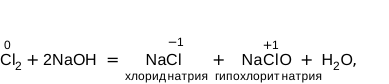
and with a hot solution — the chloride and chlorate:

Sodium hypochlorite is widely used for disinfecting wastewater, water supply systems and swimming pool water, and in the food, pulp-and-paper, and medical industries.
6. Special features of the chemical properties of fluorine. Fluorine, unlike the other halogens, which do not react with oxygen, does react with it, although the process proceeds only under the action of an electric discharge at −196 °С:
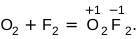
In this compound the fluorine atoms have an oxidation state of −1, while the oxygen atoms, being the less electronegative element, have a positive oxidation state of +1. Therefore O2F2 is called oxygen(I) fluoride.
Water bursts into flame on contact with fluorine. The composition of the products depends on the reaction conditions. Hydrogen fluoride and oxygen are always found among the products:
 .
.

In a fluorine atmosphere even platinum is oxidized: 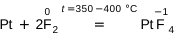 . However, some metals (Mg, Al, Ni, Cu) are resistant to the action of fluorine owing to the formation of a dense fluoride film on the metal's surface.
Under pressure or under the action of ultraviolet radiation, fluorine reacts with krypton and xenon to form noble-gas fluorides.
Halogen compounds play a significant role in the life processes of humans and animals.
Fluorine takes part in building the bone skeleton and tooth enamel, and in metabolic processes in muscles, glands, and nervous tissue. When there is insufficient fluorine in food and drinking water, damage to tooth enamel occurs. An excess of fluorine also has a harmful effect: it leads to the destruction of tooth enamel and the skeleton.
Chlorine is part of hydrochloric acid as a component of gastric juice and ensures the digestion of food, and participates in metabolism. A constant acid concentration in the stomach is maintained through table salt entering the body as part of food.
Bromine regulates the processes of excitation and inhibition of the central nervous system. That is precisely why bromine-containing preparations are used in treating nervous disorders (insomnia, hysteria, neurasthenia, and others).
Iodine plays a significant role in the function of the thyroid gland. The most important function of the hormones produced by it is regulating the work of the brain and heart, and muscular excitation. Iodine deficiency leads to enlargement of the thyroid gland and slowing of mental and physical development.
It is very important to obtain a sufficient amount of each trace element from food, since a deficiency of them can pose a threat to health.
Fluorine, bromine and iodine are found in the following foods.
| F | Lettuce leaves, spinach, apples, grapefruit, cereals, rice, potatoes, nuts, onions, tea; foods of animal origin: sea fish and seafood, chicken, eggs, milk, meat and offal |
| Br | Legumes: beans, peas, lentils; nuts, cereals, seaweed |
| I | Seafood: kelp, fish; dairy products: milk, cheese, cottage cheese; vegetables: potatoes, carrots, beets, onions, tomatoes, spinach, legumes; fruits and berries: apples, plums, grapes, cherries, strawberries; grains: millet, buckwheat |
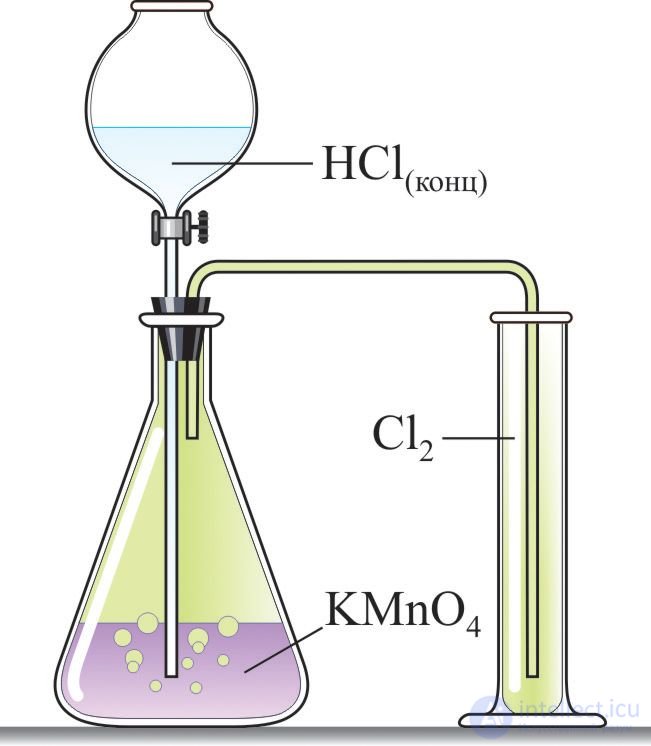
To produce chlorine in the laboratory, the reaction of concentrated hydrochloric acid with strong oxidizers (МnO2, KМnO4, KClO3) is used (Fig. 69.1):
 ;
;
 .
.
To remove trace amounts of hydrogen chloride, the resulting gas is passed through water, and to remove water vapor — through concentrated sulfuric acid.
Chlorine was first obtained by the Swedish chemist Carl Wilhelm Scheele (1742–1786) from the reaction of the mineral pyrolusite (manganese(IV) oxide) with hydrochloric acid in 1774. He is credited with the discovery of many inorganic and organic substances.
In industry, chlorine is obtained mainly by the electrolysis of an aqueous solution of sodium chloride. In this process, chlorine is released at the anode and hydrogen at the cathode.
Chlorine is also formed during the electrolysis of molten sodium chloride:
2NaCl(melt)  2Na + Cl2↑.
You will examine electrolysis processes in more detail in the chapter "Metals."
For fluorine atoms, the oxidation states 0, –1 are characteristic; for chlorine, bromine and iodine — –1, 0, +1, +3, +5, +7.
Halogens act as oxidizers in reactions with metals and nonmetals whose atoms have lower electronegativity.
In Group VIIA the oxidizing properties of the elemental halogens weaken on going from fluorine to iodine.
Halogenation of organic compounds generally proceeds via substitution or addition reactions.
1. Give:
2. For the series of substances F2 — Cl2 — Br2 — I2 indicate the trend of change in:
Give explanations.
3. Calculate the relative density of chlorine with respect to air.
4. A cylinder holds 15 kg of liquid chlorine. Calculate its amount (in moles).
5. Write the electron configuration formulas for the fluorine and chlorine atoms. Indicate the similarities and differences in the electronic structure of these atoms.
6. A mass of 4 g of bromine was dissolved in 250 cm3 of water. Calculate the mass fraction of bromine in the bromine water.
7. Write the equations for the reactions of:
8. A cylinder contains 50 kg of liquefied chlorine. Determine what volume the chlorine will occupy at STP.
9. Determine the chemical formula of a salt in which the mass fraction of potassium is 31.836 %, chlorine — 28.980 %, oxygen — 39.184 %. Determine the oxidation states of the atoms.
10. Numbered test tubes contain solutions of phenol, sodium iodide, and potassium chloride. Propose a plan for identifying the substances using a single reagent. Write the equations for the corresponding reactions.
1. Positive oxidation states are not exhibited by atoms of the element with the outer electron level configuration:
2. Regarding the series of halogens F2 — Cl2 — Br2 — I2, the correct statements are:
3. The elemental substance chlorine reacts with the substances:
4. A reaction takes place when the following gases are passed through bromine water:
5. The sum of the coefficients in the equation for the reaction of iron with chlorine is:

Comments