
Lecture
Knowledge of the rates of chemical reactions and the regularities of their course is of great scientific and practical importance. For example, in the chemical industry, the design, dimensions, and productivity of equipment, and even the safety of production, depend on reaction rates.
As noted in the previous section, the rate of a chemical reaction is determined by the nature of the reacting substances. But the rate can be increased or decreased by changing the conditions under which the reaction occurs.
The factors that significantly affect the rate of chemical reactions include the concentration of reactants, temperature, the presence and nature of a catalyst, and the contact surface area of the reactants.
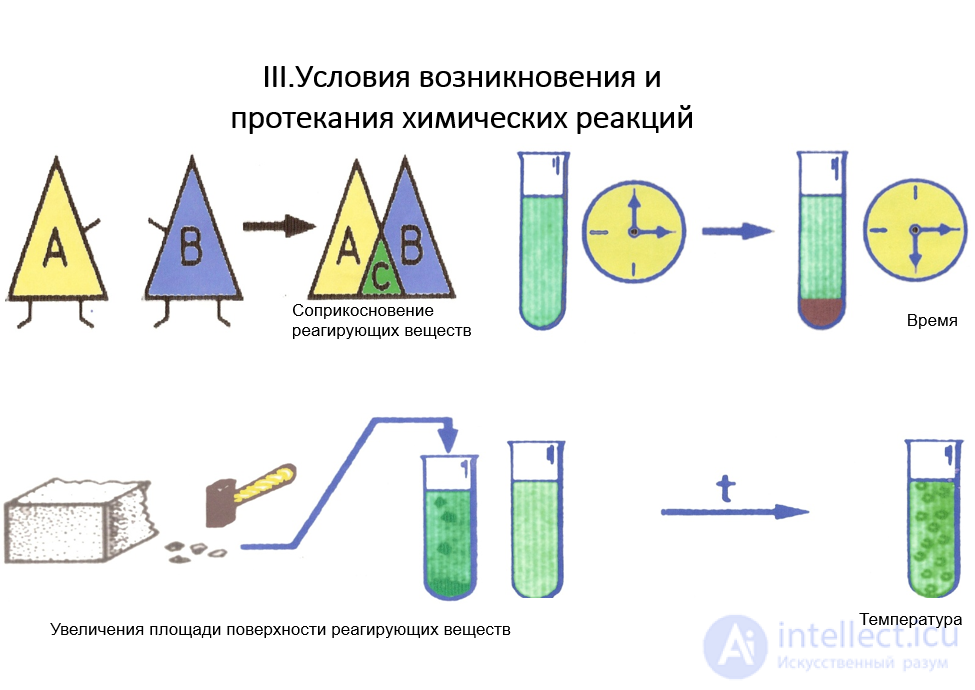
Effect of reactant concentration on reaction rate
The reaction rate is proportional to the number of collisions undergone by particles of the reacting substances. The higher the concentrations of the starting substances in the reaction mixture (solution), the more often their particles collide with each other, which leads to an increase in the reaction rate.
The rate of most chemical reactions strongly depends on temperature. This dependence was established in 1884 by the Dutch chemist J. H. van't Hoff — the first Nobel laureate in chemistry. He formulated a rule that was later named after him.
When the temperature is raised by every 10 °C, the rate of most chemical reactions increases by a factor of 2–4.
The mathematical expression for the dependence of reaction rate on temperature has the form: υ2 = υ1 ∙ γΔt/10, where:
Thus, if γ = 3, and at 20 °C a reaction takes about 10 hours, then at 100 °C it will take place in about 6 seconds. For most practically significant reactions, γ has values from 2 to 4.
When studying how the properties of polymers, medicines, oils, lubricants, and many other materials change during storage, they are kept for some time at elevated temperatures. This significantly accelerates the chemical reactions of decomposition, hydrolysis, oxidation of substances, and other natural processes, the course of which ultimately renders materials and products made from them unusable. This testing method is called accelerated aging and is used for a preliminary assessment of the useful service life of products or their shelf life (storage period).
Keeping paper at 100 °C for 24 hours corresponds to a storage period of 6–8 years at room temperature. This technique is necessary for determining the usable lifetime of books and documents.
Lowering the storage temperature of food products slows down the chemical processes of their spoilage: oxidation, decomposition, etc. Thus, the shelf life of butter at storage temperatures of +3, –6, and –16 °C is 35, 60, and 120 days, respectively.
Carrying out chemical reactions in the presence of catalysts is one of the main ways to increase the rate of transformation of substances.
Catalysis is the process of accelerating a chemical reaction under the action of a catalyst.
Recall that catalysts accelerate chemical reactions but are not part of the final products. The amount of catalyst, unlike other reactants, practically does not change after the reaction. Chemical reactions in the presence of a catalyst proceed faster because it provides an alternative pathway of transformation.
Let us consider the action of a catalyst using the example of the reaction:
A2 + B2 = 2AB.
Without a catalyst, this reaction proceeds slowly. Catalyst K quickly reacts with one of the starting substances, for example A2, and forms a reactive intermediate compound A2K:
A2 + K = A2K (fast reaction).
The intermediate compound A2K actively interacts with the other reactant — B2, converting into the reaction product AB. Catalyst K is released unchanged:
A2K + B2 = 2AB + K (fast reaction).
The interaction of reactants A2 and B2 along the multistep catalytic pathway as a whole proceeds much faster than without a catalyst.
The catalyst repeatedly enters into chemical interaction with the participants of the transformation but restores its chemical composition. The catalyst is not incorporated into the reaction products.
For example, the esterification reaction between a carboxylic acid and an alcohol proceeds significantly faster in the presence of a strong mineral acid:

To oxidize sulfur(IV) oxide SO2 to sulfur(VI) oxide SO3 with atmospheric oxygen, the catalyst V2O5 is used:

The rate of this reaction in the presence of the catalyst increases by approximately 10,000 times.
The rate of heterogeneous reactions is strongly influenced by the size of the contact surface area of the reactants. Let us carry out two experiments to verify this. To do this, we pour equal volumes of dilute hydrochloric acid into two test tubes. Into the first test tube we drop a piece of marble (CaCO3), and into the second — marble chips (CaCO3) of the same mass. It can be seen that more intense gas evolution occurs in the test tube with the chips, and the reaction with them proceeds faster than with the piece of marble.
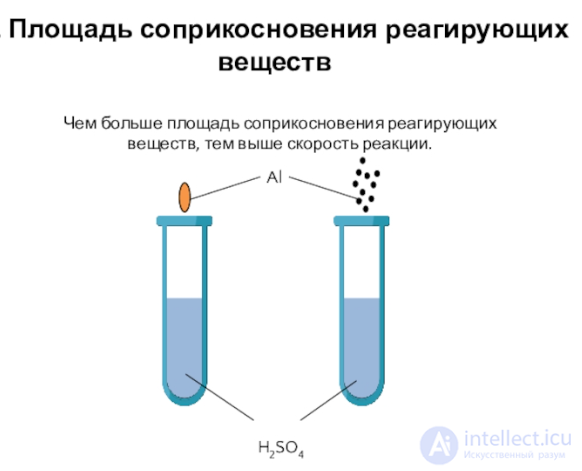
From everyday experience we know that wood shavings and chips burn faster than a log of the same wood and the same mass. This is explained by the fact that the total area of the burning surface of the shavings is much larger than that of the log.
Thus, a larger contact surface area of the reactants provides a greater probability of contact between the interacting particles and an increase in the rate of heterogeneous reactions. The limiting case of "subdividing" the reactants is their dissolution and use in the form of solutions.
The rate of chemical reactions is affected by the concentration of reactants, temperature, the presence of a catalyst, and the contact surface area of the reactants.
Catalysts, by providing an alternative pathway of transformation, accelerate chemical reactions but are not part of the final products of the transformation.
1. Indicate the position of magnesium, zinc, iron, and copper in the activity series of metals. How is this reflected in the rate of their reaction with acid solutions?
2. Why is a simple collision of reactant particles usually not sufficient for a chemical reaction to occur? What processes precede the formation of new bonds in the reaction products?
3. What is the activation energy of a reaction? Why do reactant molecules with an energy reserve less than Ea not enter into a chemical reaction?
4. Suggest ways to increase the rate of the reaction:
2Al(OH)3 = Al2O3 + 3H2O – Q.
5. Why does the rate of most reactions increase with increasing temperature?
6. Why are many medicines stored in the refrigerator?
7. What substances are called catalysts? Give examples of reactions known to you that proceed in the presence of catalysts.
8. List all the factors that increase the rate of the ammonia synthesis reaction:

9. In a closed vessel of constant volume, the chemical reaction A(g) + B(g) = C(g) takes place. Before the reaction began, the molar concentration of A was 5 mol/dm3. The reaction rate with respect to substance A is 0.06 mol/(dm3 ∙ s). Calculate the concentration of substance A 20 s after the start of the reaction.
10. Into a chemical reactor with a volume of 50 dm3, gaseous substance A in an amount of 20 mol and gaseous substance B in an amount of 60 mol were introduced, between which the reaction A(g) + 2B(g) = C(g) occurred. After 3 minutes, the concentration of substance A decreased by half. Determine the rate of consumption of substance B.
1. The rate of chemical reactions depends on:
2. The interaction of zinc granules with hydrochloric acid will be accelerated by:
3. The following reactions proceed without a catalyst:
4. The table shows the activation energy values for the decomposition reaction of hydrogen peroxide 2H2O2 = 2H2O + O2↑ without and in the presence of a catalyst:
| Presence of catalyst | Activation energy, kJ/mol |
|---|---|
| Without catalyst | 73 |
| Platinum | 48 |
| Iron ions | 42 |
| Catalase enzyme | 7 |
The rate of decomposition of hydrogen peroxide will be greatest:
5. When the temperature is increased by every 10 °C, the rate of a certain reaction doubles. The temperature of the reaction mixture changed from 20 °C to 60 °C. The reaction rate increased by:

Comments