
Lecture
Having studied this chapter, you will expand and systematize your knowledge of nonmetals based on your understanding of atomic structure, chemical bonding, and the structure of matter. You will consider each of the nonmetals presented both as a chemical element and as a simple substance, and you will study the characteristics of the most important compounds of nonmetals (oxides, hydroxides, salts, and hydrogen compounds).
The characteristics of the chemical elements are given according to the plan proposed in the chapter "Atomic Structure and the Periodic Law," supplemented with questions on the abundance of the element in nature and its biological role.
In the characteristics of the substances, their composition and structure, physical and chemical properties, methods of laboratory and industrial preparation, and areas of practical use are considered.
The most important concepts of the topic: nonmetals, acidic oxides, acids, salts, ammonia, building materials, qualitative reactions for the ions  ,
,  ,
,  ,
, ,
,  ,
,
Chemical elements are conventionally divided into metals and nonmetals according to their chemical properties. In the periodic table, nonmetals are located in the A-groups: IA, IIIA–VIIIA. A stepped line running from hydrogen to boron to oganesson separates them from the metals. Nonmetals lie above this line, that is, they occupy the upper right corner of the table, forming a kind of triangle (Fig. 61).
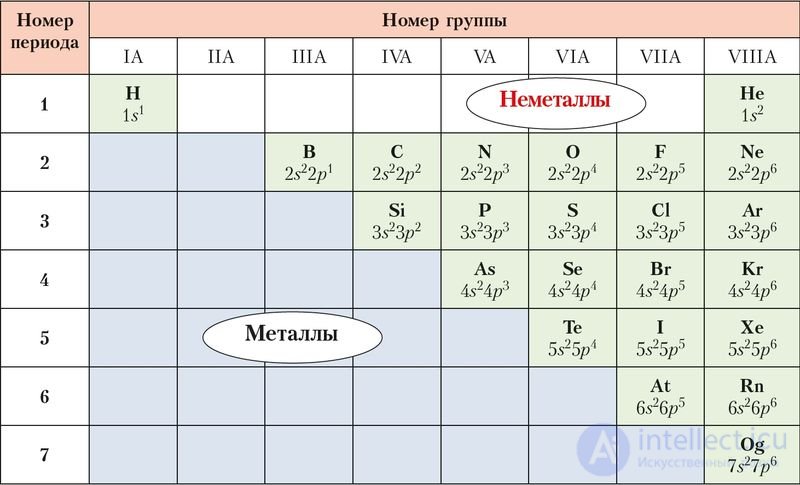
Fig. 61. Nonmetals and the electron configuration of their outer energy level
Elements located in the same group are similar in atomic structure and, therefore, largely similar in properties. For this reason, common names are used for some groups of nonmetals. Thus, the nonmetals of Group VIIIA are called noble gases. For the elements of Group VIIA the name halogens — "salt formers" — is used. The nonmetals of Group VIA have the common name chalcogens — "ore formers."
According to their electrophysical properties, as opposed to their chemical properties, simple substances composed of atoms of various elements are divided into three groups: metals, semiconductors, and dielectrics (insulators). These substances can be distinguished not only by the magnitude of their electrical conductivity but also by the nature of its dependence on temperature. As temperature rises, the electrical conductivity of metals decreases, while that of semiconductors and dielectrics increases. Typical semiconductors are silicon and germanium.
The outer electron shell of an atom largely determines the properties of the element. The number of outer-level electrons in the atoms of nonmetals corresponds to the number of the A-group in which the element is located. For most of them it is close to complete or fully complete, containing four or more electrons. Only the atoms of three elements contain fewer electrons: hydrogen has one electron (one electron short of completion), helium has two electrons (the outer level is complete), and boron has three electrons. Nonmetals are representatives of the p-elements, with the exception of hydrogen and helium, which belong to the s-elements.
Unlike atoms of metals, atoms of nonmetals are capable of exhibiting both positive and negative oxidation states. The exceptions are fluorine and the noble gases. In compounds with other elements, fluorine exhibits only a negative oxidation state, equal to –1 (for example,  ,
,  ,
,  ). The lightest noble gases — helium, neon, and argon — do not form stable compounds, while for xenon, krypton, and radon only compounds with positive oxidation states have been obtained (for example,
  ,
,  ).
).
Overall, the oxidation states of nonmetals range from –4 to +8, and their valences from I to VIII. It should be remembered that the valence of atoms of second-period elements never exceeds four:

In the historically established classification of elements, membership among the nonmetals was determined by the physical properties of the simple substances: their solid, gaseous, or liquid state under normal conditions. In the solid state, nonmetals generally lack metallic luster. Their electrical and thermal conductivity are usually low, and the substances are brittle.
Nonmetals form two types of crystals — molecular and atomic (Fig. 62).
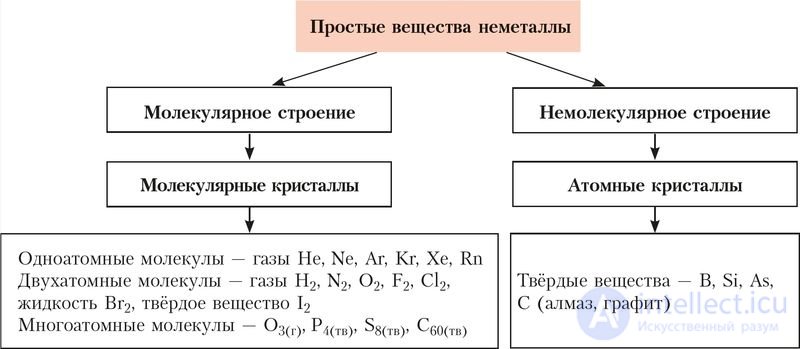
Fig. 62. Composition and structure of simple substances of nonmetals
Substances with a molecular structure are characterized by low melting points (helium –272 °C, oxygen –223 °C) and boiling points (helium –269 °C, oxygen –183 °C). Nonmetals with a non-molecular structure, on the contrary, have extremely high boiling and melting points (graphite: Tmelt. = 3850 °C, Tboil.= 4200 °C).
Nonmetals are characterized by the phenomenon of allotropy. Examples include red and white phosphorus, diamond and graphite, oxygen and ozone.
Nonmetals can react with substances of all classes (metals, other nonmetals, oxides, alkalis, acids, salts) and can exhibit both oxidizing and reducing properties (Table 20).
Table 20. General properties of nonmetals as simple substances
| Nonmetals as oxidizers react with | Nonmetals as reducing agents react with |
Metals: |
Some oxides: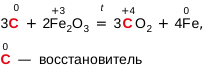 |
Other nonmetals: |
Other nonmetals: |
Acids: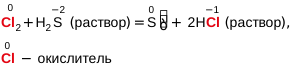 |
Organic substances: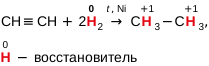 |
Salts: |
The oxidizing ability of nonmetal atoms can be compared by their position in the periodic table: it increases with atomic number within periods and, as a rule, decreases within groups. These same properties can also be assessed by comparing the electronegativity of nonmetals, which increases in the series:
| Si | B | As | As | H | C | I | S | Br | Cl | N | O | F |
| 1.9 | 2.0 | 2.1 | 2.2 | 2.2 | 2.5 | 2.5 | 2.6 | 2.8 | 3.0 | 3.0 | 3.5 | 4.0 |
 |
The oxidizing ability of nonmetals increases with increasing electronegativity.
In nature, nonmetals exist not only in the form of compounds (organic substances, oxides H2O, SiO2, CO2, salts of oxygen-free acids NaCl, As2S3, salts of oxygen-containing acids CaCO3, Ca3(PO4)2), but also in the free state, for example nitrogen, oxygen, the noble gases, carbon (in the form of graphite and diamond), and sulfur. The existence of nonmetals as simple substances in nature is related to the low reactivity of these nonmetals under normal conditions: the atoms of noble gases have a complete outer electron level, oxygen and nitrogen have fairly strong covalent bonds in their diatomic molecules, and carbon forms strong atomic crystals. On Earth, the most abundant nonmetals are oxygen and silicon (by mass about 49% and 26% respectively), while in the Universe it is hydrogen.
The fields of application of simple substances of nonmetals are extensive. Examples include: the production of semiconductor materials (silicon, selenium), metallurgical processes for obtaining metals (carbon, hydrogen) and alloys (boron, silicon), intensification of combustion processes (oxygen), creation of an inert atmosphere (nitrogen, noble gases), organic synthesis (chlorine, bromine), aeronautics (helium, hydrogen), and lighting technology (noble gases).
Nonmetals are representatives of the s- and p-elements.
The oxidation states of nonmetals range from –4 to +8.
In chemical reactions nonmetals exhibit both oxidizing and reducing properties.
1. Describe the position of nonmetals in the periodic table. Indicate the possible oxidation states and valences for the nonmetal elements of the third period.
2. Write the symbols of the elements and the general formula of the electron configuration for:
3. Determine the oxidation states of the atoms in the compounds:
4. Indicate the statements that characterize oxygen as a chemical element:
5. Write the equations of the reactions involving nonmetals, given that the nonmetal atoms in the given reactions exhibit their lowest oxidation state:
6. Determine the mass of carbon needed to reduce iron from 1 tonne of iron(III) oxide. The carbon is oxidized to its highest oxidation state.
7. Nitrogen has very low melting and boiling points, –210 °C and –196 °C, while boron has high ones, ≈2075 °C and ≈3800 °C respectively. Explain this difference.
8. Show that phosphorus acts as a reducing agent in the first reaction and as an oxidizer in the second:
9. Balance the coefficients using the electron balance method and indicate whether the simple substances act as oxidizers or reducing agents:
10. A sample of a gaseous simple substance of a nonmetal with a volume of 1 dm3 (at STP) has a mass of 3.17 g. Determine the chemical formula of the substance.
1. The outer electron level configuration ns2np5 is found in:
2. Silicon as a chemical element is characterized by the statements:
3. Group VA elements exhibit a positive oxidation state in the compounds:
4. Sulfur acts as an oxidizer when reacting with:
5. The sum of the coefficients in the reaction for the synthesis of calcium phosphide from simple substances is equal to:

Comments