
Lecture
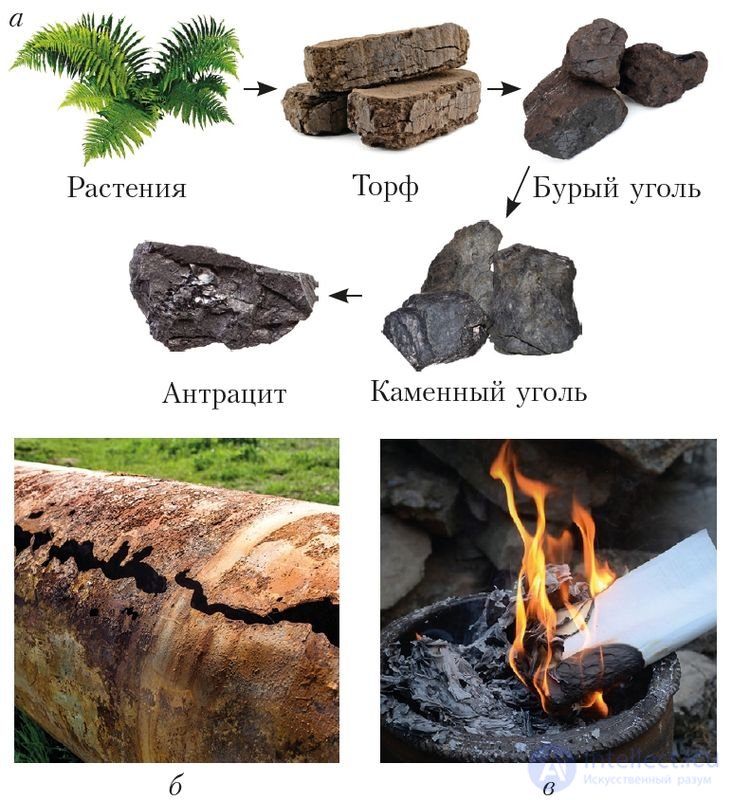
Fig. 47. Slow and fast chemical
reactions: a — conversion of wood
into coal, b — rusting of iron,
c — burning of paper
Some chemical reactions proceed quickly, others — slowly. Thus, the process of conversion of wood into coal lasts hundreds of millions of years (Fig. 47, a). Rusting of iron articles under the action of moist air takes many years (Fig. 47, b). Combustion of paper (cellulose) in air occurs in seconds (Fig. 47, c). The neutralization reaction of an alkali by a strong acid proceeds almost instantaneously.
Consequently, chemical reactions have different rates. The rate of a chemical reaction shows the change in the concentration of a substance entering into the reaction or being formed in it per unit time. This is a physical quantity, denoted by the letter  .
.
The rate of reactions changes as they proceed. Therefore one usually speaks of the average rate of the reaction over a certain interval of time.
For a quantitative determination of the rate, let us consider as an example the homogeneous chemical reaction of oxidation of nitrogen(II) oxide by oxygen to nitrogen(IV) oxide:
2NO + O2 = 2NO2.
Over the time interval Δt = t2 – t1 the amounts (mol) of the starting substances (reactants) n(NO) and n(O2) decrease, while the amount of the reaction product n(NO2) increases. We know that the ratio of the amount n of substance X to the volume of the reaction mixture V is called the molar concentration c(X):
 , moreover
 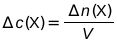 .
.
Thus, in a reaction mixture of a given volume V, the change in the amounts (mol) of the reaction participants is proportional to the change in their molar concentrations Δc.

To determine the value of the reaction rate υ, it is necessary to know the change in the amount (mol) Δn = n2 – n1 of one of the substances (NO, O2 or NO2) that occurred over the time interval Δt = t2 – t1, and the volume of the reaction mixture V.
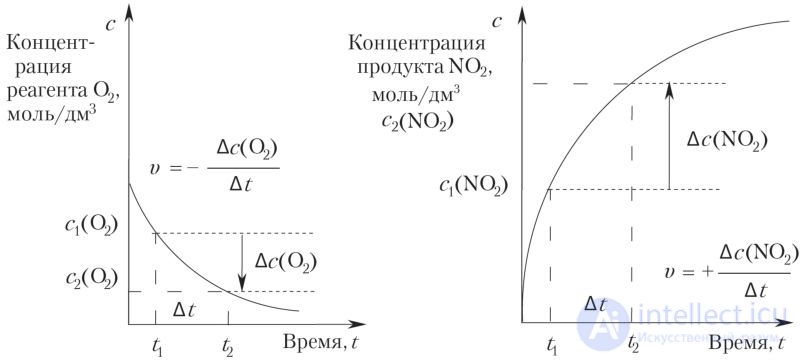
Change in the concentrations of the reactant O2 and the product NO2 over the time interval from t1 to t2
The mathematical expression of the reaction rate with respect to any given participant X can be represented as follows:
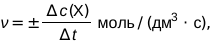
where Δc(X) — is the change in the molar concentration of substance X over time Δt.
Since the reaction rate is a positive quantity, and the concentration of the reactants NO and O2 decreases, a "minus" sign is placed in the rate expression for the starting substances. The concentration of the products increases, therefore a "plus" sign is placed in the expression.
If the coefficients in the chemical reaction equation are not equal to one, then the rates measured for different substances differ.

Dissolution of a metal in a hydrogen chloride solution
The rate of a reaction is determined by the chemical nature of the reacting substances.
Substances entering into chemical reactions differ in composition and structure, type of chemical bond, and the number and strength of these bonds. As a result, reactants possess different reactivity. Let us consider as an example the rate of interaction of different metals with a strong and a weak acid.
If pieces of magnesium and iron of the same size and shape are placed into test tubes with dilute hydrochloric acid, one can see that in the test tube with magnesium vigorous evolution of hydrogen and strong heating are observed. In the test tube with iron, gas bubbles are released much more slowly, and the temperature rises only slightly. Consequently, the rate of interaction of a metal with an acid depends on its activity.
When the strong hydrochloric acid is replaced by weak acetic acid of the same molar concentration, the rate of reaction of magnesium and iron decreases significantly. So, the rate of interaction of a metal with an acid depends on the nature of both reactants — both the metal and the acid.

Chaotic motion of molecules
For a chemical reaction to proceed, it is necessary that the reacting particles collide with one another. However, this condition is not sufficient, since a reaction does not necessarily occur upon collision. Thus, at atmospheric pressure and room temperature, each molecule in various gases (N2, O2, Ar, etc.) undergoes about 5 billion collisions every second. If all particle collisions led to a chemical reaction, then any chemical transformation would be completed in thousandths of a second. Since this does not happen, it means that not all collisions are effective. For a chemical transformation to occur, particles need to possess energy sufficient to break or rearrange the chemical bonds in the starting substances.
In the course of a chemical interaction, molecules must pass through a special transition state, in which they are especially active. To reach such a state, it is necessary to expend energy.
Activation energy is the minimum energy that must be imparted to the particles of the reacting substances in order to transfer them to the active state that ensures the chemical reaction proceeds upon their collision (Fig. 48).
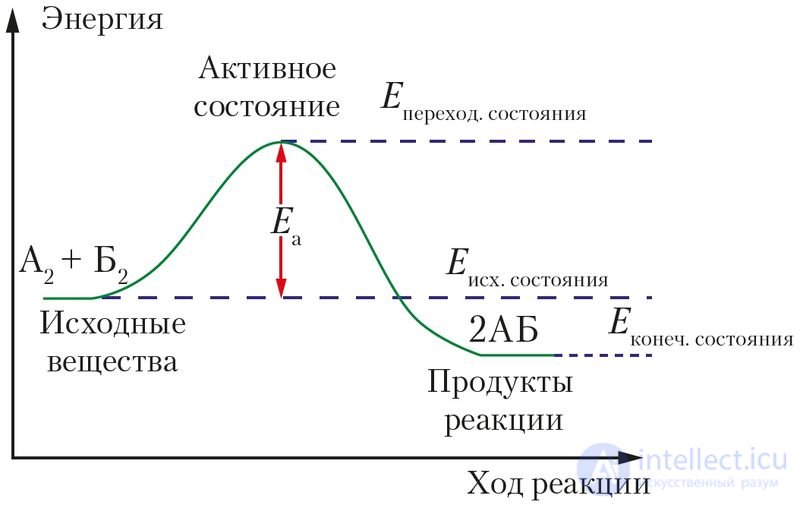
Fig. 48. Energy diagram of the course of the reaction A2 + B2 = 2AB + Q
At the same temperature, the rates of chemical reactions differ greatly mainly because of the value of the activation energy, denoted Ea (kJ/mol). The smaller the value of Ea, the lower the "energy barrier" the reactants need to overcome, and the greater the reaction rate.
In a number of cases, to initiate exothermic reactions the reactants must first be heated in order to transfer the reacting substances into the active state. For example, a match ignites upon friction, and a gas burner is lit from a burning match.
The rate of a chemical reaction is the change in the concentration of a substance entering into the reaction or being formed in it per unit time.
Quantitatively, the rate of a reaction with respect to any given participant is expressed as the ratio of the change in the molar concentration of that participant to the time interval over which the change occurred.
The rate of a reaction is determined by the nature of the reacting substances.
For a chemical reaction to proceed, the reacting particles must collide with one another and possess energy sufficient to break the bonds in the starting substances.
Questions, assignments, problems
1. How do the amounts (mol) and molar concentrations (mol/dm3) change as the reaction proceeds:
2. How does the rate of a reaction change as it proceeds?
3. Why, in order to calculate the rate of a reaction, is it necessary that the volume of the reaction mixture be constant?
4. How is the average rate of a chemical reaction calculated from the reaction equation, the volume of the reaction mixture, and the change in the amount (mol) of one of the substances over the time interval t2—t1? Write the corresponding expression.
5. Based on the concept of activation energy, explain why, in a number of cases, preliminary heating of the reactants is necessary for exothermic reactions to proceed.
6. Explain the physical meaning of the expression: "The rate of a chemical reaction is equal to 2 mol/(dm3 · s)".
7. In a vessel of volume 8 dm3 the reaction 2A(g) + B(g) = 2C(g) proceeds. 2 min after the start of the reaction, the amount of C was 4.8 mol. Determine the rate:
8. The hydrogenation reaction of benzene C6H6(g) + 3H2(g) = C6H12(g) proceeded in a reactor of volume 20 dm3. The initial amount of hydrogen was 0.5 mol, and after 10 min it turned out to be 0.3 mol. Calculate, over the indicated time interval, the rate:
9. In the process of conversion of ozone into oxygen 2O3 = 3O2, the molar concentration of ozone decreased by 0.02 mol/dm3. By what value did the molar concentration of oxygen increase?
10. At the beginning of a reaction proceeding according to the equation 2CO + O2 = 2CO2, the concentration of oxygen in the reactor was 0.03 mol/dm3. After 20 s it turned out to be 0.02 mol/dm3. Calculate the rate of oxidation of CO over the indicated time interval. How did the molar concentrations of CO and CO2 change in the process?

*Self-check
1. The rate of a chemical reaction in SI is measured in:
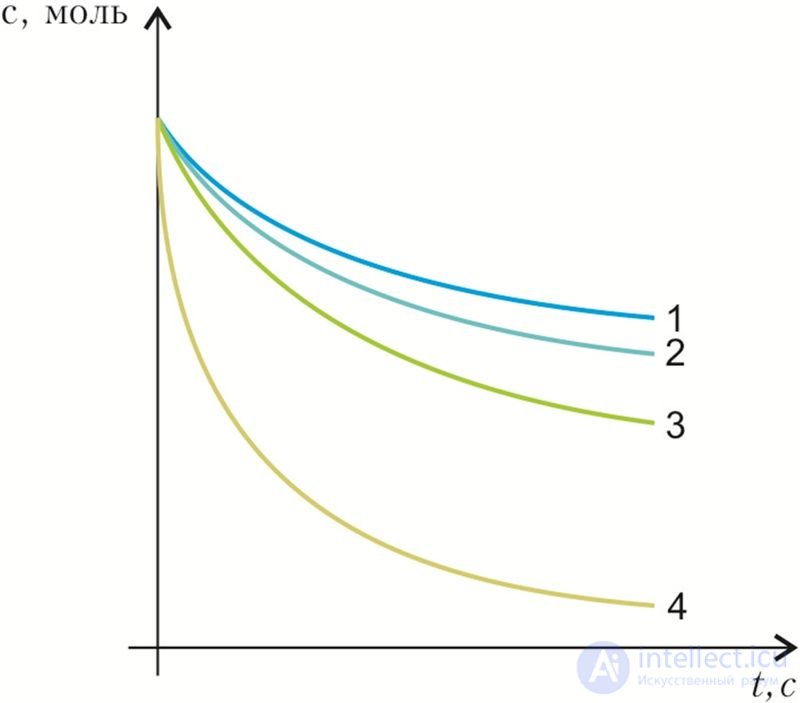
2. From the graph, determine which of the reactions proceeds with a greater rate in the initial period of time:
3. The figure shows a graph of the change in the concentration of the product of an irreversible chemical reaction versus reaction time. The dashed lines mark equal time intervals: Δt1 = Δt2.
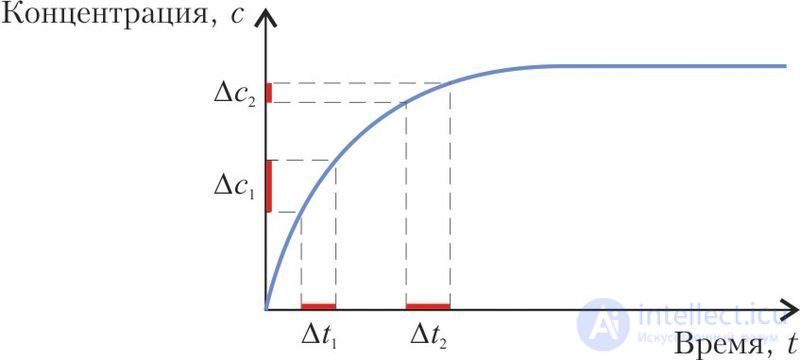
In this case, the following statements are true:
4. A lower activation energy corresponds to:
5. In a single-stage reaction A + B = C, the concentration of substance A changed from 2.2 mol/dm3 to 1.6 mol/dm3 over a time equal to 15 s. The average value of the rate of consumption of substance B is equal to (mol/(dm3 · s):

Comments