
Lecture
Reagents: solutions of iron(II) sulfate, iron(III) chloride, sodium hydroxide, hydrogen peroxide.
1. Pour 1 cm3 each of iron(II) sulfate and iron(III) chloride solutions into test tubes. To each, add a solution of the alkali you have been given (1 cm3). Immediately note the color of the precipitates.
Write the equations of the reactions carried out in molecular and ionic forms.
Draw a conclusion on how iron(II) salt solutions can be distinguished from iron(III) salt solutions.
2. After 3–4 minutes, carefully examine the first test tube — with the iron(II) hydroxide precipitate. Note the change in its color under the action of atmospheric oxygen. Explain it with a reaction equation.
3. Add a few drops of hydrogen peroxide solution to the same test tube. Describe the observed phenomena.
Write the reaction equation. Indicate the oxidizer and the reducer.
Here is a detailed walkthrough of laboratory experiment 9.1*, concerning the detection of iron(II) and iron(III) ions:
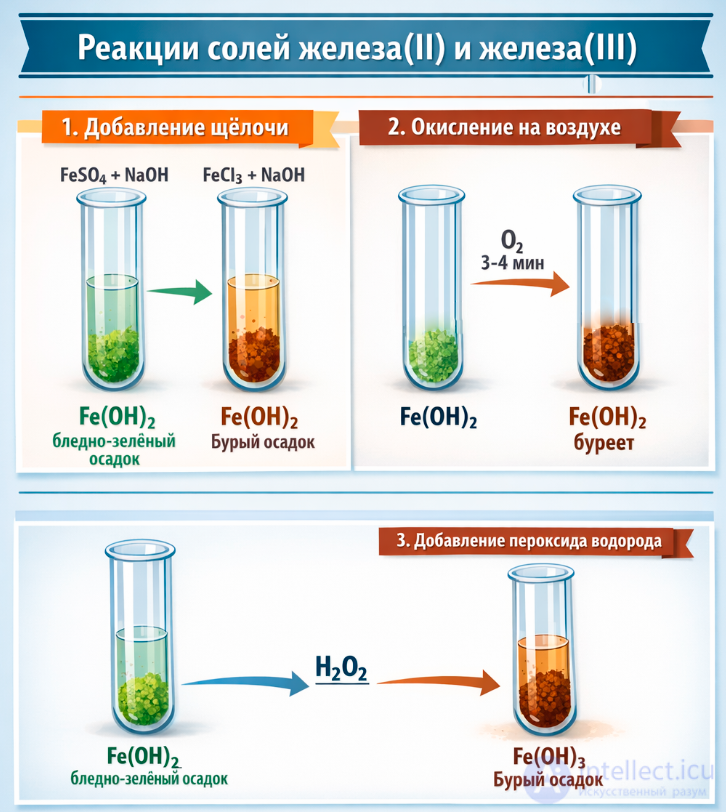
Observations:
When alkali is added to a solution of iron(II) sulfate, a pale-green precipitate forms — iron(II) hydroxide.
When alkali is added to a solution of iron(III) chloride, a brown precipitate forms — iron(III) hydroxide.
Reaction equations:
Molecular equations:
FeSO₄ + 2NaOH → Fe(OH)₂↓ + Na₂SO₄ FeCl₃ + 3NaOH → Fe(OH)₃↓ + 3NaCl
Full ionic equations:
Fe²⁺ + 2OH⁻ → Fe(OH)₂↓ Fe³⁺ + 3OH⁻ → Fe(OH)₃↓
Conclusion:
Solutions of iron(II) and iron(III) salts can be distinguished by the color of the precipitates formed upon addition of alkali:
Fe²⁺ → pale-green precipitate Fe(OH)₂
Fe³⁺ → brown precipitate Fe(OH)₃
Observation:
After 3–4 minutes, the Fe(OH)₂ precipitate gradually turns brown, as it is oxidized by atmospheric oxygen to Fe(OH)₃.
Reaction equation:
4Fe(OH)₂ + O₂ + 2H₂O → 4Fe(OH)₃
Observation:
After the addition of hydrogen peroxide, the browning of the precipitate intensifies. Fe(OH)₂ is rapidly oxidized to Fe(OH)₃, accelerated by H₂O₂.
Reaction equation:
2Fe(OH)₂ + H₂O₂ → 2Fe(OH)₃
Oxidizer and reducer

Comments