
Lecture
Manganese is located in Group VIIB. The valence-shell electron configuration of its atoms is 3d54s2. This explains why manganese exhibits the oxidation states +2, +3, +4, +5, +6, +7 in its compounds, with +2, +4, and +7 being the most characteristic.
Examples of manganese compounds in different oxidation states are given in Table 35.1.
Table 35.1. Properties of manganese compounds in various oxidation states
| Oxidation state | 0 | +2 | +4 | +6 | +7 |
| Compound formula | Mn | MnCl2 | MnO2 | K2MnO4 | KMnO4 |
| Name of compound | Manganese | Manganese(II) chloride | Manganese(IV) oxide | Potassium manganate | Potassium permanganate |
| Color | Silvery metal | Pink | Black-brown | Green | Violet |
| Medium in which the oxidation state is stable | Acidic, neutral | Neutral | Alkaline | Acidic, neutral | |
| Properties | Oxidizing properties increase |
Among manganese-containing compounds, the mineral pyrolusite (MnO2) is the most common in nature. The minerals hausmannite (Mn3O4) and braunite (Mn2O3) are also of industrial importance. Manganese does not occur in the native (elemental) form.
Manganese is a silvery-white, hard, brittle metal. Its density is 7.44 g/cm3, and its melting point is 1244 °C.
Manganese is obtained either by electrolysis of an MnSO4 solution, or by reduction of its oxides with silicon in electric furnaces.
The presence of two s-electrons in the outer shell of manganese atoms determines its metallic properties as a simple substance.
The activity of metallic manganese is fairly high. In air it becomes coated with a thin oxide film that protects it from further oxidation even on heating. However, in powder form manganese is rapidly oxidized by atmospheric oxygen. This produces oxides of various compositions (Mn3O4, Mn2O3, MnO2) depending on the processing temperature.
In the activity series of metals, manganese lies between aluminum and zinc, so it dissolves readily in acids. This produces manganese compounds in the +2 oxidation state:
Mn + 2HCl = MnCl2 + H2↑.
In the most widespread natural compound — the mineral pyrolusite, MnO2 — manganese is in the +4 oxidation state. In this oxidation state it exhibits both oxidizing and reducing properties. Here, MnO2 is a fairly strong oxidizing agent:
MnO2 + 2KBr + 2H2SO4 = MnSO4 + Br2 + K2SO4 + 2H2O.
The reducing properties of MnO2 appear in an alkaline medium or in alkaline salt melts in the presence of oxidizing agents (KNO3, KClO3):
MnO2 + KNO3 + K2CO3  K2MnO4 + KNO2 + CO2.
Manganate can also be obtained by a method already well known to you — the decomposition of potassium permanganate (common name — "potassium permanganate" or "Condy's crystals") on heating above 200 °C:
2KMnO4  K2MnO4 + MnO2 + O2.
In the +7 oxidation state, manganese forms manganese(VII) oxide — Mn2O7, permanganic acid HMnO4, and its salts — permanganates, for example KMnO4.
Manganese(VII) oxide is very unstable and decomposes with an explosion, and so it is not used in laboratory practice. It is a strong oxidizing agent. Paper and alcohols ignite on contact with it.
In aqueous solutions, permanganates are strong oxidizing agents. The reduction products depend on the pH of the medium in which the reaction takes place.
Let us turn to a chemical experiment and observe how the pH of the medium affects the reduction of potassium permanganate.
Prepare a dilute solution of potassium permanganate, which should have a faint violet color.
Add 3–4 drops of this solution to each of three test tubes. To the first test tube add 2–3 drops of water, to the second the same amount of sulfuric acid solution, and to the third 3–4 drops of sodium hydroxide solution (with a mass fraction of 30%). To all three test tubes add a few crystals of sodium sulfite (or sodium nitrite) and mix. Figure 118.2 shows the appearance of the test tubes after the reaction is complete.
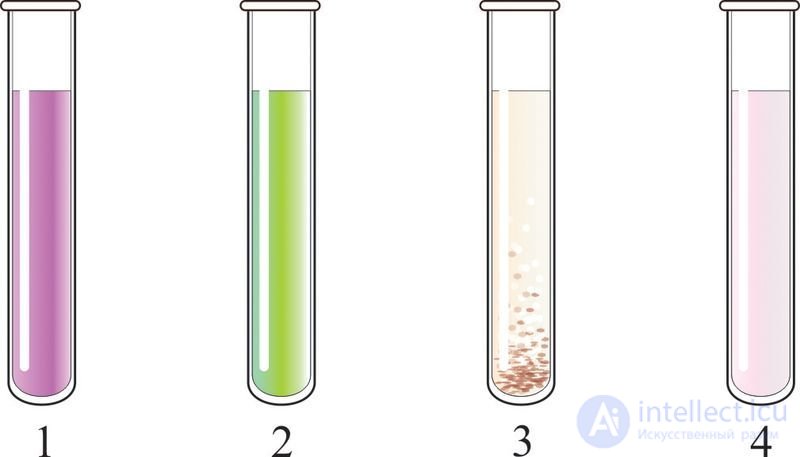
Fig. 118.2. Test tubes with solutions of manganese compounds: 1 — the original KMnO4 solution; 2 — solution after the reaction in an alkaline medium; 3 — solution after the reaction in a neutral medium; 4 — solution after the reaction in an acidic medium
Let us record the observation results in Table 35.2.
Table 35.2. Results of the reaction between KMnO4 solution and Na2SO3
| Medium of the solution | H2O, pH = 7 | H2SO4, pH < 7 | KOH, pH > 7 |
| Color of the solution | Colorless, brown precipitate | Faint pink, almost colorless | Green |
| Product | MnO2 | MnSO4 | Na2MnO4 |
The observation results suggest that the following chemical reactions take place, which can be described by the equations:
• in an alkaline medium:
 ;
;
• in a neutral medium:
 ;
;
• in an acidic medium:
 .
.
Thus, in an acidic medium the permanganate ion shows the highest oxidizing capacity.
The anion  , when alkali is added to its solution, turns into the green anion
  . When the resulting solution is acidified, the crimson color reappears, meaning the ion is formed again. Because of this ability, the anion is called a "chemical chameleon":
 + 4OH– =
  + 2H2O + O2;
 + 4H+ = + MnO2 + 2H2O.
Manganese is a d-element with the valence-shell electron configuration 3d54s2. In compounds it exhibits the most characteristic oxidation states: +2, +4, +7.
In the activity series of metals, manganese lies between aluminum and zinc, and it dissolves readily in acids.
In the +7 oxidation state, manganese forms permanganates, which are strong oxidizing agents.
In an acidic medium, Mn(VII) is reduced to Mn(II); in an alkaline medium, to Mn(VI); in a neutral medium, to Mn(IV).
As the oxidation state increases in the series of manganese oxides and hydroxides, the acidic properties increase.
1. Which oxidation states are most characteristic of manganese atoms? Give the electron-graphic diagrams of the manganese atom in these oxidation states.
2. Determine the oxidation states of manganese in the following oxides: MnO, Mn2O3, MnO2, Mn3O4, Mn2O7.
3. Give the equations of the chemical reactions that take place when manganese(IV) oxide is heated with concentrated hydrochloric acid and when it is fused with a mixture of sodium hydroxide and sodium nitrate. What properties does MnO2 exhibit in these reactions?
4. Write the equations of the reactions:
KMnO4 + H2O2 + H2SO4 → …;
MnO2 + NaNO3 + NaOH …;
PH3 + KMnO4 + H2SO4 → H3PO4 + … .
5. Potassium permanganate (KMnO4) is used in the laboratory to obtain oxygen. Suggest a method for reprocessing the substances remaining after the reaction back into potassium permanganate.
6. By what external signs can one determine in which medium the reduction of KMnO4 took place?
7. Indicate the similarities and differences in the atomic structure of elements of Groups VIIA and VIIB, using manganese and chlorine as an example.
8. The purest metallic manganese is obtained by the electrolysis method. First, ore containing pyrolusite is reduced to manganese compounds with an oxidation state of +2, and then dissolved in a mixture of sulfuric acid with ammonium sulfate. The resulting MnSO4 solution is subjected to electrolysis. The metal deposits removed from the cathodes are remelted into ingots. Give the equations of the chemical reactions possible for this technological process.
9. What is the mass of potassium nitrate ("saltpeter") consumed in obtaining potassium manganate from 4.35 kg of technical manganese(IV) oxide containing 12% impurities? Assume the product yield is 100%.
10. Calculate the molar concentration of iron(II) sulfate if 20 cm3 of a potassium permanganate solution, with a KMnO4 molar concentration of 0.125 mol/dm3, was required for the complete oxidation of 25 cm3 of its acidified solution. Assume the densities of the solutions to be equal to 1 g/cm3.
1. Manganese is produced industrially by:
2. When reacting with atmospheric oxygen, manganese forms the oxides:
3. In a strongly alkaline medium, Mn(II) typically forms the compounds:
 ;
; ;
; ;
; .
.4. The compound with the strongest oxidizing properties is:
5. Manganese acts as the oxidizing agent in the reactions:
K2MnO4 + MnO2 + O2; 3K2MnO4 + 2KCl + 3K2SO4 + 6H2O;
Comments