
Lecture
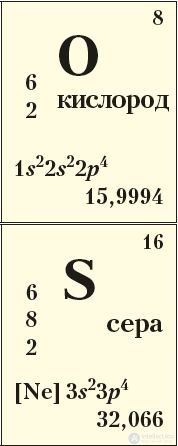
The elements of Group VIA — oxygen 8О, sulfur 16S, selenium 34Se, and tellurium 52Те — have the common name chalcogens, which translates as "ore-forming." Indeed, the overwhelming majority of natural minerals contain oxygen or sulfur, for example magnetite Fe3O4, chalcopyrite CuFeS2.
As you know, oxygen is the most abundant element on Earth, making up 49 % of the mass of the Earth's crust.
Sulfur is the sixteenth most abundant element; it occurs both in compounds and in its native (elemental) state (Table 26).
Table 26. The chalcogen chemical elements
| Element | Atomic radius, nm | χ | Oxidation states | Natural compounds |
| Oxygen 8О | 0.073 | 3.5 | –2, –1, 0, +2 | О2, О3, H2O, minerals, organic compounds |
| Sulfur 16S | 0.104 | 2.6 | –2, –1, 0, +4, +6 | Native sulfur S, copper pyrite (chalcopyrite) СuFеS2, iron pyrite (pyrite) FeS2, Glauber's salt Na2SO4 · 10H2O, proteins |
| Selenium 34Se | 0.117 | 2.5 | –2, 0, +4, +6 | Native selenium Se (occurs occasionally), compounds with iron, lead, mercury (selenides) in sulfide deposits, organic compounds — selenoproteins |
| Tellurium 52Te | 0.137 | 2.1 | –2, 0, +4, +6 | Native tellurium Те (in sulfur and selenium deposits), compounds with copper, lead, zinc, silver, gold (tellurides) in deposits of the corresponding metals |
On the outer electron shell, whose general configuration is ns2np4, chalcogen atoms have 6 electrons, two of which are unpaired in the p-sublevel (Appendix 1):
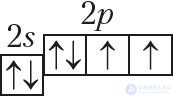
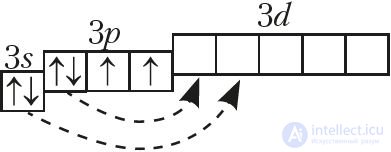
From the electron configurations of the outer electron shell of oxygen and sulfur atoms given above, it follows that the lowest oxidation state of these chalcogens is –2. Sulfur exhibits the positive oxidation states +4, +6 when the s- and p-electrons of the outer shell are excited to the d-sublevel. Sulfur is less electronegative than the halogens (except iodine), nitrogen, and oxygen. Oxygen, being second only to fluorine in electronegativity, exhibits a positive oxidation state of +2 only in combination with fluorine  .
.
The unpleasant odors noticed during the decay of animal carcasses can be explained by the release of sulfur compounds (mercaptans and hydrogen sulfide), which are formed during the decomposition of proteins.
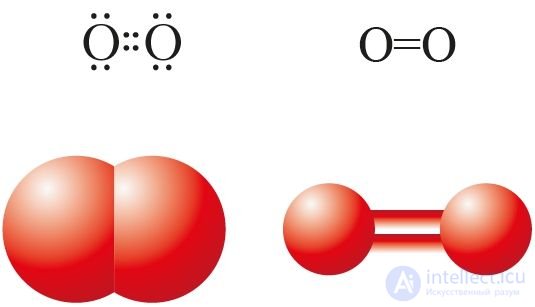
Oxygen exists in nature as two simple substances (allotropic modifications) of molecular structure — oxygen О2 and ozone О3. In the oxygen molecule there is a double, nonpolar covalent bond (Fig. 29, 72).
Physical properties of oxygen. Oxygen is only slightly soluble in water: at 20 °С, 31 cm3 of oxygen dissolves in 1 dm3 of water. Nevertheless, this is enough for fish in bodies of water to breathe. Liquid oxygen is a mobile, slightly bluish liquid that boils at a temperature of –183 °С. Solid oxygen consists of blue crystals that melt at an even lower temperature of –219 °С.
Chemical properties of oxygen. Oxygen acts as an oxidizing agent in all reactions except its interaction with fluorine. When oxygen oxidizes simple and complex substances, oxides are usually formed.
1. Oxygen interacts with metals:
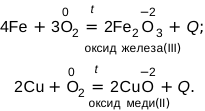
It oxidizes almost all metals, except silver, gold, and platinum. With active metals, oxygen can form not only oxides but also peroxides (Na2O2), superoxides (KО2), or other binary compounds.
2. Reacting with nonmetals, oxygen forms acidic or non-salt-forming oxides:
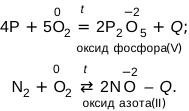
Oxygen does not react with chlorine, bromine, or iodine.
3. Oxygen oxidizes complex inorganic and organic substances:
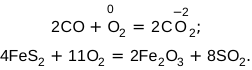
Note that the combustion of hydrocarbons is used as a source of thermal energy:
CH4(g) + 2O2(g) = CO2(g) + 2H2O(l)+ 891 kJ.

In organic synthesis, oxygen is widely used in catalytic oxidation reactions:

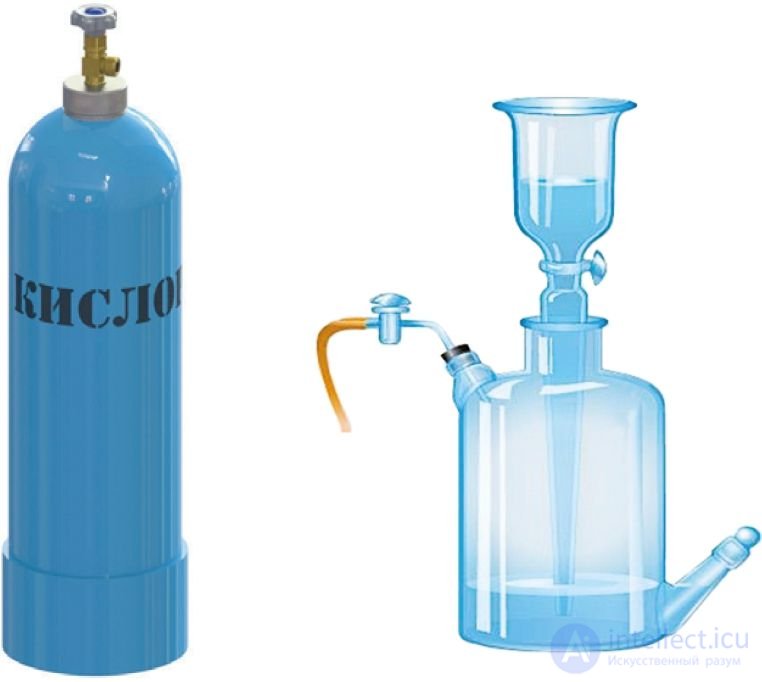
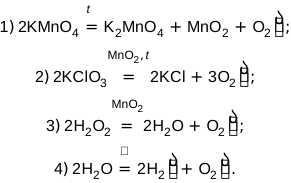
Industrially, oxygen is obtained by the separation of liquid air; small quantities are stored in blue cylinders, and in laboratories — in gas holders (Fig. 73). The most important laboratory method for obtaining it is the decomposition of certain oxygen-containing substances — potassium permanganate, potassium chlorate (Berthollet's salt), water, and hydrogen peroxide:
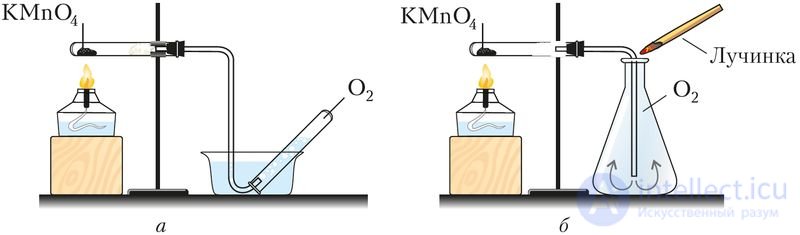
Oxygen is collected in vessels by the method of water displacement or air displacement (Fig. 74).
Ozone is a gas with a pungent odor, having a pale blue color, and in the liquid state — blue. In the course of reactions, ozone decomposes to form atomic oxygen:
О3 = О2 + О,
therefore it has greater chemical activity compared to oxygen. In nature, ozone is formed from atmospheric oxygen during lightning discharges, and at an altitude of 10–30 km — under the action of ultraviolet radiation. The ozone layer above the Earth's surface blocks short-wavelength ultraviolet radiation from the Sun, which is harmful to living organisms.
Ozone is formed during the operation of laser printers and sources of X-ray and ultraviolet radiation. The maximum permissible concentration (MPC) of ozone in the air of the working area is 0.1 mg/m3. The characteristic smell of ozone begins to be noticeable already at concentrations of 0.004–0.010 mg/m3, that is, many times lower than the hygienic standard, which is important for personnel working with ozone.
Water is disinfected by chlorination or ozonation. Ozonation of water is safer for the human body than chlorination.
Sulfur
Composition and structure of the sulfur molecule. Molecules of crystalline sulfur have the shape of closed rings. If molten sulfur is poured into a glass of cold water (rapidly cooled), plastic sulfur is formed. Its molecules are long chains (Fig. 75). Plastic sulfur is unstable and, within a few hours of being obtained, turns into yellow crystals of rhombic sulfur as the most stable of the allotropic modifications.
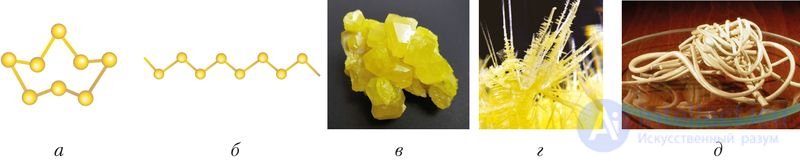
Several allotropic modifications of sulfur are known: two crystalline forms — monoclinic S8 (Tm.p.= 119.3 °С) and rhombic S8 (Tm.p.= 112.8 °С) — as well as plastic S∞ (Fig. 75). Rhombic sulfur is the most stable at room temperature.
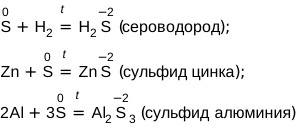
Chemical properties. Sulfur is a fairly active nonmetal. When heated, it readily oxidizes with oxygen and halogens, and acts as an oxidizing agent in reactions with hydrogen and metals (except gold and platinum):
| Sulfur as a reducing agent | Sulfur as an oxidizing agent |
 |
 |
Applications of oxygen and sulfur. The most significant areas of application of oxygen and sulfur are indicated in Table 27.
Table 27. Areas of application of oxygen, ozone, and sulfur
| О2 | Welding and cutting of metals. Oxidizer for rocket fuel. Breathing mixtures — space, submarines, medicine. Chemical industry — production of oxides, acids, etc. Organic synthesis — aldehydes, carboxylic acids. Metallurgy |
| О3 | Bleaching agent. Disinfectant in medicine. Disinfection of drinking water and wastewater |
| S | Production of sulfuric acid. Production of rubber. Production of matches. Production of dyes and pigments |
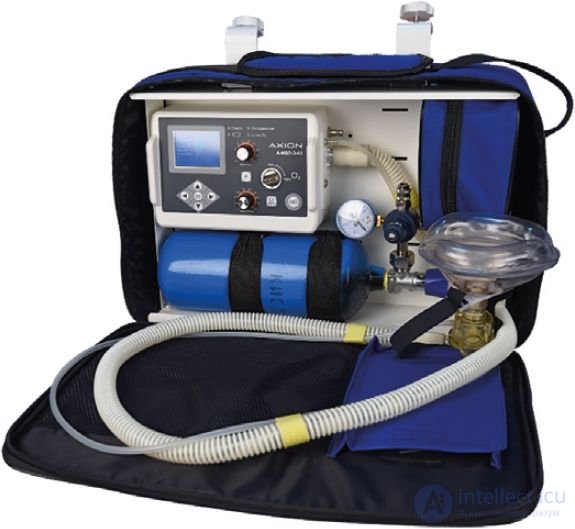
Oxygen has found application in breathing apparatus (Fig. 76).
The electron configuration of the valence shell of the chalcogens is ns2np4. Their lowest oxidation state is –2.
As an oxidizing agent, oxygen reacts with simple and complex substances, usually forming oxides.
Sulfur is an oxidizing agent in reactions with metals and hydrogen, but a reducing agent in its reaction with oxygen.
1. List the most characteristic oxidation states of:
Give examples of the corresponding compounds.
2. Name the allotropic modifications of:
3. Write the formulas of the oxides and sulfides of lithium, magnesium, and aluminum.
4. Calculate the mass of a portion of sulfur with an amount of 3.5 mol.
5. Fill in the table "Oxygen and Sulfur in Redox Reactions," writing the equations of the corresponding reactions.
| Reagents | Oxygen | Sulfur |
| Н2 | ||
| Mg | ||
| Ca | ||
| Fe | ||
| Li | ||
| Na |
6. Write 10 equations of possible reactions between the substances whose formulas are Ba, K, Рt, ZnS, S, H2, O2. Indicate the oxidation states of the elements in each case.
7. What volume of air is required to burn:
8. Calculate the volume of oxygen that can be obtained by decomposing potassium chlorate (Berthollet's salt) with a mass of 49 g.
9. Write the equations of the reactions according to the scheme:
 ;
; .
.10. When potassium permanganate with a mass of 3.16 g was heated, oxygen with a volume of 168 cm3 (S.T.P.) was obtained. Determine the mass fraction of the salt that decomposed.
1. The lowest oxidation state of chalcogen atoms is:
2. Indicate the statements characterizing sulfur as a simple substance:
3. The following can react with oxygen:
4. The chalcogens include elements with the outer electron shell configuration:
5. The number of atoms in a portion of ozone with an amount of 0.1 mol is equal to:

Comments