
Lecture
Having studied this chapter, you will be able to explain why atoms combine into molecules and crystals, and to establish a connection between their chemical composition and structure. Consequently, you will learn to predict the properties of substances from their formulas, and conversely, from the properties of substances, to make assumptions about their structure. The theoretical basis for judging the relationship between the properties and structure of substances will be knowledge about the types of chemical bonding, their properties, and mechanisms of formation.
The most important concepts of the topic: chemical bond, covalent bond (polar and nonpolar), bond order, ion, ionic bond, metallic bond, intermolecular interaction, hydrogen bond, dipole, atomic, ionic, metallic, molecular crystals, valence, valence electrons, oxidation state.
Any chemical compound — a molecule (CO2), a crystal (NaCl), a complex ion ( ) — can, from the standpoint of electronic structure, be represented as a system consisting of atomic nuclei and the electrons that bind them. The interaction that makes this system stable is called a chemical bond.
A chemical bond is an interaction as a result of which individual atoms combine into more complex systems (molecules, crystals, ions, etc.).
A chemical bond is caused by the action of forces of attraction and repulsion between positively charged nuclei and negatively charged electrons, that is, it has an electrostatic nature.
Electrons that take part in the formation of chemical bonds are called valence electrons. These are the electrons of the outer electron shells of atoms.
Let us consider how and why a chemical bond is formed.
The main condition for the formation of a chemical bond is a decrease in the total energy of the system of nuclei and electrons compared with the energy of isolated atoms.
A decrease in the total energy of the system of nuclei and electrons is achieved as a result of the shared use of electrons by different atoms. Depending on how the electron density is distributed as a result, three types of chemical bond are distinguished: covalent, ionic, and metallic.
You have already considered the mechanisms of formation of these bonds when studying chemistry in grades 8–10. Here we will supplement the concept of chemical bonding with ideas about the state of electrons in an atom.
A covalent bond is a chemical bond formed by shared (bonding) electron pairs. It is called localized, because the shared pair of electrons is placed (localized) between two nuclei. This causes the positively charged nuclei to be attracted to the pair of electrons located between the nuclei. Such a bond arises between atoms with identical or close values of electronegativity. As a rule, these are atoms of nonmetals.
The appearance of a pair of electrons connecting neighboring atoms can be represented in two ways, that is, there are two mechanisms for the formation of a covalent bond — the exchange mechanism and the donor-acceptor mechanism.
The exchange mechanism explains the formation of a shared electron pair from unpaired valence electrons belonging to different atoms. In this case, the electrons forming the shared pair must have opposite (antiparallel) spins. The overlap of two electron clouds leads to an increase in electron density between the nuclei:
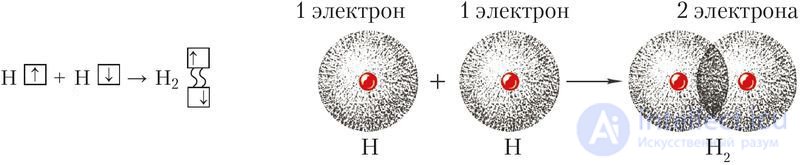
s-, p-, and d-electron clouds can take part in the formation of a covalent bond. For example, in the bonding of chlorine and hydrogen atoms in the H—Cl molecule, the 1s-electron of the hydrogen atom and the unpaired 3p-electron of the chlorine atom take part (fig. 24).
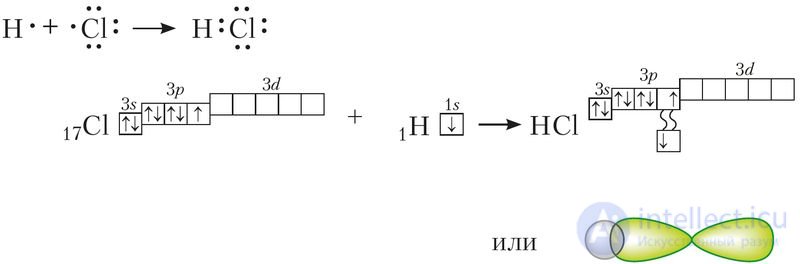
Fig. 24. Formation of a covalent bond in the HCl molecule
Each of the atoms bonded into a shared electron pair acquires the electron configuration of a noble gas: hydrogen — that of helium 1s2, and chlorine — that of argon 1s22s22р63s23р6. As a result, both atoms attain the most stable electron configuration.
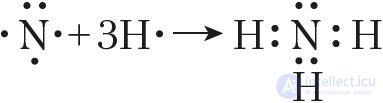
Another example is the formation of bonds in the ammonia molecule NH3. According to the electron-graphical scheme, the nitrogen atom has three unpaired electrons: 7N 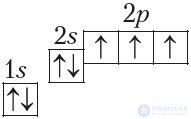 , and the hydrogen atom has one
  . These electrons take part in the formation of three covalent bonds by the exchange mechanism with hydrogen atoms:
  or
or 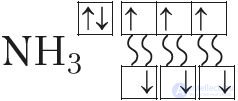
Let us note that at the same time, nitrogen retains a lone electron pair in the 2s-orbital — a pair of electrons that does not take part in the formation of chemical bonds.
The exchange mechanism explains the formation of a covalent bond in the vast majority of molecules of organic and inorganic substances, in the atomic crystals of diamond C, red phosphorus P, carborundum SiC, quartz SiO2, and others.
The donor-acceptor mechanism of covalent bond formation involves the formation of a shared pair of electrons through the transfer of a lone electron pair from one atom (the donor) to a vacant atomic orbital of another (the acceptor). As an example, let us consider the formation of a chemical bond in the ammonium cation  during the course of the reaction:
 (ammonium chloride)
or in ionic form:
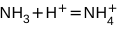 (ammonium ion).
This interaction can be represented by electron formulas:
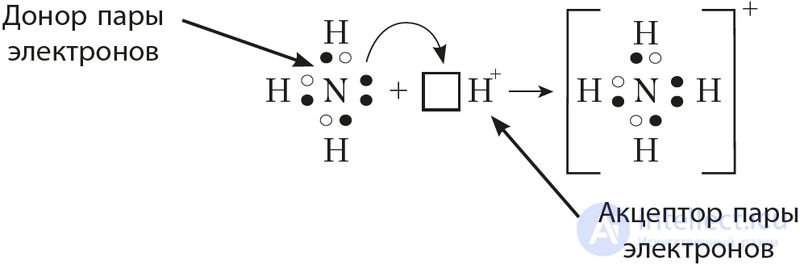
When the molecule 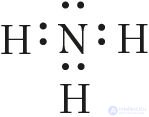 interacts with the hydrogen cation
  , which has no electrons in its 1s-orbital, the lone pair of nitrogen electrons is placed in the free 1s-orbital
  of the hydrogen ion. As a result, the ammonium cation is formed with four covalent bonds:
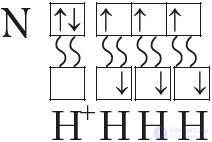
Since the ammonia molecule is electrically neutral, and the ion attached to it has a "+" charge, the resulting ammonium cation also has a positive charge. This charge belongs to the ion as a whole, not to a separate atom, so in the structural formula the sign of the ion's charge is placed outside the square bracket: 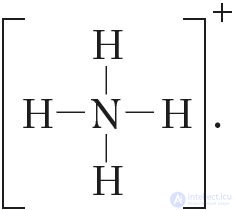 If we want to emphasize the mechanism of bond formation, we can use an arrow to indicate the direction of displacement of the electron pair from the donor to the acceptor:
 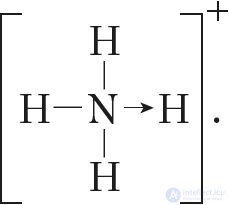 But this is not necessary, since all bonds in the molecule, regardless of their mechanism of formation, are equivalent.
In a similar way, one can represent the formation of a chemical bond in the hydronium cation H3O+: as a result of hydration of the hydrogen ion in aqueous solutions, the lone electron pair of the oxygen atom in the water molecule is placed in the free 1s-orbital of the hydrogen ion.

The donor-acceptor mechanism explains the formation of a covalent bond in molecules of carbon monoxide  , nitric acid
 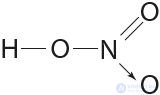 , and others.
An ionic bond is a chemical bond that is formed as a result of the electrostatic attraction of oppositely charged ions.
In the case of a covalent bond, the valence electrons taking part in its formation are localized between two bonded atoms. When an ionic bond is formed, on the contrary, the electrons are considered to have completely transferred from one atom to another. As a result of such an electron transfer, ions are formed.
The formation of ions in sodium chloride crystals can be represented, based on the electron configuration of sodium and chlorine atoms, as follows:
11Na 1s22s22p63s1 – e– → 11Na+ 1s22s22p6 (or Na – e– → Na+),
in abbreviated form [Ne]3s1 – e– → [Ne];
17Cl 1s22s22p63s23p5 + e– → 17Cl– 1s22s22p63s23p6 (or Cl + e– → Cl–),
in abbreviated form [Ne]3s23p5 + e– → [Ar].
The ions formed acquire the configuration of the nearest noble gas with an octet of electrons in the outer shell ns2nр6.
The transfer of electrons can also be shown using electron formulas:

From the diagrams above it follows that the valence electron of the sodium atom completely transfers to the valence shell of the chlorine atom. This leads to the emergence of ions with opposite charges.
Note that structural formulas are not drawn up for ionic compounds.
A question arises: why does a covalent bond form in the case of HCl, and an ionic bond in the case of NaCl? This is explained by the difference in the electronegativity values of the interacting atoms. The difference between the electronegativity values of H and Cl is significantly smaller than the difference between the electronegativity values of Na and Cl. This means that chlorine attracts the electron of sodium much more strongly than the electron of hydrogen. As a result, a complete transfer of the electron from the sodium atom to the chlorine atom occurs.
An ionic bond mainly forms in the halides, hydroxides, and oxides of alkali and alkaline earth metals. This type also includes the bond between a cation and an anion of complex composition, for example in salts of oxygen-containing acids (Na2SO4, NaNO3, (NH4)2SO4). In such substances there are two types of bonds: ionic — between the cation and anion, and covalent — between the nonmetal atoms within the cation or the ion of complex composition (fig. 25).
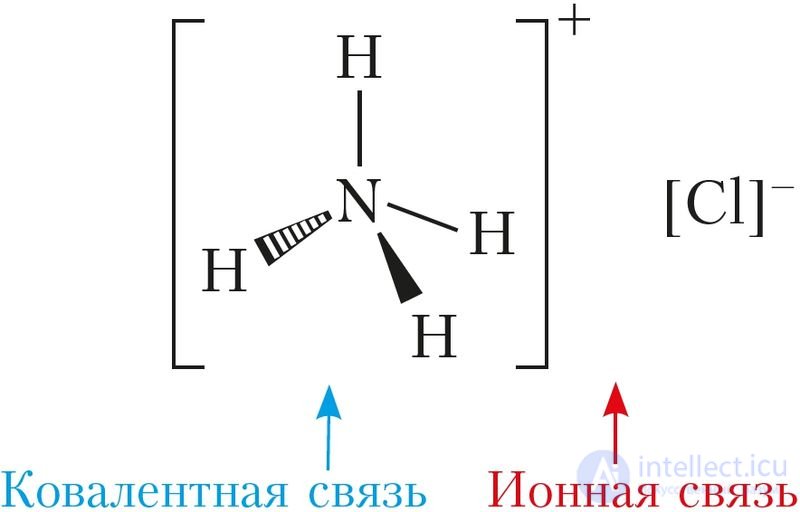
Fig. 25. Scheme of bond formation in ammonium chloride NH4Cl
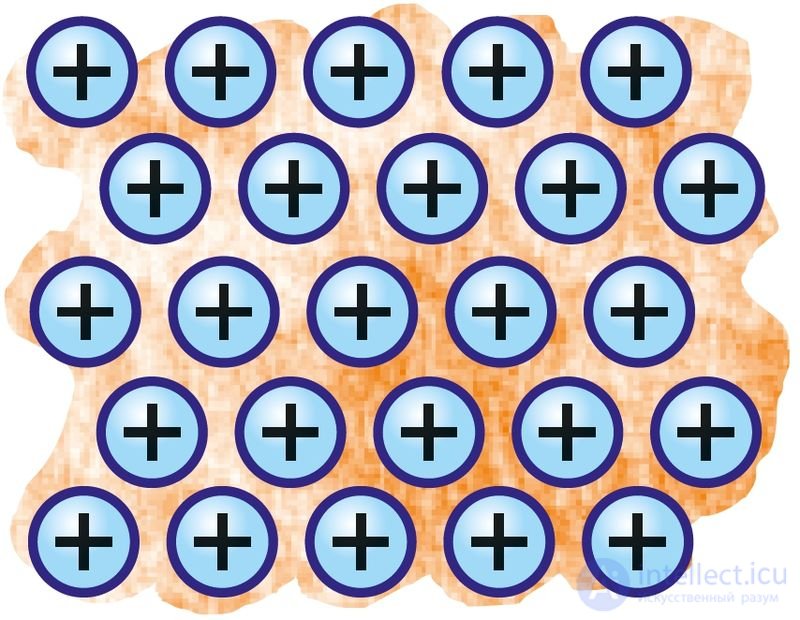
A metallic bond forms in crystals of metals and metal alloys due to the sharing of their valence electrons by all atoms.
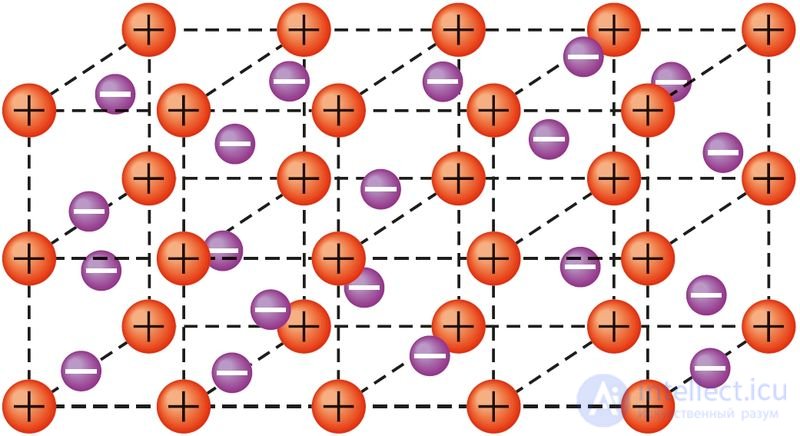
Fig. 26. A metal crystal,
consisting of regularly
arranged metal cations
and freely moving
electrons
The transfer by metal atoms of their valence electrons into collective use, and the presence of free electrons in metals, is the reason for electrical conductivity. The formation of a metallic bond can be described as follows. In metal atoms, the outer energy level contains a small number of valence electrons. In any period of the periodic table, metal atoms have, compared with nonmetal atoms, a larger radius, a smaller number of valence electrons, and the smallest nuclear charge. Therefore, the valence electrons are relatively weakly bound to the atomic nuclei and can move freely throughout the entire metal crystal. As a result, the crystal consists of positively charged ions, between which free electrons move — the so-called electron gas (fig. 26).
Table 11 summarizes information on the mechanisms of chemical bond formation and the distribution of electron density between chemically bonded atoms.
Table 11. Formation of covalent, ionic, and metallic bonds
| Type of bond | Nature of electron exchange between atoms | Conditions of interaction between atoms |
| Covalent bond | Localization of bonding electron pairs of valence electrons between positively charged atomic nuclei. Arises mainly between nonmetal atoms in molecules and atomic crystals |
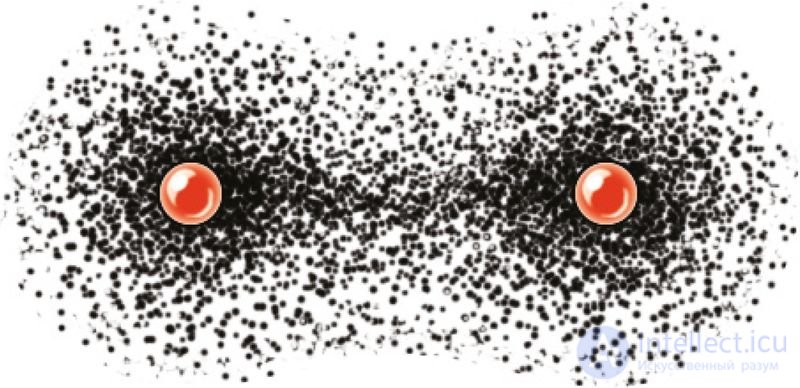
Formation of shared |
| Ionic bond | Transfer of electrons from one atom to another and formation of a crystal from cations and anions. Arises between atoms of typical metals and nonmetals, in salts, many oxides, hydroxides |
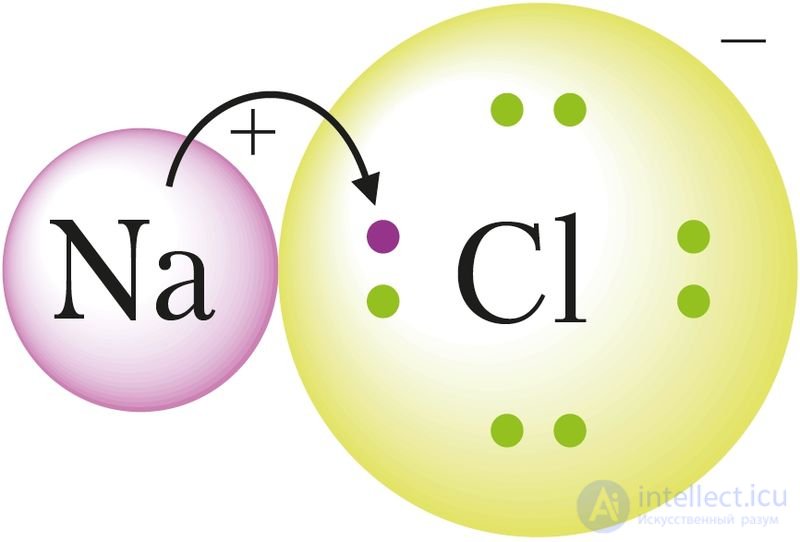
Electrostatic |
| Metallic bond | Sharing of valence electrons and their uniform distribution in space between all atomic nuclei. Arises in metals and alloys |
Sharing of all |
A chemical bond is an interaction as a result of which individual atoms combine into more stable complex systems (molecules, crystals, ions, etc.).
A chemical bond has an electrostatic nature.
When a chemical bond is formed, the total energy of the system of nuclei and electrons decreases.
Three main types of chemical bonding are distinguished: covalent, ionic, and metallic, differing in the nature of the distribution of electron density between the interacting atoms.
There are two mechanisms for the formation of a covalent bond — the exchange mechanism and the donor-acceptor mechanism.
1. Determine the type of chemical bond represented by the electron diagrams:
| a) |  |
c) |  |
| b) |  |
d) |  |
2. Write the electron formulas of the molecules of hydrogen, chlorine, hydrogen chloride, water, and ammonia, and indicate the number of bonding and lone electron pairs in each of them.
3. Indicate the type of chemical bond between the atoms in the following compounds:
4. Compare the electron diagrams and electron configurations of:
5. Name the mechanism of bond formation between atoms having the following electron-graphical diagrams of the outer electron shells:
 and
and 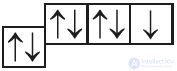
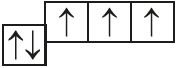 and
and 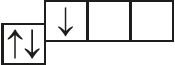 and
and 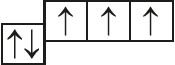
6. Based on the diagram given, explain the mechanism of formation of the covalent bond in the hydronium ion during the interaction of a water molecule and a hydrogen ion:
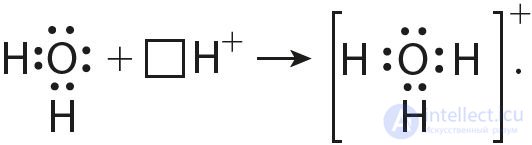
7. Using the electronegativity values of the elements (table 7), give a justification for the type of chemical bond in the substances and particles:  , ,
, ,  ,
,  ,
,  , .
, .
| Chemical formula of the substance or particle | Electronegativity of atoms | Electronegativity difference ∆χ |
Type of chemical bond | |
| χ1 | χ2 | |||
8. Indicate the compounds having both covalent and ionic bonds: НСООН, CH3COONa, MgF2, MgSO4, NH4NO3, HNO3, KNO3, CaSO4, NH3.
9. Calculate the number of electrons participating in the formation of covalent bonds in 3 mol of ammonium ions.
10. When methane is formed from carbon and hydrogen atoms, 1662 kJ/mol of energy is released. Calculate the average bond energy of С—Н (kJ/mol).
1. The correct statements are:
2. Bonds formed by means of shared electron pairs are:
3. An ionic bond exists in the substances:
4. Nitrogen acted as the donor of the electron pair in the compounds:
5. The ions having an electron configuration similar to that of the argon atom are:

Comments