
Lecture
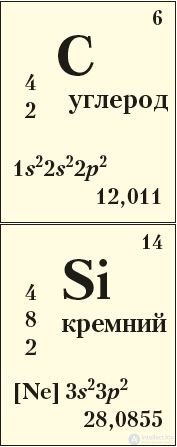
Carbon 6C and silicon 14Si are chemical elements of Group IVA of the periodic table and belong to nonmetals. Besides them, the group also includes germanium 32Ge, tin 50Sn, lead 82Pb, and flerovium 114Fl.
The outer electron shell of the atoms contains 4 electrons, with the general electron configuration ns2np2:
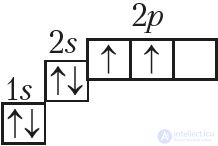
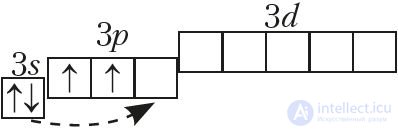
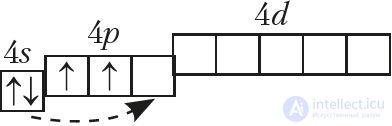
By gaining electrons, carbon and silicon atoms exhibit an oxidation state of ‒4, while by losing electrons they exhibit +2 and +4.
When atoms of carbon form chemical bonds with atoms of other elements, complete transfer or complete gain of four electrons does not occur, that is, predominantly covalent bonds are formed.
Unlike other elements of Group IVA, the number of valence electrons of carbon equals the number of valence orbitals. This is one of the reasons for the high stability of the C—C bond and the tendency of carbon atoms to link with one another into chains:
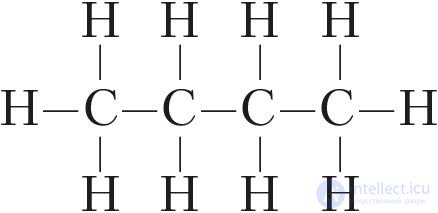 ,
,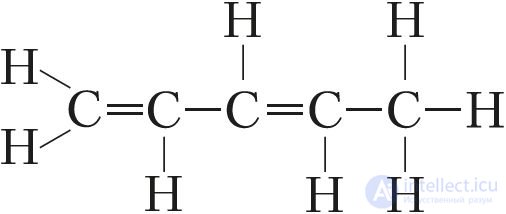 and others.
Abundance in nature. Silicon is the second most abundant element on Earth. Carbon, according to most estimates, ranks 16th. Information about natural compounds is given in Table 30.
Table 30. The chemical elements carbon and silicon
| Element | Atomic radius, nm | χ | Oxidation states | Natural compounds |
| Carbon 6C | 0.077 | 2.5 | –4, 0, +2, +4 | Simple substances — diamond, graphite. Chalk, marble, limestone, shell rock, pearl, calcite (CaCO3); carbon dioxide, natural gas, petroleum, organic substances |
| Silicon 14Si | 0.117 | 1.9 | ‒4, 0, +2, +4 | Silica, quartz, rock crystal (main component SiO2); metal silicates |
Carbon and silicon as simple substances. Carbon as a simple substance exists in the form of several allotropic modifications, the most important of which are diamond, graphite, and fullerenes. Silicon does not form allotropic modifications and exists as a single simple substance with a diamond-like structure.
The crystal lattices of the allotropic modifications of carbon are shown in Figure 38. From the material of § 16, you already know why diamond is the hardest substance and why graphite is electrically conductive and easily delaminates. You also know that fullerenes consist of spherical C60, C80 molecules (see Fig. 38).
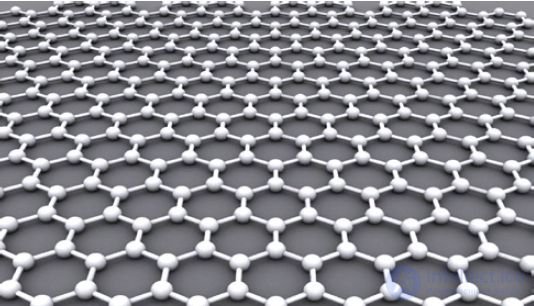
Graphene is an allotropic modification of carbon formed by a layer of carbon atoms one atom thick.
A material with unique properties — high conductivity and strength, hydrophobicity, and special optical properties — has attracted the interest not only of scientists but also of technologists involved in processor manufacturing.
Amorphous forms of carbon — charcoal, activated carbon, and soot — are of great importance and find wide application.
Silicon, unlike diamond, is a semiconductor, which allows it to be widely used in modern microcircuits. It is also used in the production of heat-resistant steels.
Thus, the structural features of substances determine their properties and, accordingly, their fields of application.
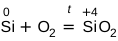
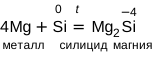
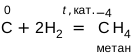
Carbon and silicon, like the vast majority of other nonmetals, exhibit both oxidizing properties (for example, when reacting with metals) and reducing properties (in reactions with oxygen and fluorine, and with certain oxides):
| Chemical properties | Carbon | Silicon |
| Reducing | 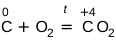 |
 |
 |
 |
|
| Oxidizing | 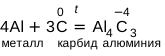 |
 |
 |
Does not react with hydrogen |

Let us also recall that carbon reacts with calcium oxide:
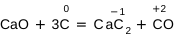 ,
,
and the carbide formed in this reaction is used to produce acetylene (for example, for gas welding):
 .
.
The second important reaction, known to you from the 9th-grade chemistry course, is the interaction of carbon and silicon at high temperatures:
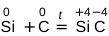 .
.
The product of the reaction — carborundum SiC — has high hardness and thermal stability, owing to which it is widely used as an abrasive and cutting material, as a structural material in the automotive industry, the chemical industry, and nuclear power engineering. Its semiconductor properties enable its use in electronics and electrical engineering, and its optical properties are used in precision optics and jewelry (Fig. 97.1).
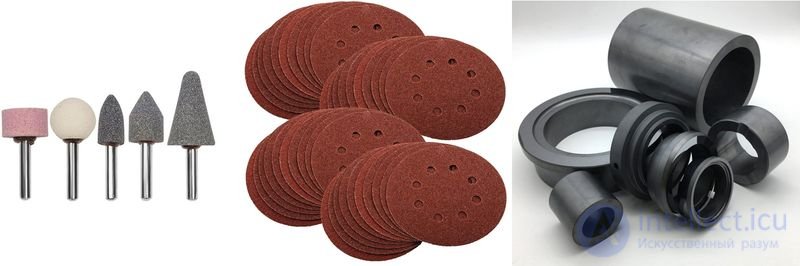
Fig. 97.1.. Tools for abrasive machining and refractory ceramic products made of silicon carbide
On an industrial scale, carborundum is produced at a temperature of 1600−2500 °C, using silicon(IV) oxide and carbon as raw materials:
SiO2 + 3C = SiC + 2CO↑.
Structural features and physical properties. Carbon(IV) oxide, or carbon dioxide  , is the highest oxide of carbon and corresponds to the general formula EO2. Carbon(IV) oxide is a substance of molecular structure. Its molecule contains two double covalent polar bonds, but is linear and therefore nonpolar (Fig. 98, a).
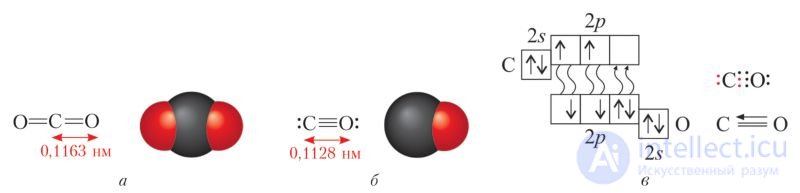
Fig. 98. Structural formula and scale model of the molecules: a — carbon(IV) oxide, b — carbon(II) oxide, c — scheme of bond formation in the CO molecule
Recall that carbon dioxide is colorless, heavier than air (M(CO2) = 44 g/mol), and partially soluble in water. In 1 volume of water at a temperature of 20 °C, 0.88 volumes of CO2 dissolve, but its solubility is 70 times higher than that of oxygen and 150 times higher than that of nitrogen. Under elevated pressure (5 MPa) it easily liquefies and solidifies. Solid carbon(IV) oxide — dry ice — sublimes without melting.
The second oxide of carbon, carbon(II) oxide — carbon monoxide CO — is also a substance of molecular structure. The atoms in the molecule are joined by a very strong triple covalent bond; the bond is polar, and the molecule is polar (Fig. 98, b). The gas is colorless, poorly soluble in water, and toxic.
Chemical properties of carbon(IV) oxide. Carbon dioxide belongs to the acidic oxides, and therefore reacts with water, alkalis, and basic oxides. On the other hand, carbon atoms with an oxidation state of +4 can take part in reactions that proceed with a decrease in oxidation state: carbon dioxide reacts with strong reducing agents. Thus, burning magnesium or calcium continue to burn in an atmosphere of carbon dioxide.
Reactions without a change in oxidation state
1. Reaction with water. When carbon dioxide is passed through water to which litmus has been added, the color changes from violet to red — carbonic acid is formed:
 .
.
2. Reaction with alkali solutions leads to the formation of salts.
As with sulfur dioxide, the composition of the products depends on the molar ratio of the reactants.
|
2 : 1 or excess alkali |
(carbonate, normal salt) |
|
1 : 1 or excess acidic oxide |
(hydrogen carbonate, acid salt) |
The reaction of carbon dioxide with limewater clearly demonstrates the sequence in which salts form as gas is passed through an alkali solution. First, a precipitate of the normal salt forms (a qualitative reaction for CO2, Appendix 3):
Ca(OH)2 + CO2 = CaCO3↓ + H2O.
On further passage of carbon dioxide, the precipitate dissolves owing to the formation of the more soluble acid salt:
CaCO3 + H2O + CO2 = Ca(HCO3)2.
3. With basic oxides carbon dioxide forms salts:
CaO + CO2 = CaCO3.
Reactions with a change in oxidation state are, as noted above, reactions of carbon dioxide with reducing agents:
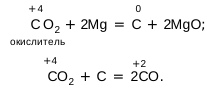
Chemical properties of carbon(II) oxide. Carbon(II) oxide, or carbon monoxide CO, belongs to the non-salt-forming oxides. On the other hand, the carbon atom, having an oxidation state of +2, can either raise or lower it. When its oxidation state is raised, it exhibits reducing properties. Such processes occur during metal smelting:
 ,
,
and during combustion in oxygen:
 .
.
Carbon monoxide does not react with sodium hydroxide solution at room temperature.
With the molten hydroxide it forms sodium formate:
NaOH + CO  HCOONa,
from which formic acid is obtained by the action of sulfuric acid.
The reaction 2CO + O2 = 2CO2 begins at a temperature above 500 °C, but in the presence of manganese(IV) oxide MnO2 as a catalyst it proceeds already at room temperature.
Lowering of the oxidation state occurs in reactions with reducing agents, in which carbon(II) oxide exhibits oxidizing properties. An example of such a transformation is known to you from the organic chemistry course: the reaction of carbon monoxide with hydrogen (a reducing agent) is the most important method for producing methanol:
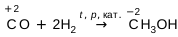 .
.
Both carbon dioxide and carbon monoxide pollute the atmosphere. Recall that carbon(II) oxide is not called carbon monoxide by accident. This oxide is highly toxic. Forming during incomplete combustion of fuel, it can lead to severe poisoning or death. Its lack of odor makes it even more dangerous. Its toxic action is related to the fact that carbon monoxide molecules form a strong compound with hemoglobin molecules in the blood. In this way they block the access of oxygen and shut down cellular respiration.
The main source of CO in the atmosphere is the exhaust gases of internal combustion engines, while the source of CO2 is the fuel and energy sector and the metallurgical industry. The accumulation of carbon dioxide contributes to global warming on Earth (the "greenhouse effect"). Recall that CO2 is absorbed during photosynthesis. Therefore, deforestation reduces the absorption of carbon dioxide by green plants and negatively affects the state of Earth's atmosphere.
Silicon(IV) oxide is a substance of non-molecular structure; in its crystals, each silicon atom is surrounded by four oxygen atoms (Fig. 99). It has fairly high hardness and is widespread in nature (Table 26, Appendix 2).
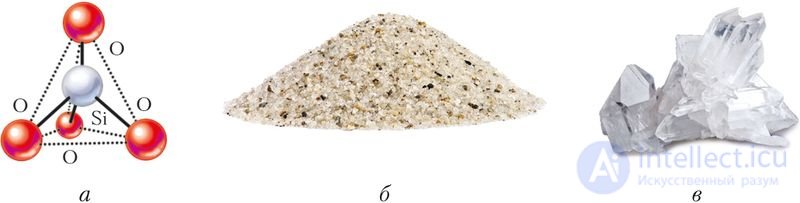
Fig. 99. Silicon(IV) oxide: a — structural unit, b — quartz sand, c — quartz crystals
Chemical properties. As an acidic oxide, silicon(IV) oxide reacts with alkalis and basic oxides:
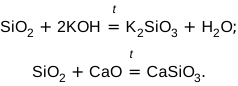
Silicon(IV) oxide does not react with water.
Having the highest oxidation state, silicon in the composition of the oxide can exhibit oxidizing properties. Thus, the process of reducing silicon(IV) with carbon is used to obtain technical-grade silicon in the production of semiconductor materials:
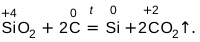
One of the important applications of silicon(IV) oxide is the production of glass by sintering sand SiO2, soda Na2CO3, and limestone CaCO3:

Carbon and silicon are oxidizing agents in reactions with metals, but reducing agents in reactions with oxygen. Carbon(IV) oxide is an acidic oxide and an oxidizing agent. Carbon(II) oxide is a non-salt-forming oxide and exhibits both oxidizing and reducing properties. Silicon(IV) oxide is used in glass manufacturing.
1. Name the allotropic modifications of carbon and their fields of application. Comment, from a chemical point of view, on the following text: "The diversity of its properties is striking: the softest and the superhard, a standard of transparency and of absolute blackness, a thermal insulator and one of the best conductors of heat, an insulator, a conductor, and a semiconductor."
2. Write the electron configuration formula and the electron-graphical scheme of silicon in the ground state and in one of the excited states.
3. For the elements with atomic numbers 6, 14, 32, 50 write the formulas of:
4. Write the equations of the reactions:
5. Why does carbon(IV) oxide not burn in an oxygen atmosphere, while carbon(II) oxide does burn? Calculate the volume of oxygen (at STP) required to burn carbon monoxide with a volume of 15 m3 (at STP).
6. Using the thermochemical equation  , calculate the amount of heat released on burning 1 m3 (at STP) of carbon monoxide.
7. Propose physical and chemical methods for separating a mixture of carbon oxides so that each of them is obtained separately.
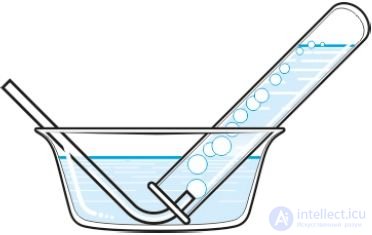
8. A mixture of carbon monoxide and carbon dioxide was passed into a vessel filled with sodium hydroxide solution. Why is a decrease in the size of the gas bubbles observed as they move through the solution? What substance collects in the test tube above the aqueous solution? What substances are present in the solution?
9. Write the equations of the reactions according to the scheme:
 ;
; .
.10. A volume of 0.784 dm3 (at STP) of carbon dioxide was completely absorbed by a solution containing sodium hydroxide in an amount of 0.04 mol. Determine the masses of the salts obtained.
1. The allotropic modifications of carbon are:
2. Regarding silicon, the following statements are true:
3. Carbon monoxide reacts with:
4. Carbon dioxide can be absorbed by passing it through a vessel containing:
5. The acidic properties of carbon dioxide are characterized by the reactions expressed by the equations:
 H2CO3;
 C + 2MgO.




Comments