
Lecture
As you study this chapter, you will become familiar with the basic concepts of the theory of chemical reactions: classification, signs and conditions for their occurrence, heat effect, rate, irreversibility and reversibility of reactions. You will learn about the nature of the dependence of the rate of a chemical reaction on the nature and concentration of the reacting substances, temperature, the surface area of contact between substances, and the presence of a catalyst. You will gain an understanding of the state of equilibrium in reversible reactions and the conditions for shifting it.
The most important concepts of the topic: classification of chemical reactions, the heat effect of a chemical reaction, exothermic and endothermic reactions, the rate of a chemical reaction, chemical equilibrium.
A chemical reaction is the transformation of one or more starting substances (reactants) into other substances (products), in which the nuclei of atoms do not change, while a redistribution of electrons and nuclei takes place, and new chemical substances are formed. Unlike nuclear reactions, chemical reactions do not change the total number of atomic nuclei or the isotopic composition of the chemical elements.
Chemical reactions occur upon mixing or physical contact of the reactants spontaneously, upon heating, with the participation of catalysts (catalysis), under the action of light (photochemical reactions), electric current (electrode processes), ionizing radiation (radiation-chemical reactions), mechanical action (mechanochemical reactions), in low-temperature plasma (plasma-chemical reactions), and so on. The interaction of molecules with one another proceeds along a chain pathway: association — electronic isomerization — dissociation, in which the active particles are radicals, ions, and coordinatively unsaturated compounds. The rate of a chemical reaction is determined by the concentration of active particles and the difference between the bond energies of the bonds being broken and those being formed.
Chemical processes occurring in matter differ both from physical processes and from nuclear transformations. In physical processes, each of the substances involved retains its composition unchanged (although substances may form mixtures), but they may change their external form or state of aggregation.
In chemical processes (chemical reactions), new substances are obtained with properties different from those of the reactants, but atoms of new elements are never formed, since the nuclei remain the same, and all changes occur in the electron shell.
In nuclear reactions, changes occur in the atomic nuclei of all the elements involved, which leads to the formation of atoms of new elements.
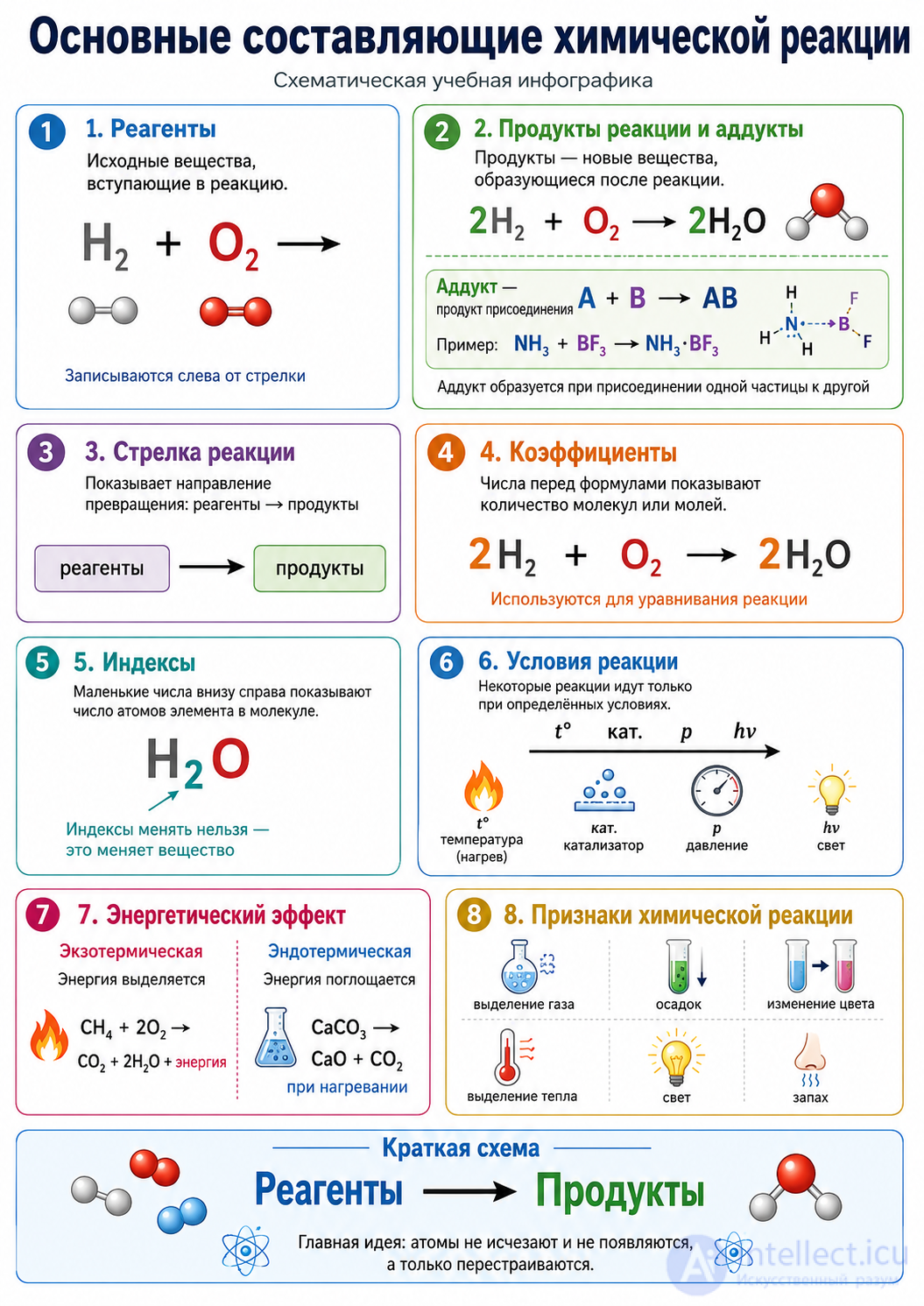
Reactants — The starting substances that enter into interaction. For example, hydrogen and oxygen in the reaction forming water.
Products of a chemical reaction — New substances formed as a result of the reaction. In the example above — water (H₂O).
Adduct of a chemical reaction — this is a special type of product arising from the direct addition of molecules to one another without the elimination of fragments. Adducts are often intermediate or unstable compounds, unlike the stable products of a reaction.
Reaction conditions — Temperature, pressure, presence of a catalyst, light, or electric current. These factors determine the rate and possibility of the reaction proceeding.
Energy effect — Reactions can be exothermic (release heat, for example combustion) and endothermic (absorb heat, for example photosynthesis).
Reaction mechanism — A sequence of stages: breaking of old bonds, formation of new ones, participation of intermediate particles (radicals, ions).
Indices in formulas — these are small numbers at the lower right of an element's symbol showing the number of atoms in a molecule. Example: H₂O The index 2 for hydrogen means that one molecule of water contains 2 atoms of hydrogen.
Coefficients — these are the numbers placed before the formulas of substances. They show how many molecules or moles of a substance participate in the reaction. Coefficients can be changed when balancing a reaction, but indices cannot be changed, because changing an index changes the substance itself.
t° heating,кат. catalyst,p pressurehv light.In the presence of a catalyst, hydrogen peroxide decomposes into water and oxygen.
Chemical transformations can be classified according to a number of criteria.
1. By the number and composition of the starting substances and of the substances formed, reactions of combination, decomposition, substitution, and exchange are distinguished.
A combination reaction is a chemical transformation in which one new substance is formed from two or more substances:
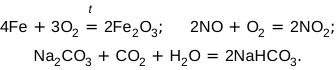
Both simple and complex substances may take part in combination reactions, but the products are only complex substances.
A decomposition reaction is a chemical transformation in which several new substances — either simple or complex — are formed from one complex substance:
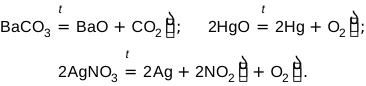
Only complex substances undergo decomposition.
A substitution reaction is a chemical transformation in which the atoms of a simple substance replace the atoms of one of the elements in a complex substance:
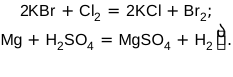
An exchange reaction is a chemical transformation in which two complex substances exchange their constituent parts.
For example:

or in ionic form, known to you from the 9th grade:

2. According to the sign of a change in the oxidation states of atoms in chemical transformations, oxidation-reduction (redox) reactions and reactions without a change in the oxidation state of atoms are distinguished.
Exchange reactions, and some combination and decomposition reactions, proceed without a change in the oxidation state of atoms:
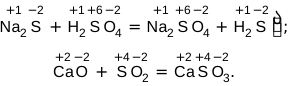
Substitution reactions, and some decomposition and combination reactions, are accompanied by a change in the oxidation states of atoms:
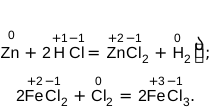
Note that a change in the oxidation states of atoms accompanies almost all reactions involving simple substances.
Oxidation-reduction (redox) reactions take place owing to the transfer of electrons from the atoms of some elements to the atoms of others, as a result of which a change in the oxidation states occurs. Here, the number of electrons given up by the reducing agent is equal to the number of electrons accepted by the oxidizing agent. This equality is called, as you know, the electron balance and is used to place the coefficients in the equations of oxidation-reduction reactions.
Example 1. Place the coefficients in the equation of the industrial reaction for obtaining nitrogen(II) oxide from ammonia:

Solution
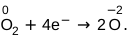
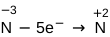
As can be seen from the scheme, the nitrogen atom N raises its oxidation state from –3 to +2, meaning it loses 5 electrons. Each of the two oxygen atoms O lowers its oxidation state from 0 to –2, therefore the diatomic oxygen molecule accepts 4 electrons:
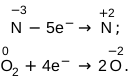
The least common multiple of the numbers 4 and 5 is 20. The coefficients are found by dividing the multiple by the number of electrons. They represent the factors needed to achieve an electron balance of 20 electrons:
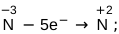 |
5 | 20 | x 4 | reducing agent | is oxidized |
 |
4 | x 5 | oxidizing agent | is reduced |
Let us place the coefficients:

3. According to the sign of the release or absorption of heat, chemical reactions are divided into exothermic and endothermic.
Exothermic reactions are those accompanied by the release of heat into the surrounding environment.
The heat released in a reaction equation is denoted by the symbol Q with a plus sign, thereby indicating that the system transfers its energy to the surroundings. Energy may also be transferred in the form of light radiation or electrical energy. Exothermic reactions are usually used to obtain heat. A typical example is the combustion reaction of methane:

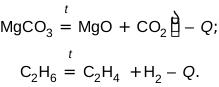
Endothermic reactions are those accompanied by the absorption of heat from the surrounding environment. The heat lost in a reaction equation is denoted by the symbol Q with a minus sign:
4. According to the sign of the completeness of the transformation of the starting substances into the final ones, chemical reactions are divided into irreversible and reversible.
Irreversible chemical reactions are those that proceed under given conditions with the complete conversion of at least one of the starting substances into reaction products.
If the reacting substances are taken in stoichiometric amounts, then all of them will react completely in the case of an irreversible chemical reaction.
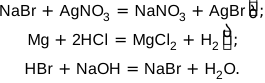
Reactions with an intense release of heat belong to the irreversible ones (for example, combustion:  ), as well as reactions in solutions leading to the formation of poorly soluble (
 ), gaseous (
 ), or weakly dissociating (for example, water) substances:
Reversible chemical reactions are those capable of proceeding under given conditions simultaneously in the forward and reverse directions. In the course of a reversible reaction, the starting substances are not converted completely into products because, at the same time, the starting substances are formed from the products.
In the equations of reversible reactions, the equals sign is replaced by oppositely directed arrows. For example, the reactions for obtaining sulfur(VI) oxide are reversible:

as well as the interaction of nitrogen with oxygen, which becomes noticeable only above 2000 °C and occurs in the atmosphere during lightning discharges.
5. According to the conditions under which they are carried out, reactions are divided into catalytic and non-catalytic.
Catalytic reactions proceed with the participation of catalysts.
Catalysts are substances that accelerate chemical reactions but are not part of the composition of the transformation products.
The catalyst is indicated above the equals sign or the reversibility sign of the reaction, usually together with brief notations of the conditions under which it proceeds (t, p), for example:

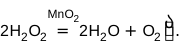
Many reactions proceed at a sufficient rate only in the presence of a catalyst. Thus, it is known that pure hydrogen peroxide is stable and decomposes at 20 °C at a rate of less than 0.5% per year. However, in the presence of a small amount of impurities, for example compounds of copper, iron, manganese, silver, or many organic substances, hydrogen peroxide is unstable even in dilute solutions:
6. According to the presence of a phase boundary, reactions are distinguished as homogeneous and heterogeneous. Chemical reactions proceeding throughout the entire volume of a homogeneous reaction medium (for example, in a mixture of gases, or in a solution of two salts in water) are called homogeneous. For example:

Reactions proceeding at the surface of contact between different substances in a non-uniform medium are heterogeneous. Such a surface is called the phase boundary, understanding a phase as the part of a system that is uniform in composition and properties. For example, in the reaction of copper with concentrated sulfuric acid, whose equation is:

solid copper is separated from the liquid sulfuric acid by a visible boundary — the surface of the piece of copper. Gas bubbles rise from the surface of the copper — SO2. This reaction is heterogeneous. Heterogeneous reactions include the dissolution of metals and their oxides in acids, the combustion of solid substances in oxygen, the interaction between acidic and basic oxides, and others.
As an example of a heterogeneous chemical reaction, one can cite the high-temperature process of obtaining iron from iron oxide Fe2O3:

Heterogeneous chemical reactions proceed at the surface of contact between the reacting substances.
Homogeneous reactions are chemical reactions proceeding in a uniform medium in the absence of a surface of contact between different substances.
In a number of cases, reactions that proceed slowly in solutions or in vapors are accelerated by the introduction of a solid catalyst. Thus, the reaction of ammonia synthesis from nitrogen and hydrogen, which is familiar to you, is accelerated in the presence of iron; V2O5 is used in the reaction of oxidation of SO2 in the synthesis of sulfuric acid. According to the criterion of the presence of a phase boundary, these reactions are classified as heterogeneous, being called reactions of heterogeneous catalysis.
Example 2. Give a characterization of the reaction of the combustion of iron in chlorine, which proceeds with the formation of iron(III) chloride and is accompanied by an intense release of heat and light.
Solution
Let us write the reaction equation and note the oxidation states of the atoms, the state of aggregation of the starting substances, and the heat effect:

Let us indicate that this is a reaction:
Classification of reactions in organic chemistry
In classifying reactions in organic chemistry, the following are distinguished: substitution reactions of an atom or groups of atoms in the molecule of an organic compound; addition reactions of atoms or groups of atoms to the molecule of an organic compound; elimination reactions of atoms from a molecule without the breaking of bonds  ; decomposition as a process of breaking bonds with the formation of simpler substances; isomerization as a process of changing the structure of a molecule while preserving its composition.
The following transformations may serve as examples:
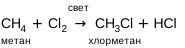
and  (substitution);
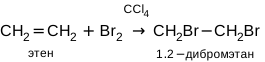 (addition);
 (elimination);
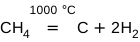 (decomposition);
 (isomerization).
According to the sign of a change in the oxidation states of atoms in the molecule of an organic substance, as in the case of inorganic substances, oxidation reactions are distinguished (involving oxygen, potassium permanganate KMnO4, potassium chromate and dichromate — K2CrO4 and K2Cr2O7, and others) and reduction reactions (involving hydrogen, LiAlH4, and others):
 (oxidation);
 (reduction).
*Example 1.1. Compose the equation of an oxidation-reduction reaction in which the atoms of three elements change their oxidation state, using as an example the interaction of iron(II) sulfide with oxygen according to the scheme:

Solution
Let us find the coefficients in the equation of this oxidation-reduction reaction, for which we will perform the following steps.
1. Let us denote the oxidation states of the atoms of the elements before and after the reaction according to the scheme:

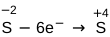
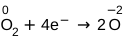
We see that in this reaction the iron atoms are oxidized to an oxidation state of +3, and the sulfur atoms to an oxidation state of +4, as a result of which each formula unit of FeS gives up 7 electrons. Oxygen is the oxidizing agent, and each of its molecules accepts 4 electrons.
2. Let us compose the electron balance scheme. Taking into account that in the formula unit FeS there is one atom each of iron and sulfur, and in the molecule O2 there are two atoms of oxygen, the electron balance scheme has the form:
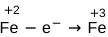 |
1 | 7 | x4 | |
 |
6 | |||
| least common multiple | 28 | |||
 |
4 | x7 |
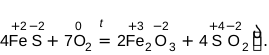
3. Let us place the corresponding coefficients before the formulas of the substances:
Chemical reactions are characterized:
1. Indicate the equations of combination, decomposition, substitution, and exchange reactions:




2. Which of the two reactions given is reversible?

Give an explanation.
3. Indicate whether each of the reactions represented by the equation is homogeneous or heterogeneous:




4. Compose the equations of the reactions:
5. Complete the transformation schemes following the model:
 (oxidation).

6. Place the coefficients using the electron balance method:

7. Characterize the chemical reactions represented by the equations according to the six classification criteria studied:



8. Prove that a neutralization reaction is not an oxidation-reduction reaction.
9. Give a complete characterization of the reaction between simple substances whose atoms have the electron configurations [Ne]3s1 and [He]2s22p5.
10. Calculate the amount (mol) of substance and the number of electrons that will pass from the reducing agent to the oxidizing agent upon the complete dissolution of 2.7 g of aluminum in sulfuric acid.
*Prepare a report on "Oxidation-reduction processes in nature, technology, and everyday life."
1. When a chemical reaction proceeds, the following necessarily occurs:
2. Substitution reactions include:
3. Heterogeneous reactions include:
4. Oxidation-reduction reactions include:
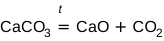 ;
; .
.5. The reaction  , proceeding in the presence of the catalyst V2O5, is:
With the help of chemical reactions, it is possible to obtain practically any substances that occur in nature in limited quantities, for example nitrogen fertilizers, or that do not occur at all for various reasons, for example sulfonamides and other synthetic medicinal drugs, polyethylene and other plastics. Chemistry makes it possible to synthesize new substances, unknown in nature, that are needed for human life activity.
In industry, adducts are used for the separation of mixtures (for example, the dewaxing of petroleum).

Comments