
Lecture
Reagents: solutions of sodium hydroxide, hydrochloric acid, an aluminum salt AlCl3 or Al2(SO4)3.
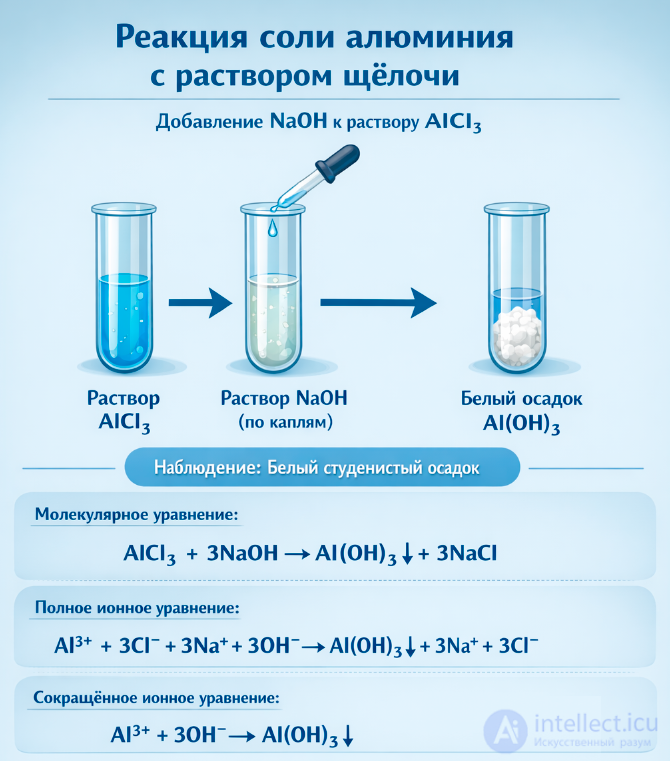
1. Preparation of aluminum hydroxide. Add an alkali solution dropwise to an aluminum salt solution (2 cm3) until a precipitate forms.
2. Studying the amphoteric properties of aluminum hydroxide. Divide the precipitate obtained in the previous experiment into two parts. To one test tube add an acid solution, and to the other an alkali solution, until the precipitates dissolve.
Draw conclusions about the method of preparing aluminum hydroxide and its properties based on the experiment performed. Write the reaction equations in molecular and ionic form.
An alkali solution (NaOH) is added dropwise to an aluminum salt solution (for example, AlCl₃), forming a white gelatinous precipitate of aluminum hydroxide:
Divide the precipitate obtained into two parts.
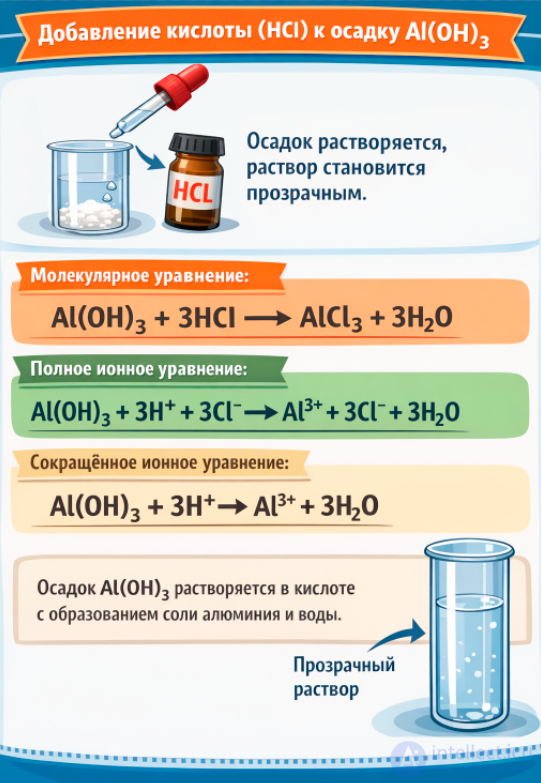
a) Action of acid (HCl):
Aluminum hydroxide dissolves in the acid, forming a salt:
Molecular equation:
Full ionic equation:
Net ionic equation:
b) Action of excess alkali (NaOH):
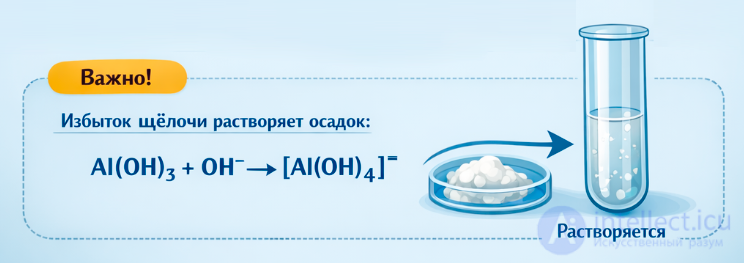
If an excess of alkali continues to be added, the precipitate dissolves, since aluminum hydroxide exhibits amphoteric properties:
The aluminum hydroxide precipitate dissolves in excess alkali, forming a complex anion:
Molecular equation:
Al(OH)3+NaOH→Na[Al(OH)4]
Ionic equation:
Aluminum hydroxide is formed when alkali is added to an aluminum salt solution.
It exhibits amphoteric properties, i.e. it can react both with acids and with bases:
In acid — it dissolves, forming a salt.
In excess alkali — it dissolves, forming a complex compound.

Comments