I. Studying the properties of acids
1. Determine the pH of the given hydrochloric acid solution.
2. Investigate which of the proposed substances hydrochloric acid will react with: magnesium, copper, potassium hydroxide, sodium carbonate, sodium sulfate.
Recall that when carrying out a neutralization reaction, an indicator (phenolphthalein or another) can first be added to the alkali, followed by the acid.
Note the qualitative signs of the reactions taking place.
Draw conclusions about the properties of acids using hydrochloric acid as an example.
II. Studying the properties of alkalis
1. Determine the pH of the given sodium hydroxide solution.
2. Investigate how sodium hydroxide behaves toward acids and salts, for example sulfuric acid and iron(III) chloride.
Note the qualitative signs of the reactions taking place.
Draw conclusions about the properties of alkalis using sodium hydroxide as an example.
III. Studying the properties of salts
Precipitate the metal cation and the acid-residue anion contained in a solution of iron(II) sulfate.
Draw a conclusion about the properties of salts using iron(II) sulfate as an example.
In the report on the work performed, present all reaction equations in molecular, full ionic, and net ionic forms.
I. Studying the properties of acids
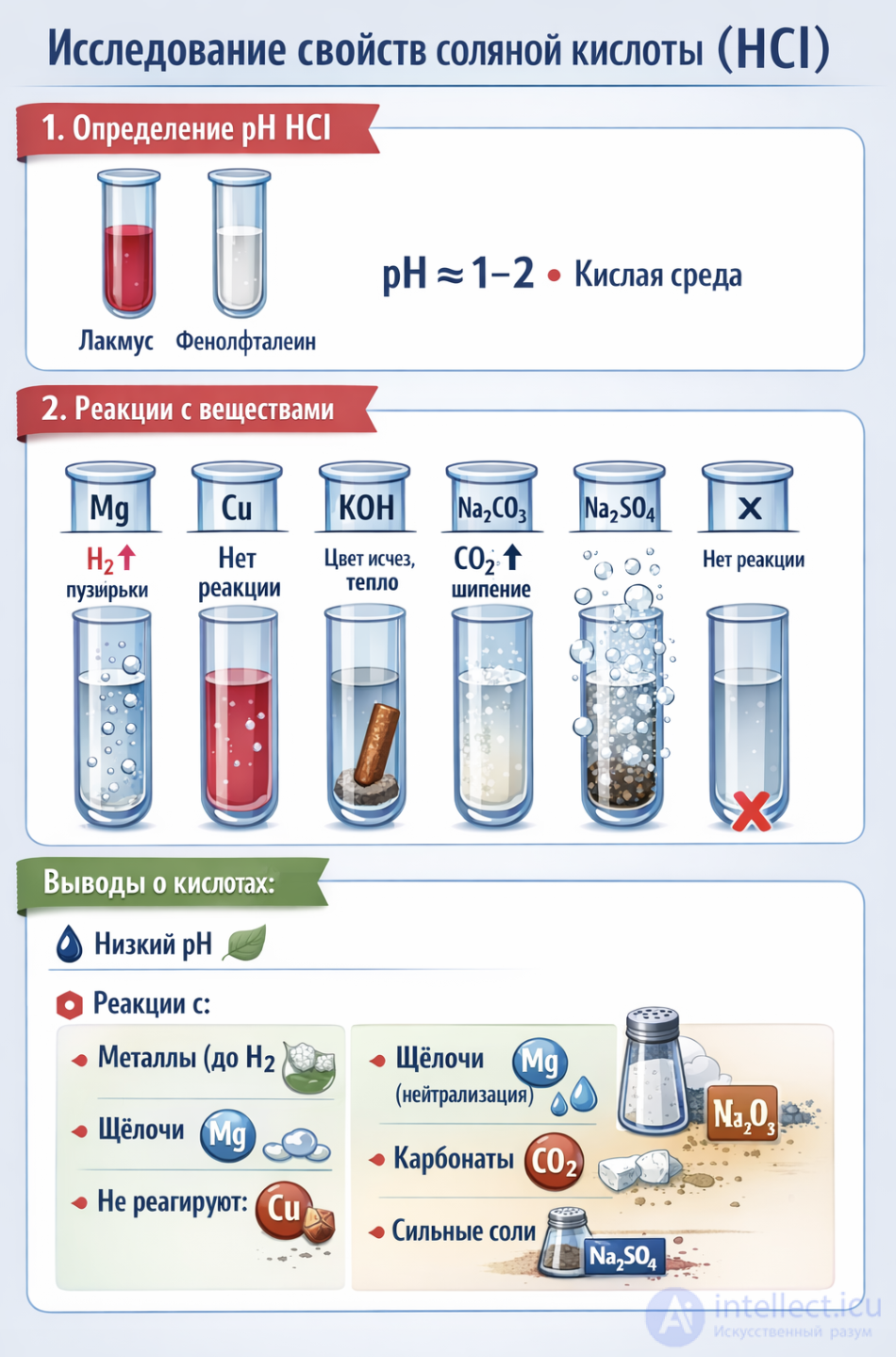
1. Determination of the pH of hydrochloric acid
- Hydrochloric acid solution — a strong acid
- Solution pH: ≈ 1–2
Sign:
- Indicator (litmus) → red
- phenolphthalein → colorless
2. Reactions of hydrochloric acid
Testing substances:
1. Magnesium (Mg) reacts
Equation:
Signs:
- gas (H₂) is evolved
- bubbles
- the metal dissolves
2. Copper (Cu) does not react
Reason:
- copper stands after hydrogen in the activity series
Signs:
3. Potassium hydroxide (KOH) reacts (neutralization)
Equation:
Signs:
- the crimson color of phenolphthalein disappears
- heat is released
4. Sodium carbonate (Na₂CO₃) reacts
Equation:
Signs:
- gas (CO₂) is evolved
- fizzing
5. Sodium sulfate (Na₂SO₄) does not react
Reason:
- a salt of a strong acid and a strong base
Signs:
Summary (schematic)
| Substance |
Reaction |
Sign |
| Mg |
+ |
gas H₂ |
| Cu |
- |
no reaction |
| KOH |
+ |
color disappears |
| Na₂CO₃ |
+ |
CO₂, fizzing |
| Na₂SO₄ |
- |
no reaction |
Conclusion
Using hydrochloric acid as an example:
Acids:
- have a low pH
- react with:
- metals (up to H₂ in the activity series)
- alkalis (neutralization)
- carbonates (with evolution of CO₂)
- do not react with:
- low-activity metals (Cu)
- certain salts
II. Studying the properties of alkalis
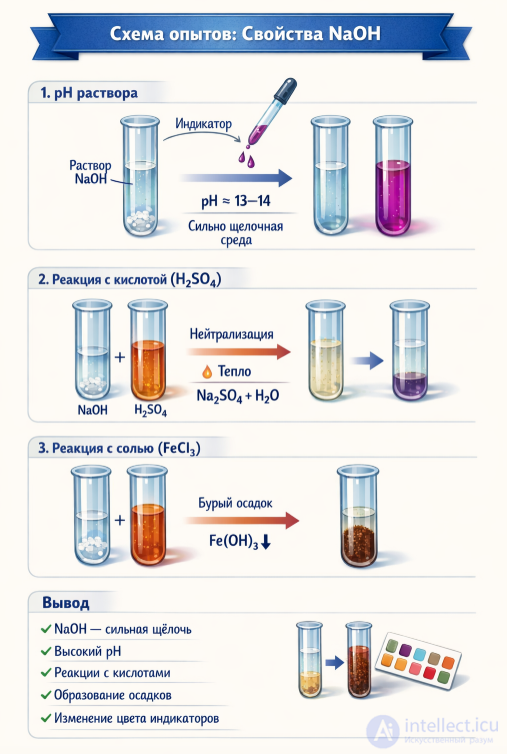
1. Determination of the pH of a sodium hydroxide solution
Sodium hydroxide (NaOH) is a strong alkali.
- Solution pH: ≈ 13–14
- Indicators:
- litmus → blue
- phenolphthalein → crimson
- universal indicator → dark blue/purple
Conclusion: the medium is strongly alkaline
2. Interaction of NaOH with substances
a) With an acid (sulfuric acid H₂SO₄)
Molecular equation:
Full ionic:
Net ionic:
Signs of the reaction:
- heat is released
- the indicator changes color (neutralization)
b) With a salt (iron(III) chloride FeCl₃)
Molecular equation:
Full ionic:
Net ionic:
Signs of the reaction:
- a brown precipitate of iron(III) hydroxide forms
Conclusion
Alkalis (using NaOH as an example):
- have a high pH (an alkaline medium)
- react with acids (neutralization reaction)
- react with salts, forming insoluble hydroxides (precipitates)
- change the color of indicators
Sodium hydroxide is a typical strong alkali, displaying all the characteristic chemical properties of alkalis.
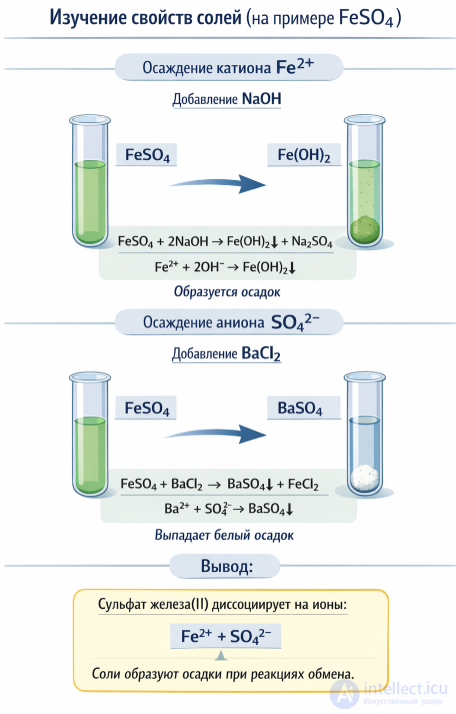
Studying the properties of salts (using FeSO₄ as an example)
1. Precipitation of the metal cation (Fe²⁺)
Add an alkali solution (for example, NaOH).
Observation:
A light green precipitate of iron(II) hydroxide forms, which turns brown over time in air.
Molecular equation:
FeSO₄ + 2NaOH → Fe(OH)₂↓ + Na₂SO₄
Full ionic equation:
Fe²⁺ + SO₄²⁻ + 2Na⁺ + 2OH⁻ → Fe(OH)₂↓ + 2Na⁺ + SO₄²⁻
Net ionic equation:
Fe²⁺ + 2OH⁻ → Fe(OH)₂↓
2. Precipitation of the acid-residue anion (SO₄²⁻)
Add a barium salt solution (for example, BaCl₂).
Observation:
A white precipitate of barium sulfate forms.
Molecular equation:
FeSO₄ + BaCl₂ → BaSO₄↓ + FeCl₂
Full ionic equation:
Fe²⁺ + SO₄²⁻ + Ba²⁺ + 2Cl⁻ → BaSO₄↓ + Fe²⁺ + 2Cl⁻
Net ionic equation:
Ba²⁺ + SO₄²⁻ → BaSO₄↓
Conclusion
Iron(II) sulfate displays the typical properties of salts:
- in solution it dissociates into ions (Fe²⁺ and SO₄²⁻);
- it undergoes exchange reactions;
- it can form precipitates:
- by cation (Fe²⁺ → Fe(OH)₂↓),
- by anion (SO₄²⁻ → BaSO₄↓).
Salts are electrolytes that break down into ions in aqueous solutions and undergo ion exchange reactions with the formation of precipitates, gases, or weak electrolytes.


Comments