
Lecture
In the course of painstaking work systematizing the properties of simple and complex substances, D. I. Mendeleev, a professor at St. Petersburg University, discovered a periodic dependence of the composition of the higher oxides and hydrogen compounds of chemical elements on their atomic mass. By arranging the symbols of the chemical elements in order of increasing atomic mass and grouping together elements with the same formula of the higher oxide, D. I. Mendeleev created, in 1869, a table that he called periodic. It turned out that elements grouped together on the basis of common valence have similar chemical properties. Based on the established regularity, he formulated a law that came to be called the periodic law.
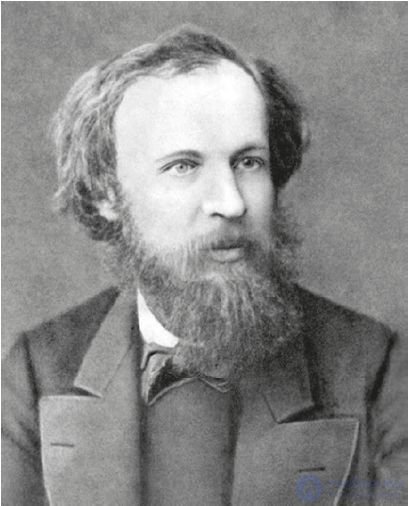
Unlike physical laws, which are usually expressed as formulas, the periodic law was represented by D. I. Mendeleev in the form of the periodic system of chemical elements.
In 1913 it was established experimentally that a chemical element is a type of atom with a definite positive nuclear charge, the value of which corresponds to the atomic number of the chemical element in the periodic system. After this, the periodic law received a new formulation:
the properties of the atoms of chemical elements, as well as the composition and properties of the substances they form, are in periodic dependence on the charge of the atomic nuclei.
Thus, the atomic number of a chemical element acquired physical meaning. As you already know, if the charge of an electron is taken as the unit of charge measurement, then the relative charge of the nucleus of any atom is numerically equal to the atomic number Z of the corresponding chemical element.
The next stage in the development of the theory of the periodic system was elucidating the cause of the periodic dependence of the properties of chemical elements on the charge of the atomic nuclei, and substantiating the intervals of periodicity.
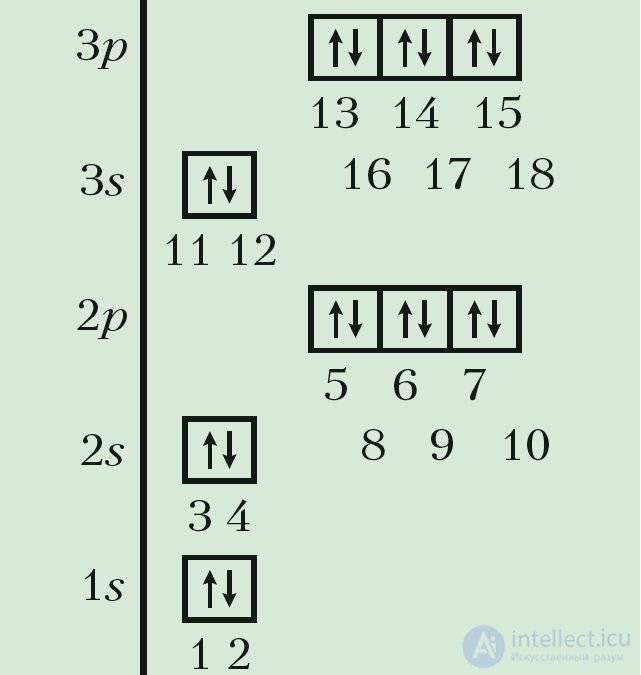
Fig. 20.
Sequence
of filling
atomic orbitals
with electrons
To clarify these causes, let us trace how, as the charge of the atomic nuclei increases, the states of the electrons in the atoms of the chemical elements change. For each element we will write the formula of the electron configuration and construct an electron-graphical diagram in accordance with Figure 20.
In deciding the order in which electrons fill atomic orbitals, we will be guided by the following rules.
1. Electrons in an atom first fill the vacant atomic orbitals with the lowest energy. The energy of atomic orbitals increases in the following sequence:
1s < 2s <2p < 3s < 3p < 4s < 3d < 4p…
2. No more than two electrons can occupy a single atomic orbital, and they must have antiparallel spins.
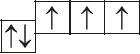
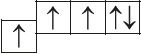
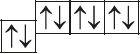
3. The number of unpaired electrons at a given energy sublevel must be maximal.
The state of an atom in which the atomic orbitals are filled with electrons in the indicated sequence is the ground state, that is, the state with the lowest energy. All other states are excited.
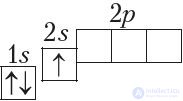
So, in the hydrogen atom, with a relative nuclear charge of Z = 1, the single electron must occupy the atomic orbital lowest in energy, 1s. In the atom of the next element, both electrons populate the same 1s orbital, but they must have opposite spins:


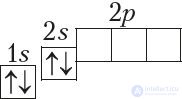
Since the first energy level contains only one atomic orbital, which cannot hold more than two electrons, the third and fourth electrons in atoms with Z = 3 and Z = 4 occupy the next orbital in energy, the 2s orbital. The atoms of these elements begin the second period:
In the atoms of the following elements, electrons fill the 2p sublevel: first one electron in each of the three p orbitals; then, starting with the oxygen atom (Z = 6), each p orbital is filled with a second electron:
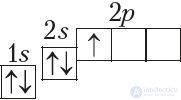
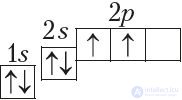
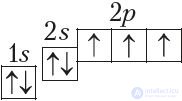
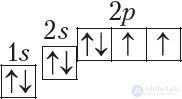
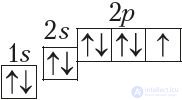
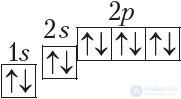
Since the second energy level cannot contain more than 8 electrons, the element with a relative nuclear charge of +11 (Z = 11) begins the third period:
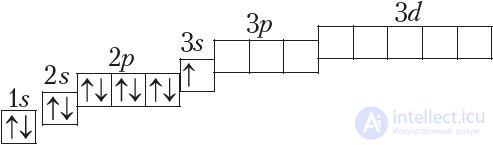
The sequence in which electrons fill atomic orbitals at the third energy level is analogous to that observed for the second level (Appendix 1). The electronic state of the last element of the third period, argon (Z = 18), is described as follows:
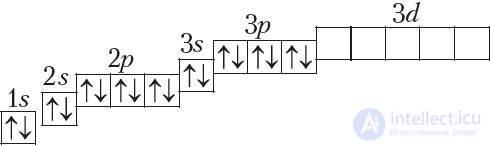
At the same time, unlike the atoms of the preceding noble gases He and Ne, the Ar atom does not complete the filling of the third energy level with electrons. It still has vacant 3d orbitals. Since the outer electron shell cannot contain more than 8 electrons, the element following argon (Z = 19) begins a new, fourth period.
For brevity of notation, in the formulas of electron configurations we will replace the filled electron shells with the symbol of the noble gas whose atom has the same electron configuration. Thus, the notation 1s2 can be replaced with [He], 1s22s22p6 — with [Ne], 1s22s22p63s23p6 — with [Ar], and so on. For example, the formula of the electron configuration of the lithium atom can be written as [He]2s1, and that of chlorine as [Ne]3s23p5.
Here we will stop considering the electron configurations of the atoms of chemical elements.
Comparing the formulas of the electron configurations of atoms with the position of the corresponding chemical elements in the periodic system, we can note the following regularities.
First, the beginning of each period coincides with the beginning of the filling of a new energy level in the atom. The value of the number of this level (n) equals the period number. This is the physical meaning of the period number.
Second, the number of electrons on the outer electron shell of an atom of an A-group equals the group number in which the corresponding chemical element is located. This is the physical meaning of the group number. The maximum number of electrons on the outer electron shell of atoms does not exceed eight (Table 6).
Table 6. Electron configuration of atoms of chemical elements of the A-groups
| Comparison parameters | Groups | |||||||
| IA | IIA | IIIA | IVA | VA | VIA | VIIA | VIIIA | |
| Outer shell | ns1 | ns2 | ns2np1 | ns2np2 | ns2np3 | ns2np4 | ns2np5 | ns2np6 |
| Number of e– on the outer shell | 1 | 2 | 3 | 4 | 5 | 6 | 7 | 8 |
| Higher oxide | R2O | RO | R2O3 | RO2 | R2O5 | RO3 | R2O7 | — |
| Hydrogen compound | RH | RH2 | RH3 | RH4 | RH3 | RH2 | RH | — |
The third regularity follows from an analysis of the following logical scheme, which we will construct using the knowledge gained in grades 8–10.

The fourth regularity is revealed by the following logical scheme.
The comparison conducted allows us to conclude: the properties of chemical elements change periodically because the electron configuration of the outer electron shell of their atoms changes periodically.
*Electron configurations of the atoms of the elements of the fourth period
According to the scheme of the distribution of atomic orbitals by energy shown in Figure 18, the energy of the 3d orbitals is higher than that of the 4s orbitals, so in the potassium atom the last electron occupies the lower-energy 4s orbital, forming the electron configuration 1s22s22p63s23p64s1. The same happens with the last two electrons of the calcium atom. This forms the electron configuration 1s22s22p63s23p64s2.
In the atoms of the elements following calcium in the 4th period, it is energetically more favorable for electrons to fill not the 4p sublevel, but the 3d sublevel.
The principle of filling the 3d orbitals with electrons is the same as for the s and p orbitals: as electrons accumulate, they fill the 3d orbitals in turn, first one electron each, and after all orbitals are filled, a second electron each. Thus, the electron configuration of the iron atom, with six electrons at the 3d sublevel, is described by the formula 1s22s22p63s23p63d64s2.
The order of filling of the atomic orbitals with electrons is violated in the atoms of chromium and copper. For them, states with a single electron in the 4s orbital are energetically more stable: Cr — 1s22s22p63s23p63d54s1, Cu — 1s22s22p63s23p63d104s1.
The electrons in the zinc atom complete the filling of the 3d sublevel, and in the next element, gallium, the 4p sublevel, next in order of increasing energy, begins to fill. The filling of this sublevel is completed at the atom of the noble gas krypton. The formula of the electron configuration of Kr is 1s22s22p63s23p63d104s24p6.
Since in the atoms from scandium to zinc the electrons successively fill the 3d sublevel, they are called d-elements. Since there are five d orbitals, the 4th and each subsequent period contains ten d-elements. The formulas of the electron configurations for the d-elements of the 4th period are given in Table 5.1.
Table 5.1. Electron configurations of the atoms of the elements of the 4th period
| Electron diagram | Formula of the electron configuration |
| 19K 2e–, 8e–, 8e–, 1e– | 19K 1s22s22p63s23p64s1 |
| 20Са 2e–, 8e–, 8e–, 2e– | 20Са 1s22s22p63s23p64s2 |
| 21Sc 2e–, 8e–, 9e–, 2e– | 21Sc 1s22s22p63s23p63d14s2 |
| 22Тi 2e–, 8e–, 10e–, 2e– | 22Тi 1s22s22p63s23p63d24s2 |
| 23V 2e–, 8e–, 11e–, 2e– | 23V 1s22s22p63s23p63d34s2 |
| 24Cr 2e–, 8e–, 13e–, 1e– | 24Cr 1s22s22p63s23p63d54s1 |
| 25Mn 2e–, 8e–, 13e–, 2e– | 25Mn 1s22s22p63s23p63d54s2 |
| 26Fe 2e–, 8e–, 14e–, 2e– | 26Fe 1s22s22p63s23p63d64s2 |
| 27Co 2e–, 8e–, 15e–, 2e– | 27Co 1s22s22p63s23p63d74s2 |
| 28Ni 2e–, 8e–, 16e–, 2e– | 28Ni 1s22s22p63s23p63d84s2 |
| 29Cu 2e–, 8e–, 18e–, 1e– | 29Cu 1s22s22p63s23p63d104s1 |
| 30Zn 2e–, 8e–, 18e–, 2e– | 30Zn 1s22s22p63s23p63d104s2 |
| 31Ga 2e–, 8e–, 18e–, 3e– | 31Ga 1s22s22p63s23p63d104s24р1 |
| 32Ge 2e–, 8e–, 18e–, 4e– | 32Ge 1s22s22p63s23p63d104s24р2 |
| 33As 2e–, 8e–, 18e–, 5e– | 33As 1s22s22p63s23p63d104s24р3 |
| 34Se 2e–, 8e–, 18e–, 6e– | 34Se 1s22s22p63s23p63d104s24р4 |
| 35Br 2e–, 8e–, 18e–, 7e– | 35Br 1s22s22p63s23p63d104s24р5 |
| 36Kr 2e–, 8e–, 18e–, 8e– | 36Kr 1s22s22p63s23p63d104s24р6 |

The order in which the 3d and 4s orbitals are arranged in atoms has been established experimentally. Based on this data, when electrons are removed from an atom, the ns2 electrons are removed before the (n–1)d electrons, which results in the usual oxidation state of +2 for d-elements. It follows from this that the ns electron layer is outer relative to the (n–1)d electron layer.
*The structure of the periodic system of chemical elements from the standpoint of atomic structure
The main structural components of the periodic system of chemical elements are the group and the period. A group is a vertical row of elements arranged in order of increasing charge of the nucleus of their atoms, united by a common feature — the same type of electron configuration of the outer electron shell.
The elements of groups IA and IIA belong to the s-elements, since their outer-shell electrons are located at the s sublevel. The elements of groups IIIA–VIIIA belong, respectively, to the p-elements. The elements located in the periodic system between the s- and p-elements in the 4th–8th periods are called d- and f-elements. In them, electrons fill the d and f sublevels of the penultimate electron shell. Such elements belong to the B-groups.
Periods are horizontal rows in the periodic system in which the chemical elements are arranged in order of increasing charge of the atomic nucleus and the number of electrons in the outer energy level. In the atoms of the elements of the 2nd and 3rd periods, the s orbitals, and then the p orbitals, are gradually filled with electrons.
Each period begins with s-elements (alkali metals), in whose atoms electrons begin to fill a new energy level. The last element in each period is a noble gas, whose atoms have a completely filled p sublevel.
Thus, the development of the theory of atomic structure made it possible to give a physical justification of the periodic law and of the structure of the periodic system of chemical elements. Today the periodic system can be regarded as a natural classification of chemical elements according to the electronic structure of their atoms.
*The position of d- and f-elements in the periodic system
d- and f-Elements belong to the elements of the B-groups. Since these elements are located in the periodic system between the s- and p-elements in the 4th–8th periods, they are called transition elements.
The 4th period (K — Kr) contains 18 elements. Because of the larger number of elements in this period compared with the first three periods, D. I. Mendeleev called the 4th and subsequent periods long periods.
The fifth period (Rb — Xe) is constructed similarly to the 4th: it also contains ten transition d-elements (Y — Cd).
The sixth period (Cs — Rn) contains 32 elements. In addition to ten d-elements (Lu — Hg), it includes 14 f-elements. The elements from lanthanum (La) to ytterbium (Yb) are placed as a separate row at the bottom of the table, which is called the "lanthanides" after its first element, lanthanum. The lanthanides are similar in chemical properties. This is explained by the fact that their inner 4f orbitals are being filled with electrons, while the valence electron shell has a similar electron configuration — most often 5d16s2. In compounds the lanthanides predominantly exhibit an oxidation state of +3.
The seventh period also contains 32 elements — from francium (Fr) to oganesson (Og). The period begins with s-elements (Fr and Ra), followed by 14 actinides (Ac — No). These elements are also placed in a separate row at the bottom of the table because of the similarity of their properties, although this similarity is less pronounced than for the lanthanides. Then follow ten 6d-elements and six 6p-elements. All the elements of this period are radioactive, and most of them have been obtained artificially.
In the periodic system, elements are divided into groups. Two groups, IA and IIA, are filled by s-elements. Next come ten B-groups, filled by d-elements. Six A-groups containing p-elements complete the table.

Could even more chemical elements be discovered than are known now? After all, the most recently known elements were discovered quite recently.
The theory of nuclear physics answers this question. At present, the existence of chemical elements with atomic numbers up to 126 can be predicted with confidence. At the same time, there are scientific concepts that suggest the artificial production of chemical elements with atomic numbers up to 173, with an "island of stability" in the region of element 164.
The periodic law has no mathematical expression of the kind customary for physical laws. All attempts to derive a mathematical formula for the periodic law, made repeatedly, have proved unsuccessful. This is a peculiarity of the properties of chemical elements and their compounds. Their inherent properties do not fit into simple mathematical expressions.
A distinctive graphical form expressing the periodic law became the periodic system, which D. I. Mendeleev presented in the form of a table. At the proposal of IUPAC, it is officially called the "Periodic Table of the Elements," while among us it is often called, in short, the "Mendeleev Table."
The table of the periodic system is an illustration of the regular arrangement of chemical elements relative to one another in the periodic system.
Mendeleev considered it more acceptable to present the periodic system in a short-period form, which in its modern version is shown in Figure 20.1. In it, the groups of elements are subdivided into subgroups — main and secondary. In the main subgroups are placed the s- and p-elements, and in the secondary subgroups, the d-elements.
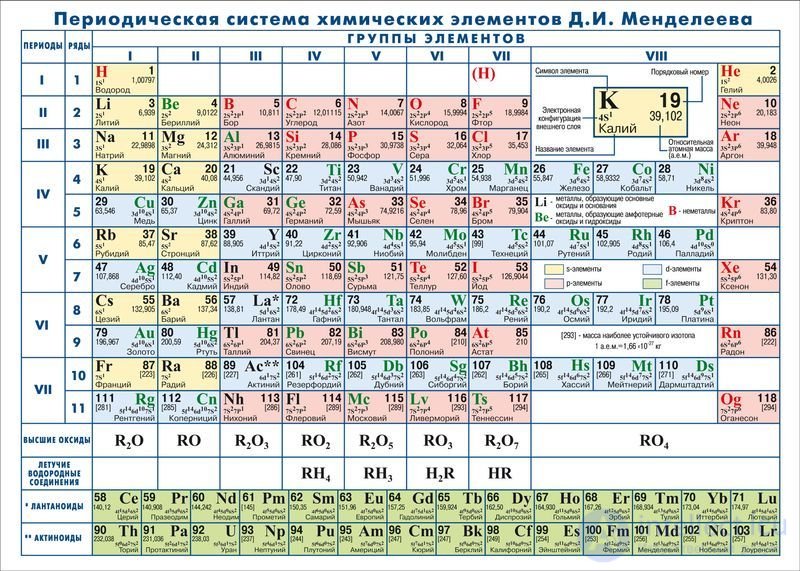
Fig. 20.1. Modern version of the short-period periodic system of chemical elements
Later, IUPAC proposed using a medium-long-period version of the table, in which the main and secondary subgroups were converted into separate A- and B-groups: the main subgroups into A-groups, the secondary subgroups into B-groups. There turned out to be 18 such groups. This table is shown on the inside cover of the textbook.
There is a version of the long-period table in which the f-elements are built into a row with the d-elements (Fig. 20.2). There are also other versions for depicting the periodic system, of which there are about 500.
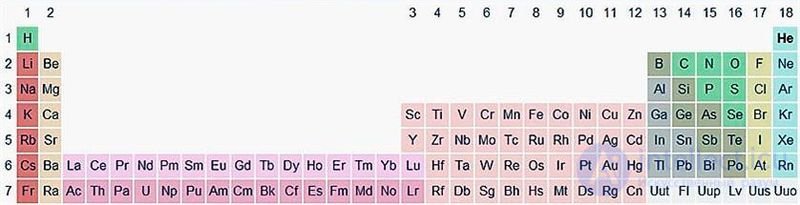
Fig. 20.2. Long-period form of the periodic system of chemical elements
The properties of the atoms of chemical elements, as well as the composition and properties of the simple substances and compounds they form, are in periodic dependence on the charge of the atomic nuclei.
The atomic number of a chemical element equals the number of protons in the nucleus of an atom of that element.
The number of an A-group corresponds to the number of electrons on the outer electron shell of the atoms of the chemical elements of that group. Elements located in the same group of the periodic system have the same electron configuration of the outer electron shell.
The period number coincides with the number of energy levels on which electrons are located in the atoms of all the elements of that period.
Questions, assignments, problems
1. Using nitrogen as an example, explain the physical meaning of the atomic number of a chemical element, the A-group number, and the period number.
2. Why are the elements of groups IA and IIA called s-elements, and the elements of groups IIIA–VIIIA called p-elements?
3. Construct electron-graphical diagrams and write the electron formulas of the atoms of the chemical elements of the 3rd period.
4. Why do the properties of chemical elements and their compounds obey the periodic law? Justify your answer.
5. Why do elements of the same group show similarity in properties? What is the reason for the difference in the properties of chemical elements located in the same group?
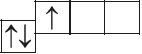
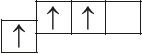
6. From an analysis of the electron-graphical diagrams given, indicate which states of the atom are ground states and which are excited:
7. Determine the number of energy levels on which electrons are located in the ground state of the atoms of oxygen, magnesium, calcium, and lead.
8. Indicate:
9. Determine the mass of the salt obtained by dissolving in an acid of composition НЭ a metal Ме with a mass of 5 g. It is known that the element making up the acid has the electron configuration [Ne]3s23p5, and the electron diagram of the metal is 2е–, 8е–, 2е–.
10. Construct the electron-graphical diagram of the atom of chemical element Э, whose compounds are widely used in agriculture. One of them has the composition (ЭН2)2СО, and the mass fraction of the element in it is 46.67%.
1. In periodic dependence on the charge of the atomic nuclei is:
2. The magnesium atom corresponds to the electron configuration formulas:
3. The general formula of the electron configuration of the elements of group IIIA:
4. The electron configuration formulas of the noble gases:
5. Two unpaired electrons in the outer electron shell in the ground state are found in the atoms of:

Comments