
Lecture
While studying the structure of molecules of organic substances, you learned that all molecules have a definite spatial structure. This is a consequence of the directionality of covalent bonds. Covalent bonds are arranged in space in the direction of maximum overlap of electron clouds. The angle between bonds — the valence angle — depends on the number of atomic orbitals of a given atom taking part in the formation of σ-bonds.
To explain and predict the spatial structure of molecules of both organic and inorganic substances, as well as complex ions (for example,  ,
,  ), the concept of hybridization of atomic orbitals is used.
The term hybrid is familiar to you from biology and means an organism obtained as a result of crossbreeding. By analogy with this, the theory of chemical bonding introduces the concept of a hybrid orbital. It is regarded as the result of a kind of "crossing" of atomic orbitals that differ in shape but are close in energy.
The theoretical concepts of atomic orbital hybridization are built on the following principles.
1. When covalent σ-bonds are formed, the initial valence s- and p-orbitals acquire the same shape and energy, turning into hybrid orbitals.
Hybridization is the redistribution of the electron density of the orbitals of a free atom during the formation of a molecule, with the formation of hybrid orbitals.
2. Hybrid orbitals resemble one another and differ from the original s- and p-orbitals in their energy and the shape of the electron cloud. As a result of hybridization, the energy of the hybrid atomic orbitals is equalized. Hybrid orbitals are more elongated in space toward neighboring atoms. This ensures their more complete overlap with the atomic orbitals of neighboring atoms and, accordingly, stronger bonds with them.
3. Atomic orbitals that differ in shape but are close in energy take part in hybridization. This means that, for example, a 2s-orbital can take part in hybridization together with a 2p-orbital, but not a 1s-orbital together with a 2p-orbital.
4. The number of hybrid orbitals formed equals the total number of original orbitals taking part in the hybridization.
5. Hybrid orbitals take part only in the formation of σ-bonds.
6. π-Bonds are formed by the lateral overlap of non-hybridized orbitals.
7. Hybrid orbitals are arranged in space at the maximum distance from one another.
8. Not only orbitals that form σ-bonds take part in hybridization, but also s- and р-orbitals bearing a lone pair of electrons of the same energy level. Hybrid orbitals bearing a lone pair of electrons occupy a larger volume than a bonding pair of electrons between two atoms. For this reason, lone pairs possess the greatest repulsive force, which leads to a decrease in the valence angle between orbitals with bonding electrons.
Several types of hybridization are distinguished. Each of them corresponds to a specific orientation of the hybrid orbitals in space (table 12.1).
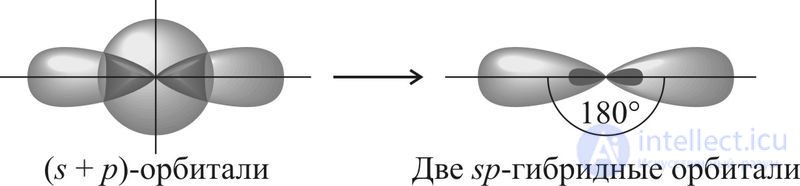
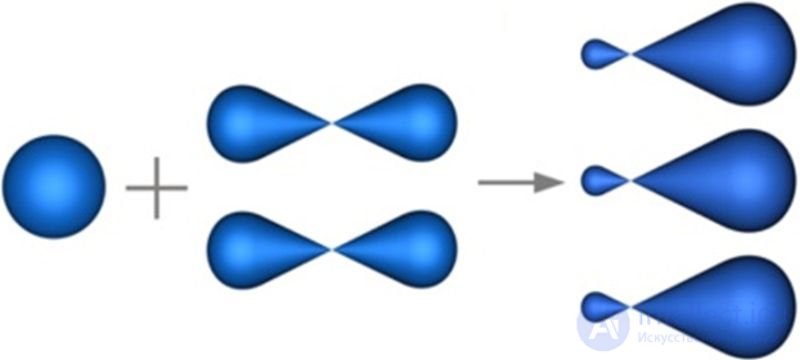
Thus, if an atom forms two σ-bonds by means of one of its s- and one of its p-orbitals, then two sp-hybrid orbitals are formed, which are oriented toward each other at an angle of 180°. This type of hybridization is called sp-hybridization.
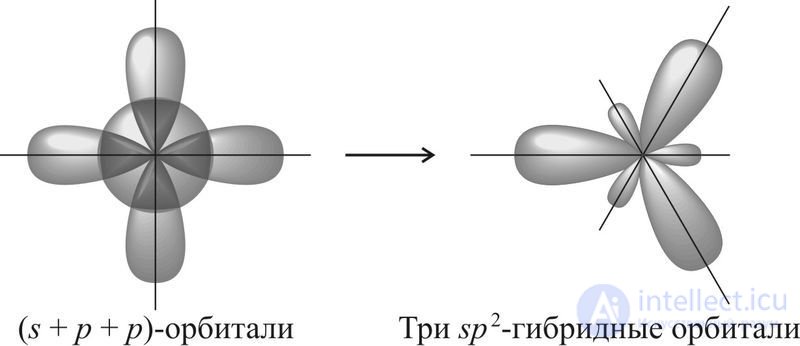
If an atom forms three σ-bonds by means of one of its s- and two of its p-orbitals, then the angle between the three resulting sp2-hybrid orbitals is 120°. This type of hybridization is called sp2-hybridization.
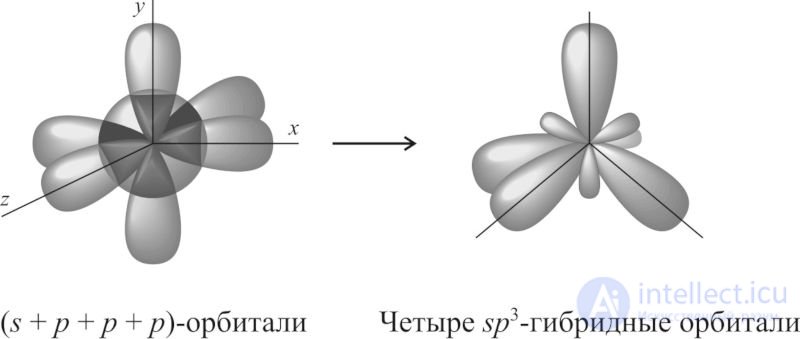
If an atom forms four σ-bonds by means of one of its s- and three of its p-orbitals, then the angle between the four resulting sp3-hybrid orbitals is 109.5°. This type of hybridization is called sp3-hybridization.
For elements of the 3rd and subsequent periods, d-orbitals can also take part in the formation of hybrid atomic orbitals.
Thus, the spatial arrangement of hybrid orbitals determines the angles between σ-bonds, that is, the spatial structure of molecules and complex ions.
The characteristics of the various types of hybridization and examples of molecules and complex ions whose spatial structure corresponds to these types of hybridization are given in table 12.1.
Table 12.1. Characteristics of sp-, sp2-, and sp3-hybridization of the valence orbitals of the central atom
| Original atomic orbitals | Number of hybrid orbitals | Type of hybridization | Valence angle* | Geometric figure corresponding to the hybridization type of the central atom, and the shape of the structural units | Examples |
|---|---|---|---|---|---|
| s + p | Two | sp | 180° |
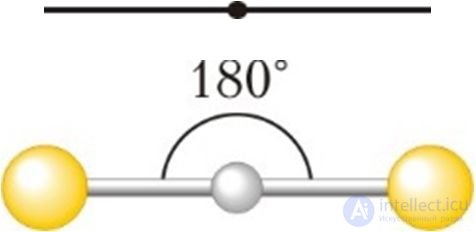
Dumbbell, linear |
   |
| s + p + p | Three | sp2 | 120° |
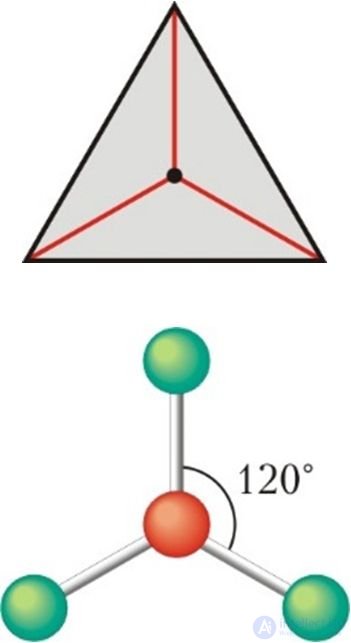
Triangle, planar |
 , ,  , ,  , ,  , , 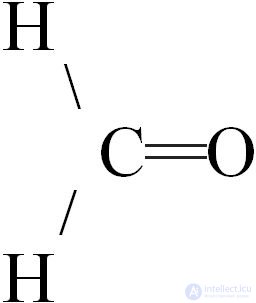 |
| s + p + p + p | Four | sp3 | 109.5° |
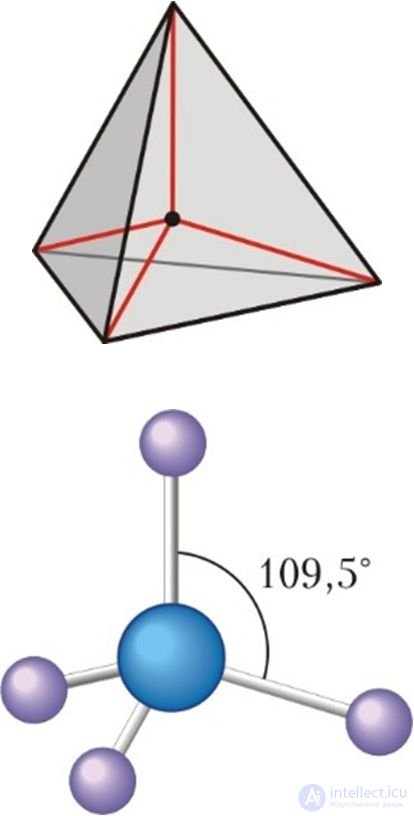
Tetrahedron, tetrahedral |
 , ,  , ,  , ,  , ,  , ,  , ,  |
* The ideal valence angle is indicated. In real structures, due to the repulsion of lone electron pairs, the valence angle may deviate from the ideal.
Let us consider how the concept of atomic orbital hybridization can be used to predict and explain the shape of molecules of inorganic substances.
Example 1. The valence angle in the ammonia molecule is 107°, and in the ammonium ion it is 109.5°. Using the concept of hybridization of the atomic orbitals of the nitrogen atom, explain the observed differences in the valence angle values in NH3 and  .
.
Solution
In the ammonia molecule, nitrogen is the central atom and forms three covalent bonds with hydrogen atoms by the exchange mechanism. If the original dumbbell-shaped р-orbitals of nitrogen took part in the formation of the covalent bonds, the angle between the bonds would have to be 90°. The actual valence angle in ammonia can be explained by using the concept of hybridization of atomic orbitals.
In the valence shell of the nitrogen atom there are three unpaired electrons in р-orbitals and a pair of electrons in an s-orbital. During the formation of chemical bonds, all these orbitals (s + 3p) undergo hybridization, forming four sp3-hybrid orbitals, which in the ideal case would have to be arranged at the vertices of a tetrahedron at an angle of 109.5° to one another.
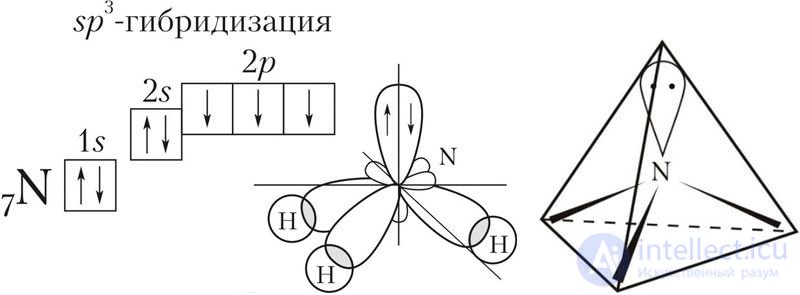
However, because one of the hybrid orbitals bears a lone pair of electrons, which repels the orbitals with bonding electrons, the valence angle decreases to 107°.
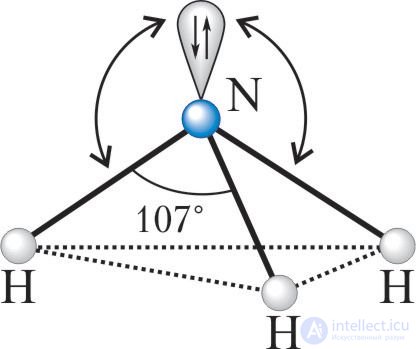
Since the orbital with the lone pair of electrons is not included in the description of the mutual arrangement of the atoms, it is customary to say that the ammonia molecule has the shape of a triangular pyramid with a base in the form of a regular triangle of Н—Н—Н atoms and an apex — the N atom.
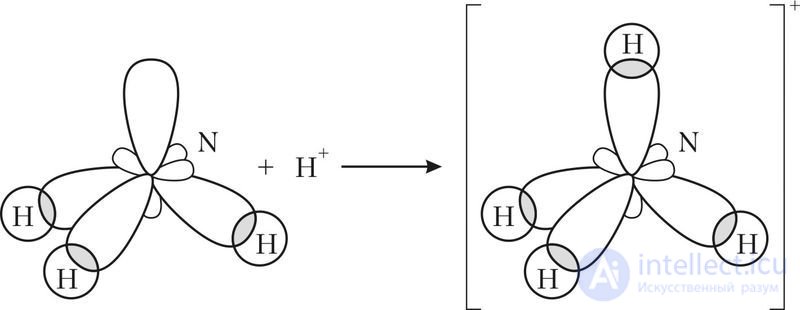
When a hydrogen cation is attached to the ammonia molecule, the distortion of the valence angles is eliminated.
Example 2. According to experimental data, the valence angle Н—O—Н in the water molecule is 104.5°, that is, the water molecule has an angular (bent) structure. Using the concept of hybrid orbitals, explain the spatial structure of the water molecule.
Solution
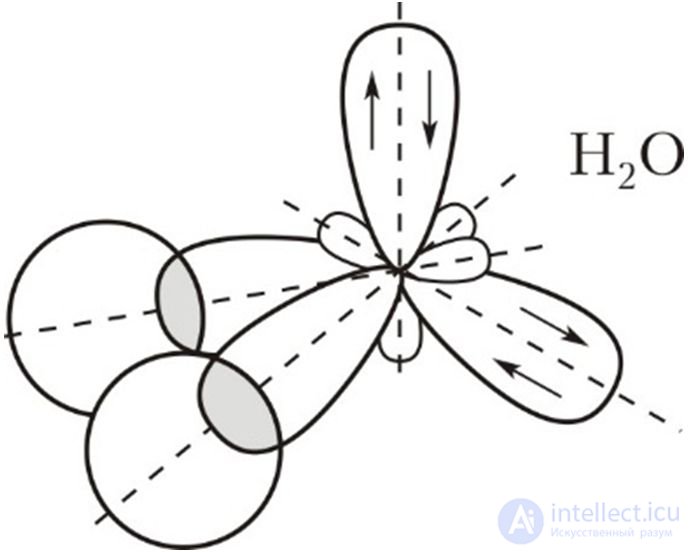
In the water molecule, the central oxygen atom forms two σ-bonds with hydrogen atoms. The remaining electrons of oxygen, located in the valence electron shell, form two lone pairs. In this case, one can speak of the formation of four hybrid orbitals (s + 3p) and, accordingly, of sp3-hybridization of the orbitals of the oxygen atom.
As in the case of the ammonia molecule, the hybrid orbitals are oriented toward the corners of a tetrahedron; however, the orbitals with two lone pairs of electrons repel the pairs of electrons forming the О—Н chemical bonds. This decreases the valence angle Н—O—Н. It becomes equal to 104.5°, that is, less than the tetrahedral angle (109.5°):
Lone pairs of electrons do not have a strong repulsive effect on the electrons of the chemical bond in all compounds. For example, in alcohols the valence angle Н—O—C is 107–109° and differs little from the tetrahedral angle. In the sulfuric acid molecule, the angle Н—O—S is also 108.5° and likewise differs little from the tetrahedral angle. In simple ethers, for example H3C—O—CH3, the angle C—O—C is 109–112° and is also close to the tetrahedral angle.
When determining the spatial structure of molecules, one must always remember that, like any model concept, the concept of hybridization has a limited area of application. While hybridization gives a good prediction when determining the shape of molecules formed by elements of the 2nd period, for elements of periods with higher numbers its predictive capabilities do not always coincide with experimental data. For example, in the molecules of water and hydrogen sulfide, the oxygen and sulfur atoms, from the standpoint of the possible type of hybridization, should be in a state of sp3-hybridization. However, in the water molecule the valence angle is close to the tetrahedral angle, while in the hydrogen sulfide molecule it is 92°. Nevertheless, the valence angle in the H3C—S—H molecule is already 99.5°, in the Cl—S—Cl molecule — 103°, and for the cyclic S8 molecule the S—S—S angle equals 108°, which is very close to 109.5°.
To explain and predict the spatial structure of molecules and ions, the concept of hybridization of atomic orbitals is used.
Hybridization is the redistribution of the electron density of the orbitals of a free atom during the formation of a molecule, with the formation of hybrid orbitals.
According to this concept, when covalent σ-bonds are formed, the original valence s- and p-orbitals turn into hybrid orbitals, having the same shape of electron cloud and energy. Hybrid orbitals are arranged symmetrically in space.
The type of hybridization indicates the spatial structure of molecules: sp — linear, sp2 — triangular, sp3 — tetrahedral.
1. Explain the spatial structure of the methane molecule.
2. Using your experience in explaining the structure of hydrocarbon molecules, comment on the diagrams presented in figure 32.1.
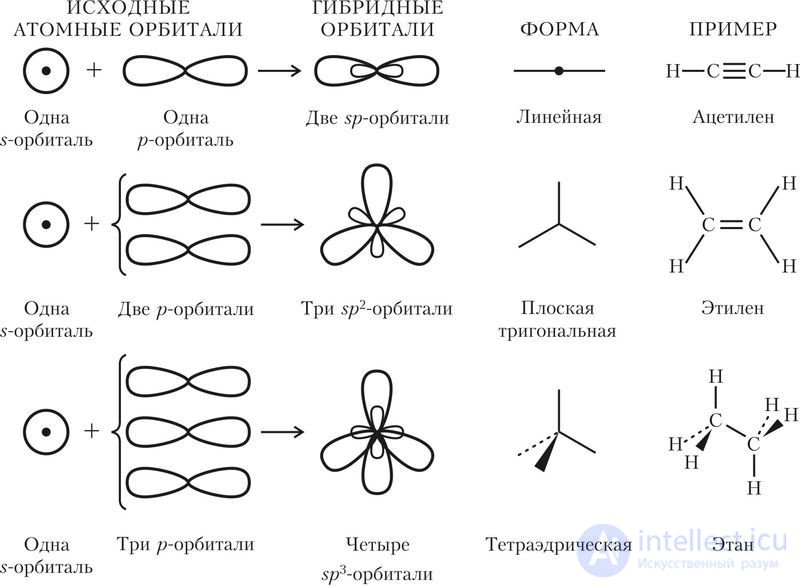
Fig. 32.1. Diagrams of the spatial structure of hydrocarbon molecules
3. Compare the spatial structure of the ammonia molecule and the ammonium ion. Explain the difference.
4. According to experimental data, the CO2 molecule has a linear structure. Explain the value of the valence angle in this molecule based on the concept of atomic orbital hybridization.
5. Taking into account the type of hybridization of atomic orbitals, determine the number of carbon atoms whose atomic orbitals are in a state of sp2-hybridization in the molecule of oleic acid СН3(СН2)7СН СН(СН2)7СООН.
6. Determine the type of hybridization of the atomic orbitals of the central atom and explain the spatial structure of the following molecules and ions: CCl4 (the valence angle Cl—C—Cl equals 109.5°), SiH4 (the valence angle H—Si—H equals 109.5°), BF3 (the valence angle F—B—F equals 120°),  (the valence angle F—B—F equals 109.5°).
7. Depict the spatial structure of the molecules and ions indicated in task 6.
8. Using the concept of atomic orbital hybridization, explain the spatial structure of the molecules of butane, trans-2-butene, methylbenzene, benzoic acid, formaldehyde, and propyne.
9. Using the concept of hybridization, predict what shape the molecules HClO, HClO4, HNO3 should have. Indicate the values of the valence angles and compare your answer with data available online.
10. Arrange the following molecules in order of increasing valence angles: СО2, NH3, Н2О, BCl3, CCl4, CH4, CH3NH2,  .
.
1. The valence angle is determined by:
2. The atomic orbitals that take part in hybridization are:
3. The type of hybridization represented by the diagram is characteristic of atoms in the molecules:
4. sp-Hybrid orbitals:
5. The spatial structure of molecules is:

Comments