
Lecture
Let us consider the change in the acid-base properties of aqueous solutions of volatile hydrogen compounds depending on the position of the element in the periodic system. It is known that СН4 does not dissolve in water, NH3 forms the weak base NH3 ∙ Н2O, and a solution of НF is a weak acid:
NH3 ∙ Н2O 
 + OН–;
Н2О Н+ + ОН–;
HF H+ + F–.
This means that the acidic properties of the hydrogen compounds of nonmetals within a period become stronger as the atomic number of the element increases.
Within groups, the acidic properties of aqueous solutions of nonmetal hydrogen compounds also become stronger: НF is a weak acid, while HCl, HBr, HI are strong acids.

Carbon and hydrogen form a considerable number of binary organic compounds of various classes: alkanes СnH2n+2, alkenes СnH2n, alkynes СnH2n–2, arenes СnH2n–6, and others.
Oxygen forms two stable compounds with hydrogen — Н2О and Н2О2 (water and hydrogen peroxide).
For sulfur, a series of hydrogen compounds of composition Н2Sn (n = 1–20) is known, for example, Н2S, Н2S2.
The hydrogen compounds of alkali and alkaline earth metals can be obtained by direct combination of the elemental substances, for example:
Н2 + 2Li = 2LiH,
Н2 + Вa = ВaH2.
To do this, hydrogen under pressure is passed over the metal heated to 200−600 °C.
The most common compounds of hydrogen with nonmetals, as well as with Group IA and IIA metals, are shown in Figure 67.1.
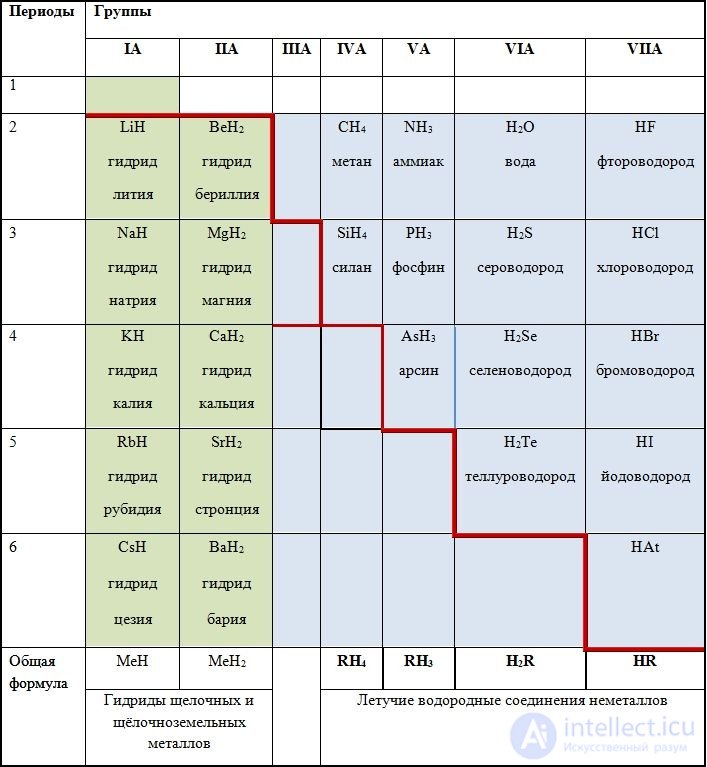
Fig. 67.1. Hydrogen compounds of certain metals and nonmetals
The hydrogen compounds of Group IA and IIA metals (s-elements, except beryllium) are ionic hydrides. These are white crystalline substances with fairly high boiling points; their melts conduct electricity.
The most important property of metal hydrides is their reaction with water and acids to form hydrogen:
LiH + Н2О = LiOH + H2↑;
СаН2 + 2НСl = CaCl2 + 2H2↑.
Ionic hydrides are substances that, on heating, decompose into the metal and hydrogen without melting: 2NaH = 2Na + H2.
The exceptions are LiH and CaH2, which melt without decomposition, but on further heating still decompose.
Ionic metal hydrides possess reducing properties:
NaH + C2H5OH = C2H5ONa + H2.
Owing to their reducing properties, ionic hydrides are used to obtain metals from their oxides or halides, and to remove scale from the surface of refractory metals. Hydrides are sources of hydrogen and are therefore promising as a component of rocket fuel.
When ionic hydrides react with the hydrides of aluminum or boron, complex hydrides are formed. Of these, the most important are sodium borohydride Na[BH4] and lithium aluminum hydride Li[AlH4], as strong reducing agents:
2RCHO + 2Li[BH4] + 2H2O = 2RCH2OH + 2LiOH + B2H6↑ (reduction of aldehydes);
2Ni2+ +  + 4OH− → 2Ni +
  + 2H2↑ (reduction of metal ions in the production of metal coatings and powders).
The acidic properties of aqueous solutions of nonmetal hydrogen compounds become stronger across periods.
The hydrides of s-elements (metals) are ionic compounds. They possess reducing properties, undergo hydrolysis, and react with acids to form hydrogen.
1. Name the general formulas of the hydrogen compounds of the Group VIIA, VIA, VA, and IVA elements.
2. Write out the formulas of the hydrogen compounds with covalent bonding: HCl, СаН2, Н2Se, LiH, HF, BaH2, NaH.
3. Determine the oxidation states of the atoms in the following hydrides:
4. Write the equations for the synthesis of the hydrides listed in assignment 3.
5. Name the hydrogen compounds of nonmetals between whose molecules a strong hydrogen bond exists. Explain the reason for this phenomenon.
6. Write the equations of the reactions between potassium hydroxide and the hydrogen compounds of fluorine and iodine in molecular and ionic form. Why does the sum of the coefficients differ in the equations written in ionic form?
7. Write the equations of the reactions according to the scheme:
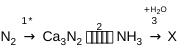 ;
;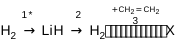 .
.Characterize reactions 1* according to the classification criteria known to you.
8. There is a series of hydrogen compounds: NaH, BaН2, Н2О, NН3, HCl. Which of them, owing to their hydrogen atoms, can exhibit:
9. A binary compound of calcium and a Group VА nonmetal, with a mass of 1.82 g, forms a gas with a volume of 448 cm3 (at STP) on reaction with water. Establish the chemical formula of the gaseous compound.
10. A mixture containing chlorine with a mass of 35.5 g and hydrogen with a mass of 1.5 g was ignited. Determine the volume fractions of each component in the gas mixture after the reaction is complete.
1. Volatile hydrogen compounds are the substances with the formulas:
2. The acidic properties strengthen in aqueous solutions of the compounds in the series:
3. On dissolving in water, the following compounds form an alkali:
4. Hydrogen atoms can exhibit only oxidizing properties in the composition of:
5. Four test tubes contain distilled water, as well as the products of dissolving ammonia, hydrogen bromide, and calcium hydride in water. The results of testing the contents of the test tubes with universal indicator are as follows:
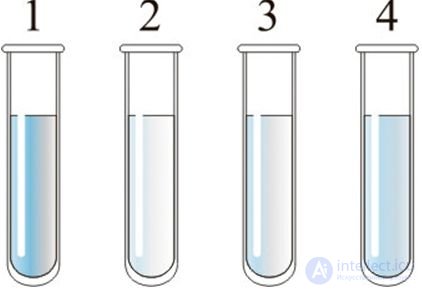 |
1 – рН = 10 |
| 2 – рН = 7 | |
| 3 – рН = 13 | |
| 4 – рН = 2 |
Water and the hydrogen bromide solution are located in test tubes:

Comments