
Lecture
Reagents: solutions of sodium hydroxide, sulfuric acid, sodium chloride, sodium carbonate, iron(III) chloride, potassium nitrate, phenolphthalein.
Carry out reactions between the following pairs of substances:
Write the equations of the reactions carried out in molecular form, and in full and net ionic forms. Indicate the effects you observed.
Draw a conclusion about the necessary conditions for ion exchange reactions to occur.
Ion exchange reactions are chemical processes in solutions of electrolytes in which substances exchange ions. They proceed only when a precipitate, a gas, or a weak electrolyte (for example, water) is formed as a result. Otherwise, exchange reactions are reversible.
An ion exchange reaction is an interaction between solutions of acids, bases, and salts in which ions change places.
An important feature: the oxidation state of the elements does not change, since these are not oxidation-reduction reactions, but purely exchange reactions.
For a reaction to proceed, at least one condition must be met:
Formation of a precipitate (for example, Fe(OH)₃).
Evolution of a gas (for example, CO₂ upon the interaction of carbonates with acids).
Formation of a weak electrolyte (for example, H₂O upon the neutralization of an acid and a base).
If none of the conditions is met (for example, mixing solutions of NaCl and KNO₃), the reaction does not proceed.
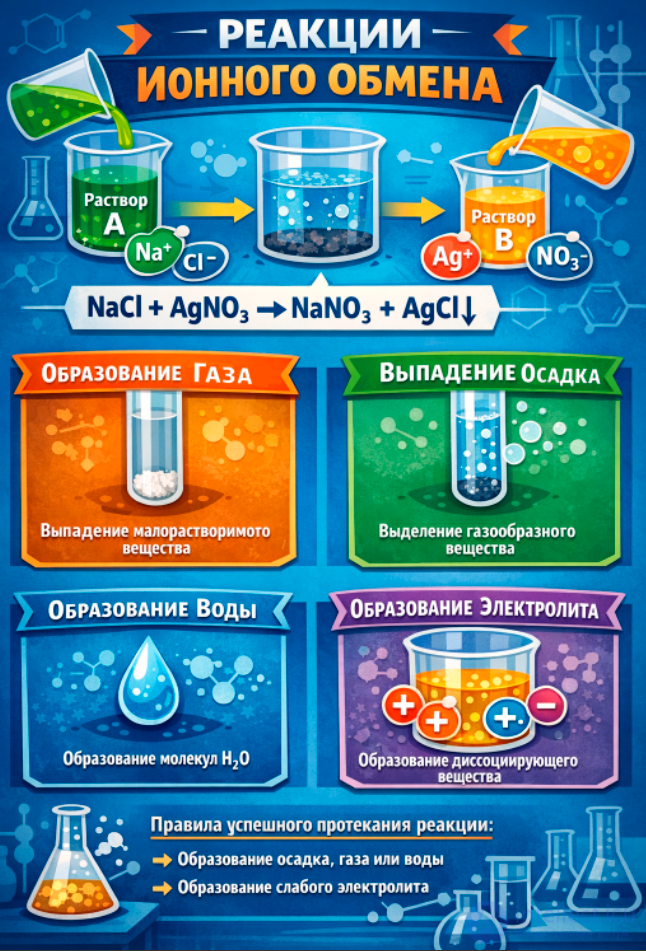
Ion exchange reactions are conventionally written in three forms:
Molecular form — shows the substances in full. Example:
Full ionic form — all strong electrolytes are written out as ions.
Net ionic form — only the particles that actually take part in the reaction remain.
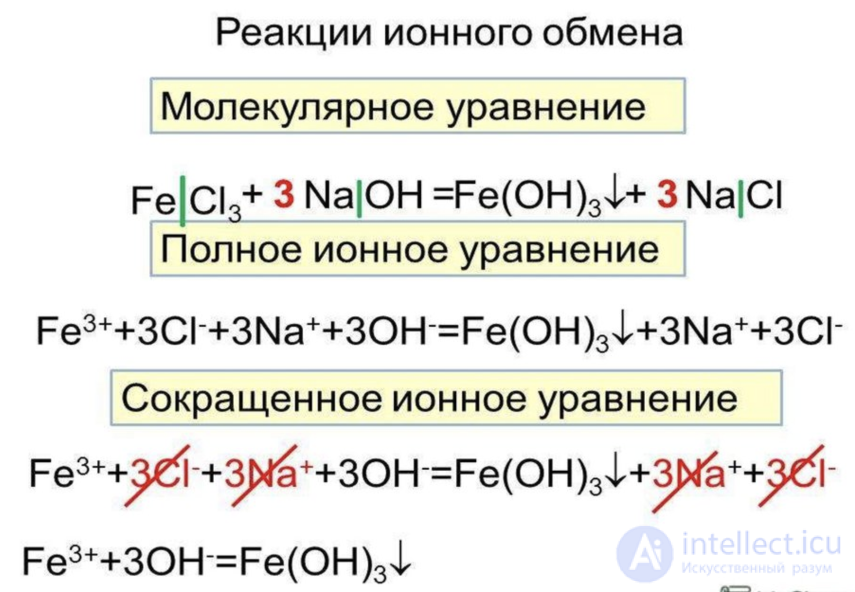
Formation of a precipitate (brown Fe(OH)₃).
Evolution of a gas (CO₂).
Change in indicator color (phenolphthalein becomes colorless upon neutralization).
Dissolution of a precipitate upon reaction with an acid.
Molecular equation:
Full ionic equation:
Net ionic equation:
Observation: the phenolphthalein becomes colorless (alkaline medium → neutralization).
Molecular equation:
Full ionic equation:
Net ionic equation:
Observation: a brown gelatinous precipitate of iron(III) hydroxide.
Molecular equation:
Full ionic equation:
Net ionic equation:
Observation: evolution of gas bubbles (carbon dioxide).
Molecular equation:
Ionic equation: none, since there is no precipitate, gas, or weak electrolyte.
Observation: no changes occur.
Molecular equation:
Full ionic equation:
Net ionic equation:
Observation: the brown precipitate dissolves, forming a clear salt solution.
Ion exchange reactions proceed when one of the following conditions is met:
formation of a precipitate (Fe(OH)₃);
evolution of a gas (CO₂);
formation of a weak electrolyte (H₂O).
If none of the conditions is met (example: KNO₃ + NaCl), the reaction does not proceed.

Comments