
Lecture
In 1896, A. Becquerel, while studying uranium salts, discovered that they emit a previously unknown radiation. This phenomenon was called radioactivity.
Radioactivity (or radioactive decay) is the spontaneous transformation of unstable atomic nuclei of some chemical elements into nuclei of other elements, accompanied by the emission of high-energy particles as well as hard electromagnetic radiation.
Such a transformation is not a chemical reaction.
Depending on the nature of the emitted particles, several types of radioactive decay of atomic nuclei are distinguished. They are studied in detail by nuclear physics. We will consider two of them — α- and β-decay.
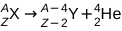
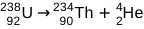
Alpha decay is accompanied by the emission of α-particles — positively charged helium nuclei containing two protons and two neutrons:  . This decay can be represented as a nuclear reaction equation:
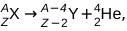
where X is an unstable nucleus with atomic number Z and mass number А; Y is the resulting nucleus, whose atomic number is 2 units and whose mass number is 4 units less than that of the original nucleus. An example of such decay is the decay of radium-226, forming gaseous radon-222 and helium-4:

When writing nuclear reaction equations, it must be taken into account that the sum of the charges (Z) and the sum of the mass numbers (А) on both sides of the equation must be equal.
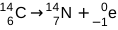
Beta decay involves the emission by the nucleus of a β-particle — an electron ( ). In this case, the charge of the new nucleus increases by one, while its mass number А does not change:
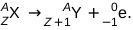
For example, β-decay of carbon-14 produces nitrogen-14:
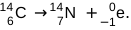
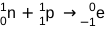
Electrons arise from the decay of a neutron ( ) into an electron () and a proton (
 ):
):

Radioactive transformations are often accompanied by gamma radiation. It is hard electromagnetic radiation with a wavelength of 10–10–10–13 m.
Stable and radioactive nuclides
The cause of radioactivity is the instability of the atomic nuclei of a number of chemical elements. Unstable nuclides are called radioactive nuclides, or radionuclides. Radioactive nuclides differ from stable ones in the ratio of protons and neutrons in the nucleus and in their binding energy.
Any chemical element has both stable and radioactive nuclides. For some elements only radionuclides are known. These include all elements of the periodic table starting from bismuth, as well as technetium Tc and promethium Pm.
84 radionuclides have been found in nature. They are called natural, or naturally occurring, radionuclides. These include radionuclides that have survived since the formation of the Earth, as well as those that arise in continuously occurring nuclear reactions. These reactions are related either to the decay of already existing radionuclides, or to the interaction between high-energy cosmic particles and the nuclei of atoms present in the atmosphere. For example, granite contains the radionuclide uranium-238, whose decay leads to the formation of the radionuclide radon-222. In the atmosphere, under the action of particles arriving from space (a flux of neutrons, etc.), radioactive carbon-14 nuclei are formed:

The most common natural radionuclides are uranium-238, uranium-235, thorium-232, and potassium-40.
The environment also contains a significant portion of artificial radionuclides. They are also called man-made radionuclides, since they were formed as a result of the operation of nuclear industry facilities and the testing of nuclear weapons in the 1940s–1980s, as well as due to careless handling of radioactive sources in other branches of industry.
The stability of radionuclides is characterized by their half-life. The half-life is the time during which half of the initial amount of nuclei of a radioactive element decays.
For example, the half-life of iodine-131 (T½) is 8.04 days, while the half-lives of cesium-137 and strontium-90 are about 30 years. This does not at all mean that after 60 years no radioactive cesium and strontium will remain. If calculated, by that time a quarter of it will still remain, and even after 180 years about 1.5% of the original amount will remain.
As a result of the accident at the Chernobyl nuclear power plant on 26 April 1986, radioactive nuclides of 37 chemical elements were released into the environment. Their elevated levels made part of the territory of our country unfit for habitation. At present the Republic of Belarus continues to overcome the consequences of the Chernobyl disaster. Chemists play a leading role in this work. They monitor contaminated territories, participate in developing projects for their cleanup and restoration, and seek ways to reduce the content of hazardous radionuclides in agricultural products.

Besides the radioactive decay of nuclei, their synthesis is also possible. For example:

Knowledge of the mechanism and patterns of nuclear transformations makes it possible to carry out the targeted synthesis of chemical elements. All elements with atomic numbers greater than 92 have been obtained artificially.
As a result of nuclear reactions, the synthesis of chemical elements occurs on the Sun and other stars. Nuclear fusion reactions of elements on the Sun are the source of the star's energy and of life on Earth.
Use of radionuclides
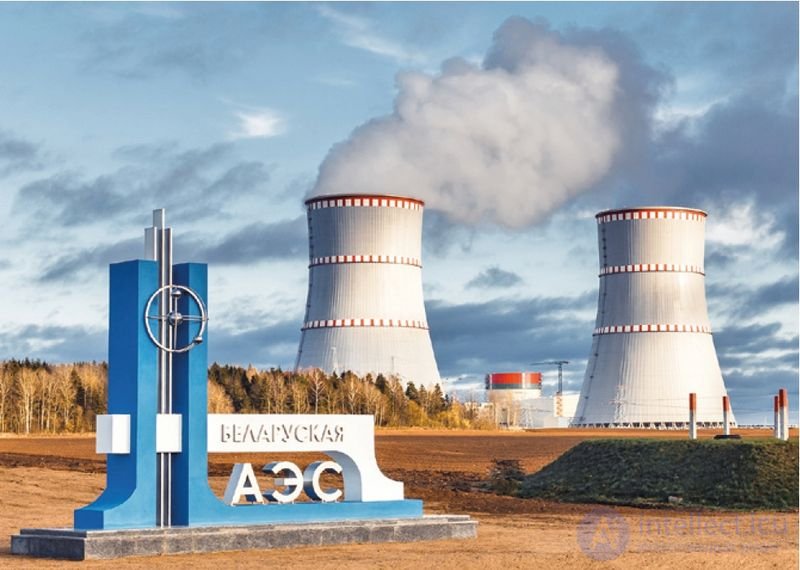
Fig. 13. Belarusian NPP
The decay of radioactive atomic nuclei is accompanied by the release of a huge amount of energy. Humanity has learned to control the decay of radionuclides and to use the energy released in this process for its own purposes.
At nuclear power plants, the energy released during the fission of uranium nuclei is converted first into thermal energy and then into electrical energy (Fig. 13).
The process of fission of radioactive uranium-235 nuclei under the action of neutrons can be represented by the equation:

The resulting neutrons cause the fission of new uranium-235 nuclei via a chain mechanism.
The action of nuclear weapons is based on the instantaneous release of a huge amount of energy during the fission of uranium or plutonium nuclei.

Complete fission of 1 kg of uranium-235 releases about 7.7 · 1013 J of energy, which is equivalent to the heat of combustion of about 3000 t of high-quality hard coal.
About 200 nuclear power plants are in operation in 32 countries of the world, providing approximately 20% of the total electricity consumed by these countries.
Radionuclides are used in medical diagnostics and for the treatment of certain diseases.
Radiation safety
During the decay of atomic nuclei or, conversely, their synthesis, protons, neutrons, and electrons are released, accompanied by gamma radiation. This process is called radioactive emission, or radiation. Its natural sources are solar radiation and cosmic radiation, as well as radioactive substances present in the Earth's crust, in the objects around us, in water and air, gradually entering the bodies of humans and animals.
There are also man-made sources of radioactivity, created by humans or triggered by human activity. Negative examples of the formation of such sources are the testing of nuclear weapons, the disposal of radioactive waste, and errors in the operation of nuclear power plants leading to disasters.
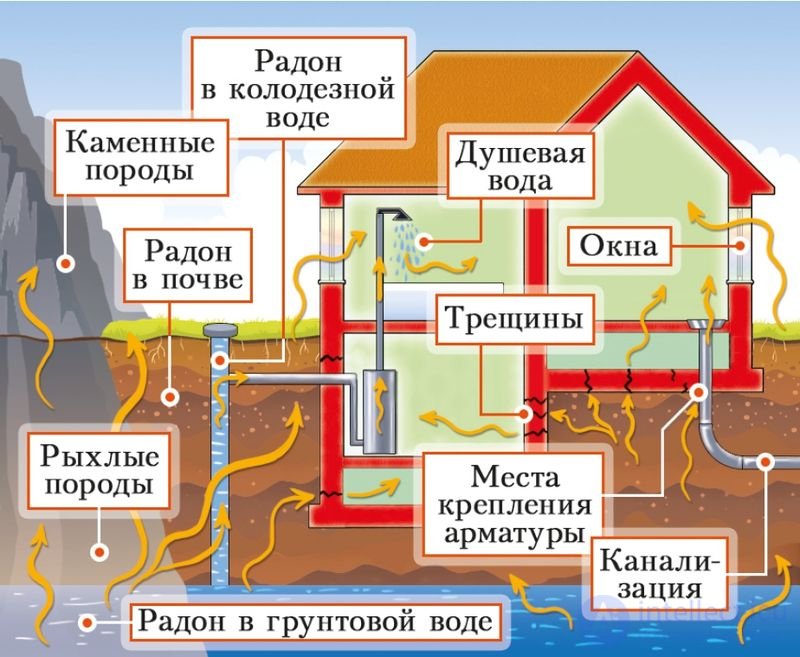
Fig. 14. Pathways of penetration
of radioactive radon into residential premises
Exposure of the human body to significant doses of external radiation can cause severe diseases. An even greater danger is the entry of radionuclides into the human body through the respiratory organs, with food and water (Fig. 14). Radiation from radionuclides damages individual cells, blocks synthesis, or damages DNA. The greatest danger to humans is posed by the radionuclides: 210Ро, 90Sr, 131I, 137Cs, 235U, 222Rn.
Thus, the thyroid gland is responsible for producing hormones involved in metabolic processes in the body. Iodine is necessary for its normal functioning. Once in the body, radioactive iodine-131 accumulates in the thyroid gland, causes intense irradiation, and leads to the formation of cancerous tumors. To reduce the danger of such exposure, it is recommended to take preparations of non-radioactive iodine (KI).
The radionuclide strontium-90 is a chemical analog of calcium, and therefore is deposited in bone tissue in place of calcium, causing damage to bone marrow cells. One of the preventive measures against such disease in territories contaminated with strontium-90 is liming the soil. The intake of non-radioactive calcium leads to a decrease in the amount of strontium-90 not only in plants, but also in the bodies of animals and humans consuming these plants.

Radon is the second most common cause (after smoking) of lung cancer. It is naturally released from the depths of the Earth and accumulates in basements. From there it penetrates into residential premises through ventilation shafts (Fig. 14). To reduce its concentration, and consequently its effect, premises must be well ventilated.
Radioactivity (or radioactive decay) is the spontaneous transformation of unstable atomic nuclei of some chemical elements into nuclei of other elements, accompanied by the emission of high-energy particles as well as hard electromagnetic radiation.
Radioactive decay of atomic nuclei occurs with the emission of α-particles (helium nuclei), β-particles (electrons), and γ-rays.
A type of atom subject to radioactive decay is called a radionuclide.
Radioactive nuclides are used in nuclear power, medicine, scientific research, and military purposes.
Questions, tasks, problems
1. What is radioactivity? Name the types of radioactive decay.
2. Indicate the characteristics of α- and β-particles, using Table 4 on p. 37.
3. Name the sources of natural radioactivity.
4. What radiation hazard to humans is posed by staying in basement and unventilated premises?
5. Compare the nuclear composition of the nuclides 131I and 127I, 137Cs and 133Cs, 90Sr and 88Sr.
6. Write the equations of the nuclear reactions:


7. The radionuclides 210Ро, 235U, 222Rn undergo α-decay, while the radionuclides 90Sr, 131I, 137Cs undergo β-decay. Write the equations of their decay reactions and name the products.
8. The mass fraction of potassium in the human body is 0.25%. Of the total number of potassium atoms, potassium-40 accounts for 0.0117%. Calculate the number of radioactive 40K atoms in the body of a person with a mass of 60 kg.
9. The first artificial nuclear reaction, carried out by E. Rutherford in 1919, was the reaction of nitrogen-14 atoms with α-particles. In the course of the reaction, an atom of a certain element is formed and a proton is released. Determine this element.
10. The average energy released during the decay of one uranium-235 nucleus is 3.24 · 10–11 J. Calculate the energy value that will be released during the decay of uranium-235:

*Self-check
1. α-Decay is represented by the schemes:
 ;
; ;
; ;
; .
.2. The formation of electrons occurs in the reactions:
 ;
; ;
; ;
; .
.3. Hydrogen is a product in the nuclear reactions:
 ;
; ;
; ;
; .
.4. Radionuclides are:
5. Examples of man-made sources of radioactive emission are:

Comments