
Lecture
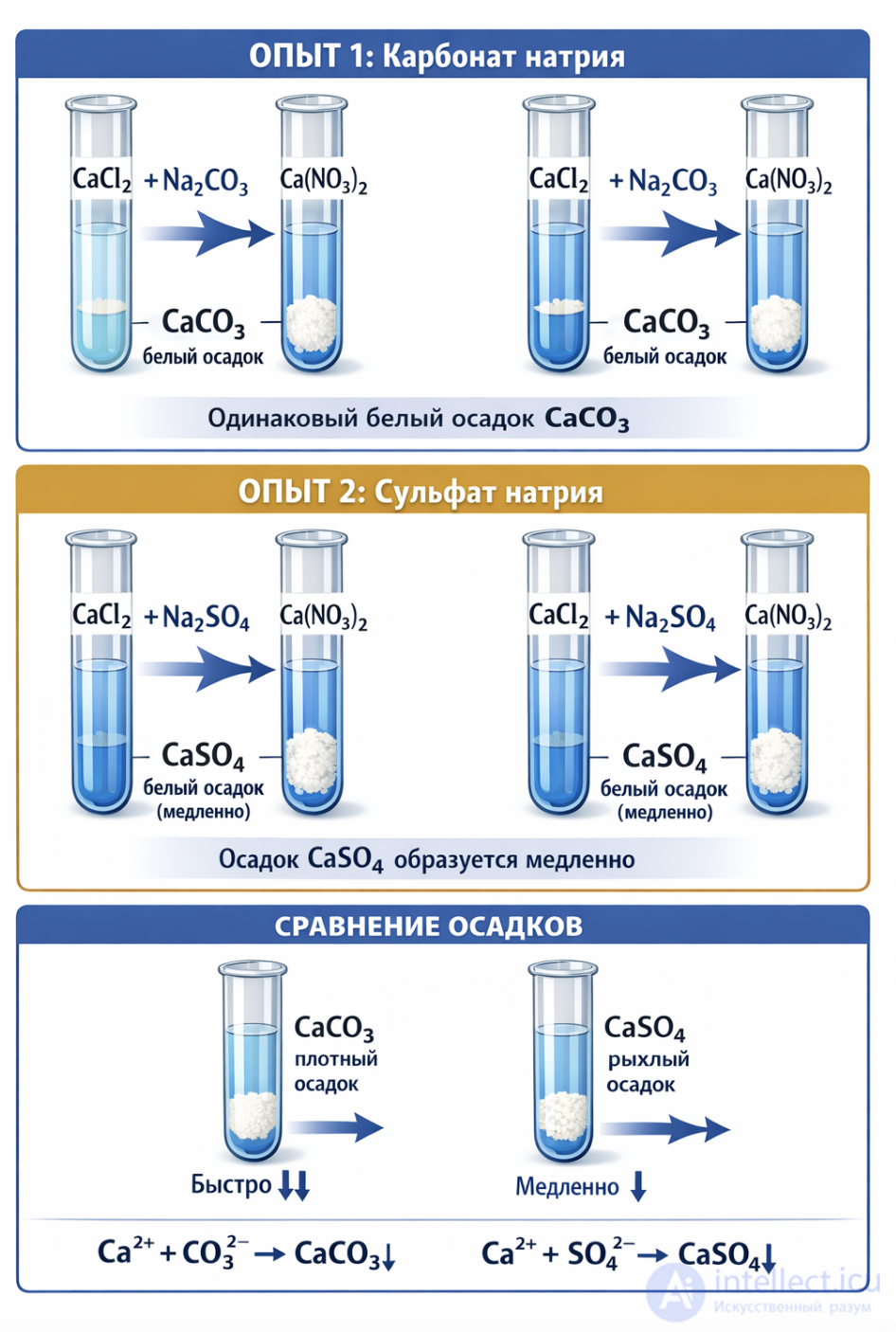
Reagents: calcium chloride, calcium nitrate, sodium carbonate, sodium sulfate.
Compare the precipitates obtained — calcium carbonate and calcium sulfate.
Which of the reagents — sodium carbonate or sodium sulfate — is preferable for detecting calcium ions?
To learn to determine the presence of calcium ions (Ca²⁺) in aqueous solutions using a qualitative reaction.
Test tubes
Pipettes
Calcium chloride solution (CaCl₂)
Oxalic acid solution (H₂C₂O₄)
Distilled water
Alcohol burner
Test tube holder
Calcium ions belong to the alkaline earth metals. To detect them, a reaction with oxalic acid is often used, which produces a white, sparingly soluble precipitate of calcium oxalate (CaC₂O₄):
Ca2++C2O42−→CaC2O4↓
Pour 1–2 mL of a solution containing calcium ions (for example, CaCl₂) into a test tube.
Add a few drops of oxalic acid solution.
Observe the formation of a white precipitate — calcium oxalate.
If necessary, the precipitate can be filtered and washed with distilled water.
Draw a conclusion about the presence of calcium ions in the solution.
Work while wearing safety goggles and gloves.
Handle acids with care.
Observe safety procedures when working with the alcohol burner.
For detecting calcium ions, it is preferable to use a sodium carbonate solution, since it forms a sparingly soluble precipitate of calcium carbonate (CaCO₃), which is easily observed. Sodium sulfate also gives a precipitate (CaSO₄), but its solubility is higher, and the reaction is less reliable.
Why sodium carbonate is better
The CaCO₃ precipitate is white, dense, and clearly visible, which makes qualitative analysis easier.
The solubility of CaCO₃ is extremely low, so even small amounts of calcium give a noticeable result.
CaSO₄ is more soluble, and at low calcium concentrations the precipitate may not form, which reduces the accuracy of detection.
Practical notes
In school and laboratory experiments, sodium carbonate is more often used as the main reagent for detecting calcium.
For more precise analysis, ammonium oxalate (NH₄)₂C₂O₄ is also used in chemistry, which forms a poorly soluble precipitate of calcium oxalate (CaC₂O₄). This method is considered even more reliable.
As a result of the laboratory work, a qualitative analysis was carried out confirming the presence of calcium ions in the solution by the formation of the characteristic white calcium oxalate precipitate.

Comments