
Lecture
In most cases you have studied the chemical properties of substances using the example of irreversible reactions, that is, transformations that under certain conditions proceed in only one direction. Such reactions end when at least one of the reactants is completely converted into product. If the reactants are taken in stoichiometric ratio, the reaction ends when all the starting substances are completely converted.
Having studied the material of § 18, you learned that there are many reversible reactions, which under certain conditions proceed simultaneously in both the forward and reverse directions. As a result, reactions do not proceed "to completion" but rather up to a state of equilibrium. When the conditions of a reversible reaction change, it can usually be made to proceed predominantly in the forward or reverse direction.
As an example, let us consider the reversible reaction of the synthesis of hydrogen iodide from gaseous simple substances at a temperature of 450 °C:

At the start of the reaction, only hydrogen H2 and iodine I2 are present in the vessel.
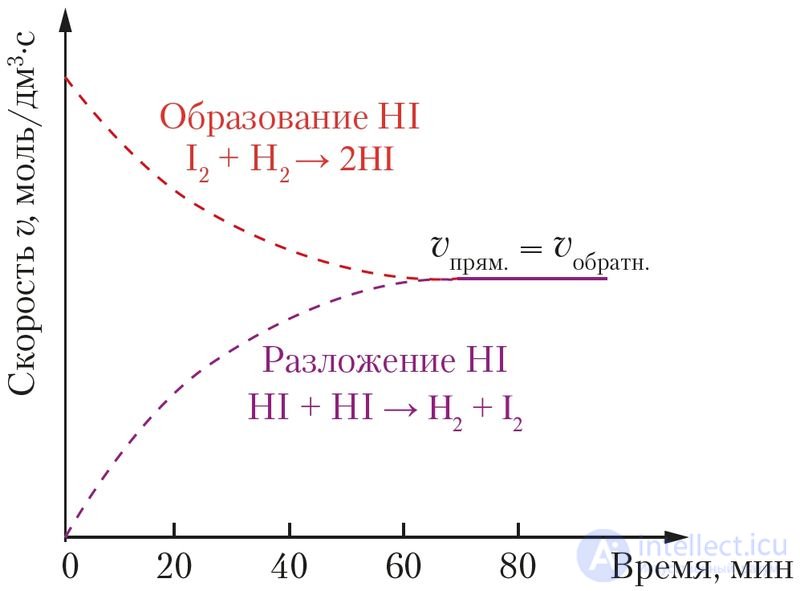
Fig. 49. Change over time in the rates
of the forward and reverse reactions during HI synthesis
As the reaction proceeds, their amount gradually decreases. As a result, the rate of the forward reaction forming HI also decreases (Fig. 49).
At the same time, the amount of hydrogen iodide increases, causing the rate of the reverse reaction (decomposition of HI) to gradually increase. After some time, the rates of both the forward and reverse reactions become equal and no longer change:  forward = reverse
This state is called dynamic chemical equilibrium, or simply chemical equilibrium.
Chemical equilibrium is a stable state of the reaction mixture in which the forward and reverse reactions proceed at the same rate. In the state of chemical equilibrium, the concentrations of reactants and reaction products do not change over time and are called equilibrium concentrations.
Chemical equilibrium is established regardless of how the process is carried out — from left to right or from right to left. If hydrogen iodide is placed in the reactor instead of a mixture of H2 and I2 and heated to 450 °C, then after some time the rate of the HI decomposition reaction will become equal to the rate of the HI synthesis reaction. The resulting equilibrium mixture will have the same ratio of amounts of H2, I2, and HI as in the case where the starting substances were a mixture of H2 and I2.
So, in the equilibrium state, the ratio of the amounts of reactants and products for a given reaction under given conditions is quite definite and can be maintained indefinitely. To change this ratio, for example in order to increase the yield of the product, it is necessary to create new conditions for the reversible reaction.
A shift of chemical equilibrium is the process of establishing a new state of equilibrium of a reversible reaction when the conditions of its occurrence change.
If, after a change in the conditions of a reversible reaction, the rate of the forward reaction becomes greater than the rate of the reverse reaction, the equilibrium shifts to the right: the equilibrium concentrations of the reaction products increase, while those of the starting substances decrease.
If, after a change in conditions, the reverse reaction begins to proceed at a greater rate, the equilibrium of the reversible reaction shifts to the left: the equilibrium concentrations of the starting substances increase, while those of the reaction products decrease.
It takes some time for the reaction mixture to reach the new state of equilibrium. The new chemical equilibrium is characterized by different equilibrium concentrations of the reaction participants.
The direction of the shift of chemical equilibrium when the reaction conditions change is determined by Le Chatelier's principle, established by the French scientist H. L. Le Chatelier in 1884.
If a system in equilibrium is subjected to an external influence (a change in temperature, pressure, or concentration), then the equilibrium shifts in the direction of the reaction (forward or reverse) that weakens the applied influence.

Independently of H. L. Le Chatelier, the principle of chemical equilibrium in reversible reactions was formulated and theoretically substantiated in 1887 by the German physicist K. F. Braun. This principle applies to reversible reactions in gases, as well as to reactions in solutions or to heterogeneous reactions involving solid and gaseous substances.
From thermochemical equations written in the form:
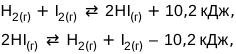
it follows that the forward reaction of HI synthesis proceeds with the release of heat, while the reverse reaction proceeds with the absorption of the same amount of heat.
When the temperature increases, the chemical equilibrium shifts in the direction of the endothermic reaction; when it decreases, it shifts in the direction of the exothermic reaction.
When the temperature increases in the equilibrium system, the rate of the HI decomposition reaction with absorption of heat increases to a greater extent. This weakens the heating and reduces the amount of heat supplied (Table 15).
Table 15. Equilibrium content of HI(g) in a mixture with starting amounts of H2(g) and I2(g)
| Temperature, °C | 100 | 200 | 300 | 400 | 500 | 600 | 700 |
| HI content, % | 90 | 86 | 83 | 81 | 79 | 76 | 73 |
At constant temperature and volume, the pressure in the system is directly proportional to the total amount of gases in the mixture. If during the course of a chemical reaction the amount (in moles) of gases in the system increases, the pressure increases. Using the example of the reversible reaction of ammonia synthesis:
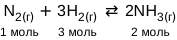
let us consider the change in the amount of gases during the chemical transformation. From the reaction equation it follows that:
If the pressure in the system is increased, the equilibrium will shift toward its decrease, that is, toward a decrease in the amount of gases as the reaction proceeds in the forward direction. Conversely, when the pressure decreases, the equilibrium will shift in the reverse direction to increase the amount of gases through the decomposition of ammonia.
If the volume of the system can be changed, then increasing the pressure by compressing the gases will cause their volume to decrease and the equilibrium to shift toward the forward reaction — the interaction of nitrogen and hydrogen.
Quite a large number of reversible reactions are known in which the total amount of gases does not change. For example:

It is evident that in such cases, a change in the volume of the system or in the total pressure of the gaseous reactants and reaction products in it does not affect the position of the chemical equilibrium.
Chemical equilibrium can be shifted by changing the concentration of the substances participating in the reaction. In a system of constant volume, an increase in the concentration of one of the substances is equivalent to adding it to the reaction mixture, while a decrease in the concentration of a substance is equivalent to removing it from the reaction mixture.
Let us consider the effect of a change in concentration on the equilibrium state of the reaction:  .
.
When the concentration of one or both starting substances A and B increases, the rate of the forward reaction increases. This leads to a shift of the equilibrium to the right and an accumulation of the reaction products (C and D).
When the concentration of one or both reaction products C and D increases, the rate of the reverse reaction increases, which leads to a shift of the equilibrium to the left and an accumulation of the starting substances A and B.
When the concentration of the starting substances increases, the chemical equilibrium shifts to the right, and when it decreases, to the left.
When the concentration of the reaction products increases, the chemical equilibrium shifts to the left, and when it decreases, to the right.
Example 1. Determine in which direction the chemical equilibrium of the reaction will shift

The volume of the system is constant.
Solution. Since nitrogen is a starting substance, when its concentration increases, the rate of the forward reaction will increase, and the equilibrium will shift to the right, toward the formation of NH3.
Since hydrogen is a starting substance, when its concentration decreases, the rate of the forward reaction will decrease, and the equilibrium will shift to the left.
Since ammonia is a reaction product, when its concentration decreases, the rate of the reverse reaction will decrease, and the equilibrium will shift to the right, toward its formation.
Why are catalysts used in equilibrium reactions?
Catalysts simultaneously increase the rates of the forward and reverse reactions, that is, they speed up the time it takes to reach equilibrium.
Catalysts do not affect the position of the chemical equilibrium, since they speed up both the forward and reverse reactions to the same extent.
Thus, from Figure 49 on p. 120 it can be seen that without a catalyst, the equilibrium state at 450 °C for the HI synthesis reaction is reached within an hour. When a catalyst is used, equilibrium in this reaction is reached within seconds, even at a temperature of about 350 °C.
If a system in equilibrium is subjected to an external influence (a change in temperature, pressure, or the concentration of one of the substances), the equilibrium shifts in the direction of the reaction (forward or reverse) that weakens the applied influence.
Catalysts speed up the achievement of chemical equilibrium but do not affect its position.
1. Write the equations of three reversible reactions.
2. What state of the reaction mixture is called chemical equilibrium?
3. What process is called a shift of chemical equilibrium?
4. Formulate Le Chatelier's principle.
5. Explain the meaning of the expression: "The chemical equilibrium has shifted toward the forward reaction (to the right)." How did the concentrations of the reacting substances change as a result?
6. How does a change in temperature affect the position of equilibrium if the forward direction is
7. How does a decrease in the volume of the system affect the position of equilibrium for reactions in which the total amount (in moles) of gaseous products increases?
8. In which direction will the chemical equilibrium  shift:
9. In which direction will the chemical equilibrium in the system  shift:
10. A mixture of SO2 and O2 with concentrations of 0.04 and 0.03 mol/dm3 respectively was placed in a closed vessel. After equilibrium was established in the reaction mixture  , SO3 formed in the vessel, with a concentration of 0.025 mol/dm3. Determine the equilibrium concentrations of SO2 and O2.
1. For the state of chemical equilibrium, the following statements are true:
2. An increase in temperature will shift the equilibrium toward the reverse reaction:
 2HI(g) + Q; 2Fe(s) + 3H2O(g) – Q; COCl2(g) + Q; 2NO2(g) + Q.
3. The equilibrium will shift when the pressure increases in the reaction:
CaCO3(s); 3Fe(s) + 4H2O(g); N2O4(g); 2HNO3(l) + NO(g).4. A simultaneous increase in temperature and decrease in pressure shifts the equilibrium of the reaction to the right the most:
CH3OH(g) + Q; 2O3(g) – Q; CH3–CH2–CH3(g) + Q; CO(g) + H2(g) – Q.5. In the ammonia synthesis reaction N2(g) + 3H2(g) 2NH3(g) + Q, the equilibrium amount (in moles) of NH3 will increase when:

Comments