
Lecture
Substances of molecular structure can exist in three states of matter — solid, liquid, and gaseous. But the temperature conditions of one state or another are individual for each substance.
There is one reason for this — the difference in the strength of interaction between molecules. This interaction is called intermolecular. Like a chemical bond, intermolecular interaction occurs owing to electrostatic attraction forces, but ones that are tens and hundreds of times weaker. The stronger the intermolecular interaction in a substance, the higher its melting and boiling points. The strength of intermolecular interaction is an individual characteristic of a substance; it depends on the electronic structure of its molecules.
A molecule as a whole is an electrically neutral particle, but inside a molecule there are positively charged nuclei surrounded by electrons. Depending on the polarity and directionality of the chemical bonds within a molecule, charges can arise on the atoms. Thus, in the HCl molecule the bond between the atoms is polar, and the shared electron pair is shifted toward the more electronegative chlorine atom. As a result, a partial negative charge arises in one part of the molecule — on the chlorine atom — and a partial positive charge arises in the other — on the hydrogen atom. Dipoles are formed  . Electrostatic attraction arises between them (Fig. 40, a; 41, a).
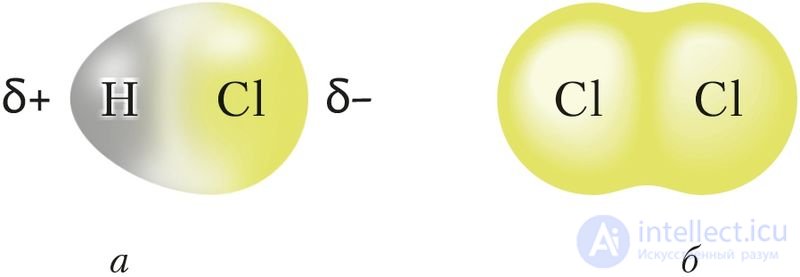
Fig. 40. Models of the polar molecule HCl and the nonpolar molecule Cl2
A weak electrostatic attraction also exists between nonpolar molecules, for example those of chlorine. It is explained by the formation of instantaneous dipoles resulting from the motion of electrons in atoms belonging to neighboring molecules (Fig. 40, b; 41, b).
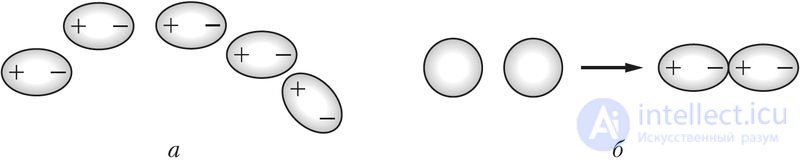
Fig. 41. Types of intermolecular interactions: a — between polar molecules,
b — between nonpolar molecules (instantaneous dipoles are formed)
It should be kept in mind that molecules with polar bonds may be nonpolar overall, that is, they may not represent dipoles. For example, the molecules  have a linear structure. However, water molecules are dipoles, since they have a bent (angular) structure (Fig. 33, p. 81).
The magnitude of the intermolecular interaction forces depends on the size of the molecules. The larger the molecule, the more easily its outer electrons are attracted to another molecule, and the stronger the intermolecular interaction. This explains the transition from the gaseous (F2, Cl2) to the liquid (Br2) and solid (I2) states of the substance in the series of halogens. As is known, the atomic radius increases down the group from fluorine to iodine. Correspondingly, the size of the molecules they form also increases (Table 14).
Table 14. Characteristics of halogen molecules
| Substance | Fluorine | Chlorine | Bromine | Iodine |
| Molecular models and their sizes | 0.142 nm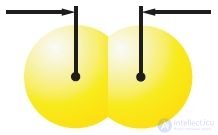 F2 |
0.198 nm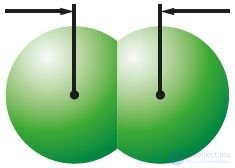 Cl2 |
0.228 nm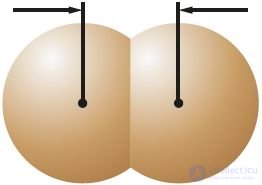 Br2 |
0.266 nm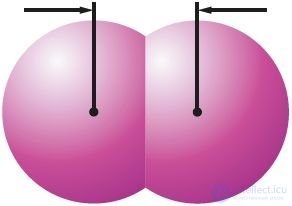 I2 |
| Boiling points, °C | –188.2 | –34.1 | +58.8 | +184.4 |
Hydrogen bonding
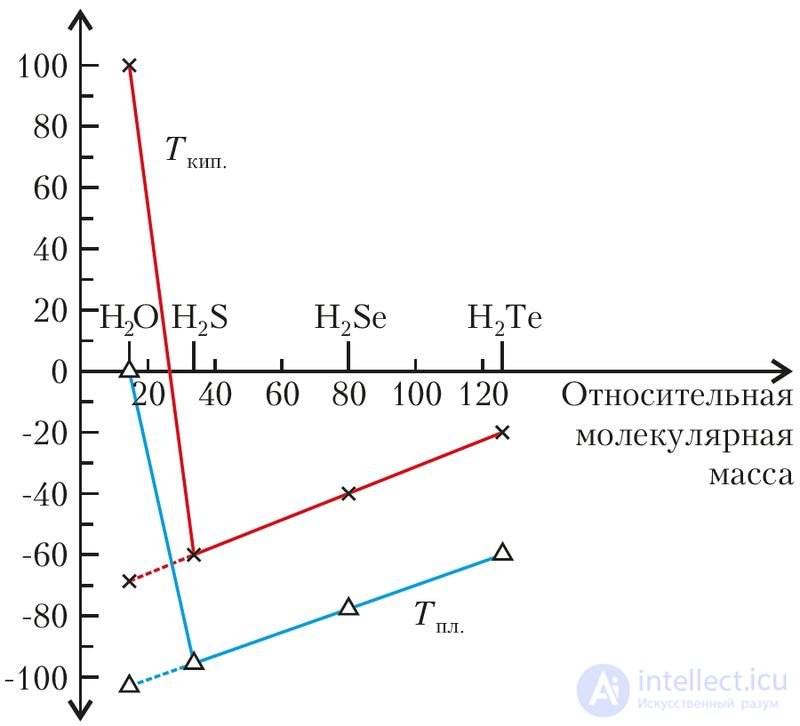
Fig. 42. Dependence of the melting
and boiling points of the hydrogen compounds
of the elements of Group VIA on the relative
molecular mass of the molecules Э2S.
The dotted line indicates the dependence
that would exist
in the absence of hydrogen bonding
When studying organic substances, you became acquainted with the pattern: the greater the mass and size of a molecule, the higher the melting and boiling points of the molecular substance. If we follow this logic, then the intermolecular interaction between water molecules should be weaker than between the molecules of the hydrogen compounds of other elements of Group VIA. In the series H2O, H2S, H2Se, H2Te, the water molecule has the smallest molecular mass — 18 a.m.u. Water should melt at a temperature of about –100 °С and boil at –80 °С. In reality, the melting point (0 °С) and boiling point (100 °С) of water are anomalously high (Fig. 42). Let us understand the reason for this.
This phenomenon can be explained by the presence, in addition to the usual intermolecular bonds between water molecules, of an additional special type of intermolecular interaction, which has come to be called a hydrogen bond.
A hydrogen bond is understood to be a bond formed as a result of electrostatic interaction between the hydrogen atom of one molecule and a more electronegative atom of another molecule that carries a negative charge and has a lone electron pair.
Let us explain the mechanism of hydrogen bond formation taking into account the electronic and spatial structure of water molecules (Fig. 43, a).
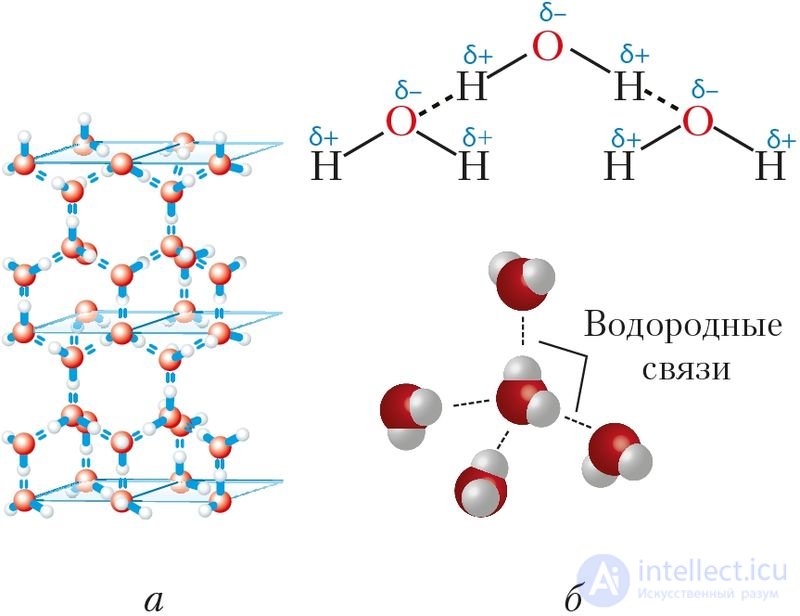
Fig. 43. Scheme of the formation of hydrogen
bonds between water molecules:
a — hydrogen bonds in the structure of ice;
b — structure of the water molecule
and notation of the hydrogen bond
Owing to the polarity of the water molecule, the positively charged hydrogen atom of one molecule is attracted by electrostatic forces to the negatively charged oxygen atom of another molecule (Fig. 43, b). This interaction also involves partial covalent bonding between the oxygen and hydrogen of neighboring molecules by the donor-acceptor mechanism. This is possible because the oxygen atom in the water molecule significantly pulls the shared electron pair away from the hydrogen toward itself, so to speak "emptying" its atomic orbital. The lone electron pair of the oxygen atom of a neighboring molecule is partially accommodated in this "empty" orbital.
A hydrogen bond is present in all substances containing hydrogen atoms chemically bonded to a more electronegative atom. But it is clearly noticeable when there is a significant difference in electronegativity between hydrogen and the atom bonded to it by a covalent bond. The strongest hydrogen bonds arise in the presence of the most electronegative elements — fluorine, oxygen, and nitrogen (Fig. 44).
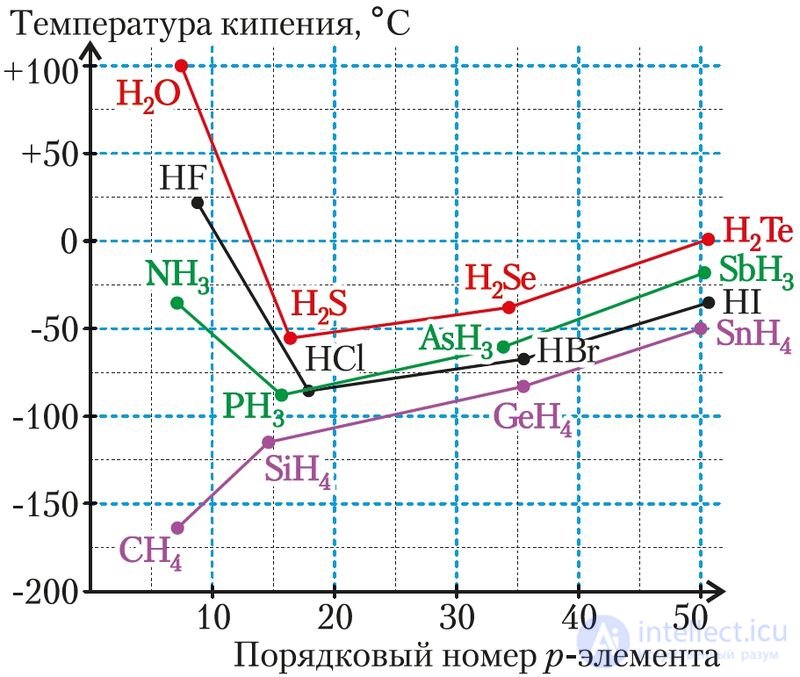
Fig. 44. Effect of hydrogen bonding
on the boiling point of the hydrogen
compounds of p-elements of Groups IVA–VIIA
A hydrogen bond has an energy of about 20–160 kJ/mol, which is considerably lower than the energy of a chemical bond (about 400–900 kJ/mol) and higher than the energy of intermolecular interaction (2–10 kJ/mol).
The uniqueness of water lies in the fact that Н2О molecules are able to form a branched network of hydrogen bonds — four per molecule (Fig. 43, b). Owing to hydrogen bonds, water has the ability to exist under terrestrial conditions simultaneously in three states of matter — solid, liquid, and gaseous. At the same time, the temperature range from 0 to 100 °С is favorable for the existence of all living things on the planet. Owing to the four hydrogen bonds, water molecules in the solid state form an open, lace-like crystalline structure of ice, similar to the structure of diamond (Fig. 43, a). The cavities in this structure make ice less dense than liquid water, which is why ice does not sink and, by covering bodies of water, prevents them from freezing to the bottom.
Strong hydrogen bonds are formed not only in water, but also between the molecules of inorganic and carboxylic acids, phenols, alcohols, ammonia, and amines.
Substances capable of forming intermolecular hydrogen bonds are usually noticeably soluble in water, have relatively high melting and boiling points, and considerable viscosity, for example glycerol and phosphoric acid.
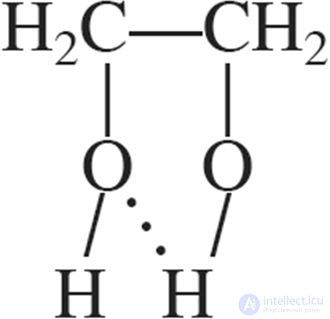
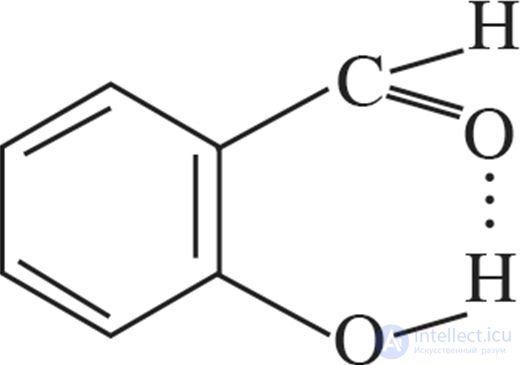
Hydrogen bonds can be not only intermolecular, but also intramolecular. Thus, cellulose macromolecules are long chains with intramolecular hydrogen bonds, arranged in parallel and joined to one another by numerous intermolecular hydrogen bonds. This gives cellulose mechanical strength while preserving elasticity (Fig. 45, a). Hydrogen bonds determine the formation of the secondary structure of protein macromolecules (Fig. 45, b).
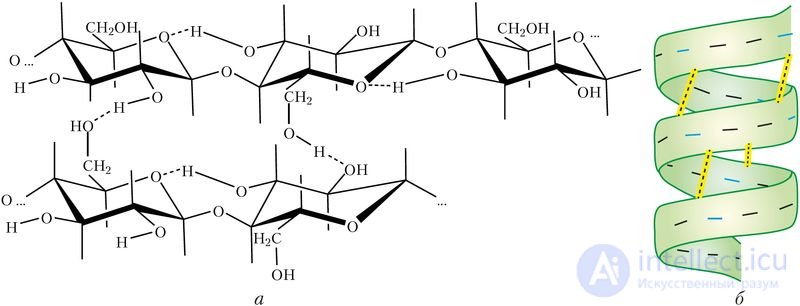
Fig. 45. Hydrogen bonds in the structure of: a — cellulose, b — protein
The state of matter of molecular substances is determined by the forces of intermolecular interaction.
The forces of intermolecular interaction are electrostatic in nature, but considerably weaker than a chemical bond.
A hydrogen bond is an electrostatic interaction between the hydrogen atom of one molecule and a more electronegative atom of another molecule that carries a negative charge and has a lone electron pair. Hydrogen bonds can also be intramolecular.
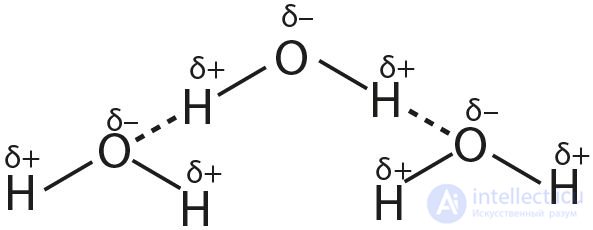
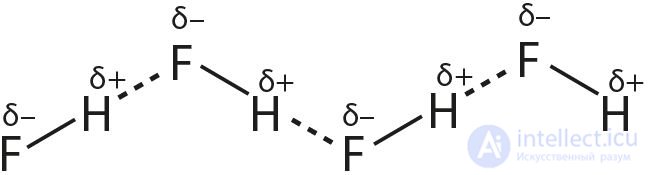
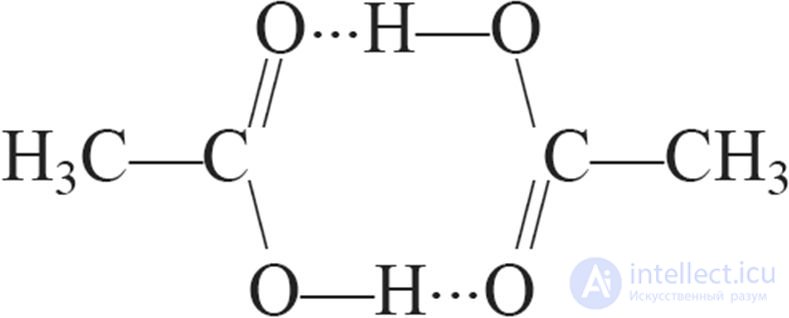
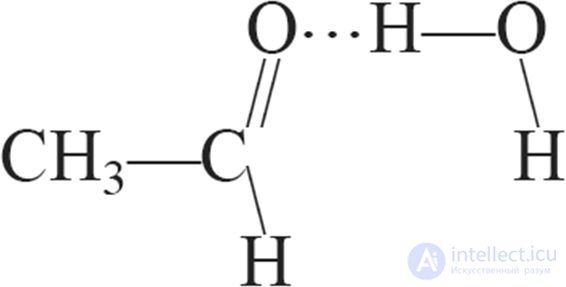
1. Describe the formation of hydrogen bonds using the example of:
2. Give examples of substances that, when dissolved in water, form hydrogen bonds between water molecules and molecules of that substance.
3. Given that the formation of hydrogen bonds is characteristic of molecules of substances containing OH groups, explain the low volatility and comparatively high viscosity of sulfuric and phosphoric acids.
4. Arrange the following molecules in order of increasing intermolecular interaction forces: Н2, He, F2, Br2, H2O. Compare these substances by their boiling points.
5. Indicate the substances for which the following may exist:
6. Explain why the boiling point of ammonia is higher than the boiling point of phosphine.
7. Explain the nature of the dependence of the boiling point of the hydrogen compound ЭHx on the atomic number of the p-element Э, using the data in Figure 44.
8. Why do molecular crystalline substances, unlike ionic ones, practically fail to conduct electric current after melting?
9. Calculate the amount of substance in a block of ice with a volume of 1 dm3. The density of ice is 0.917 g/cm3.
10. Determine the simplest formula of a substance and draw a diagram of the formation of hydrogen bonds between molecules of the substance, in which the mass fraction of carbon is 0.375, of hydrogen is 0.125, and of oxygen is 0.500.
1. Intermolecular interaction increases in the series:
2. The figure shows the formation of a hydrogen bond between:
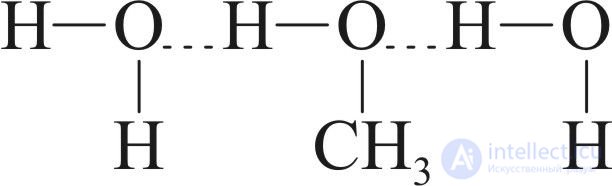
3. The first substance has a higher boiling point than the second, owing to hydrogen bonding, in the pairs:
4. The formation of an intramolecular bond is reflected by the diagrams:
5. A strengthening of intermolecular interaction leads to:

Comments