
Lecture
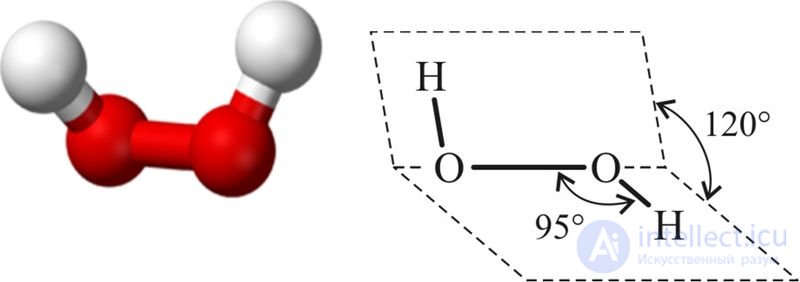
Hydrogen peroxide H2O2 is a substance of molecular structure, whose structural formula is H—O—O—H. The structure of the molecule is shown in figure 67.2.
The bond energy of H—O is 468 kJ/mol and is almost twice as high as the bond energy of O—O (210 kJ/mol). The molecule is asymmetric and polar. Hydrogen bonds exist between the molecules.
At room temperature, hydrogen peroxide is a pale blue, syrupy liquid. Compared with water, it has higher boiling and melting points: tboil. = 150.2 °C, tmelt. = 0.41 °C. It is miscible with water in any proportion, aided by the formation of hydrogen bonds with water molecules. A solution with a mass fraction of H2O2 of 30% is called perhydrol. A 3% solution is normally used in everyday life.
Hydrogen peroxide exhibits weakly pronounced acidic properties and also takes part in redox reactions. In redox reactions, the oxygen, having an intermediate oxidation state of –1, can either lower it to –2, acting as an oxidizer, or raise it to 0, acting as a reducing agent.
1. A solution of hydrogen peroxide has an acidic reaction, which is explained by the formation of hydrogen ions H+ (hydronium ions (H3O+)):

or 
Hydrogen peroxide is a very weak acid. As an acid, H2O2 reacts with some alkalis (for example, Ba(OH)2):
H2O2 + Ba(OH)2 = BaO2 + 2H2O (barium peroxide).
2. When stored in light, and also on heating, in the presence of catalysts (for example, MnO2), H2O2 decomposes into oxygen and water:
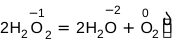 ,
,
therefore hydrogen peroxide and its solutions are stored in dark containers in a cold place, and inhibitors are added for stabilization.
3. In reactions with reducing agents (for example,  ), the oxygen atoms lower their oxidation state:
 ;
;
 .
.
4. In reactions with strong oxidizers (for example, KMnO4), the oxygen atoms raise their oxidation state:

Preparation. Hydrogen peroxide can be obtained in the laboratory by the action of sulfuric acid on metal peroxides:
BaO2 + H2SO4 = BaSO4↓ + H2O2.
Uses. Aqueous solutions of hydrogen peroxide are used as an antiseptic in medicine, as a rocket propellant oxidizer, for bleaching fabrics, and in cosmetic products for coloring hair. Its action is due to its decomposition under the effect of heat, light, and certain other substances, releasing oxygen. Other peroxides are obtained from hydrogen peroxide.
Hydrogen peroxide H2O2 exhibits weakly pronounced acidic properties. In redox reactions, hydrogen peroxide acts as both a reducing agent and an oxidizer.
1. Write out the formulas of the peroxides: H2O, H2O2, Na2O2, OF2, BaO2, CO2.
2. Write the electronic and structural formulas of hydrogen peroxide.
3. Describe the chemical bonds in the hydrogen peroxide molecule.
4. Write the equation for the decomposition reaction of hydrogen peroxide in the presence of manganese(IV) oxide. Characterize the reaction in terms of oxidation and reduction processes.
5. To a 75 g solution of hydrogen peroxide, a small portion of manganese(IV) oxide was added. As a result of the complete decomposition of the hydrogen peroxide, a gas with a volume of 0.5 dm3 was released. What was the mass fraction of peroxide in the original solution?
6. Balance the coefficients using the electron balance method:
KMnO4 + H2O2 → MnO2 + KOH + H2O + O2↑.
7. Propose the products of the reactions between hydrogen peroxide and: a) iron(II) hydroxide, b) sodium iodide. Write the equations of the reactions and indicate the transfer of electrons.
8. Propose the molecular and structural formulas of disulfane — the hydrogen compound of sulfur that is the analogue of hydrogen peroxide (in composition and structure). Write the equation for its decomposition reaction into hydrogen sulfide and sulfur.
9. Determine the substances X, Y, Z in the scheme:
 , if
, if 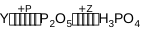 .
.
Write the equations of the corresponding reactions.
10. Calculate the volume of a hydrogen peroxide solution with a mass fraction of 3% (density 1.01 g/cm3) that can be prepared from 1 dm3 of perhydrol (density 1.112 g/cm3, mass fraction of H2O2 30%).
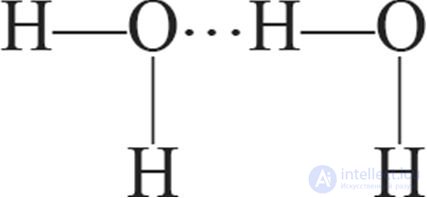
1. The scheme for the formation of a hydrogen bond between molecules of water and hydrogen peroxide:
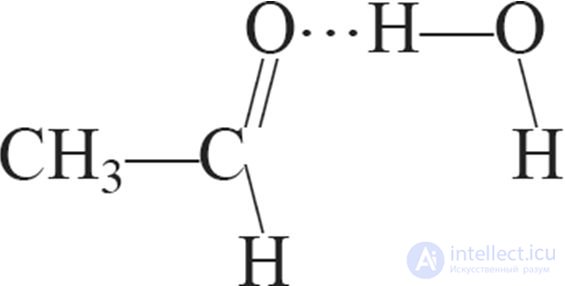
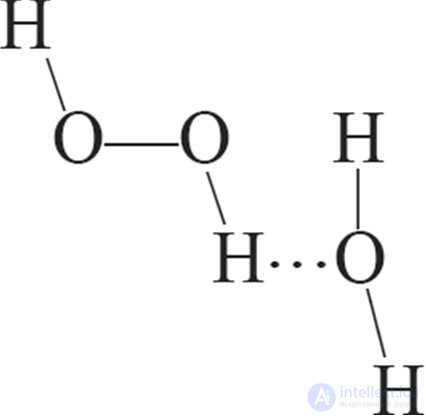
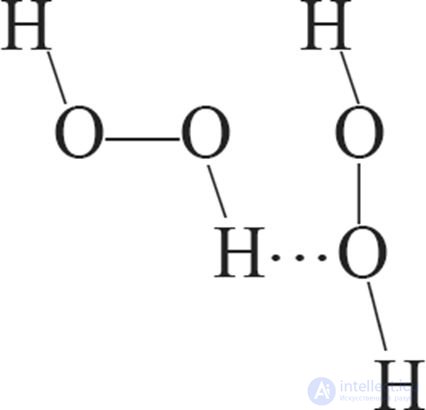
2. The sum of the coefficients in the equation of the reaction H2O2 + PbS → H2O + PbSO4 is equal to:
3. Oxygen atoms have an oxidation state of –1 in the compounds:
4. Hydrogen peroxide is formed in reactions with the schemes:
5. The following statements about hydrogen peroxide are correct:

Comments