
Lecture
You are already familiar with mixtures of substances — solutions and mechanical mixtures — and with their classification (Fig. 50). Recall that mechanical mixtures form as a result of simply mixing substances without the formation of a chemical bond between them or other chemical changes. Each component of such a mechanical (heterogeneous) mixture retains its composition and properties.
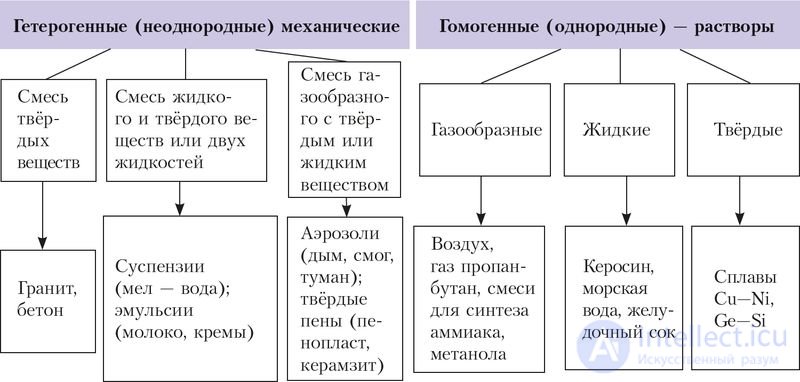
Fig. 50. Classification of mixtures
You are also already familiar with solutions — homogeneous stable systems of variable composition, consisting of several components. Liquid (aqueous and non-aqueous), gaseous, and solid solutions are distinguished. Some examples of them are shown in Figure 50. We will consider mainly aqueous solutions.
Unlike mechanical mixtures, solutions are uniform, that is, there are no phase boundaries. In addition, solutions are stable, since under unchanged conditions (concentration of the dissolved substance, temperature, pressure) they remain homogeneous systems indefinitely.
The physicochemical process in which the particles of the dissolved substance and the solvent interact to form a homogeneous stable system of variable composition is called dissolution.
The chemical side of the dissolution process consists in the breaking of bonds between the particles of the dissolved substance and their interaction with the molecules of the solvent. During dissolution, physical processes of mutual diffusion of the particles of the dissolved substance and the water molecules take place.
The solvent is the component of a solution whose state of aggregation does not change during the formation of the solution.
In liquid solutions and mixtures of gases, the solvent is usually the component that predominates in the solution by amount. Nevertheless, in aqueous solutions, regardless of the concentration of the dissolved substance, water is considered the solvent, for example in a sulfuric acid solution with a mass fraction of 98%, or medicinal alcohol with an ethanol mass fraction of 97%.
Gases, liquids, or other solids can be dissolved in solids. For instance, gaseous hydrogen dissolves readily in metals: 900 volumes in one volume of palladium at 80 °C. About 70 volumes of oxygen dissolve in one volume of platinum at 450 °C. These solid solutions have enhanced catalytic activity in many redox processes.
The formation of solid solutions of high-molecular-weight compounds with liquid plasticizers is of great importance in polymer chemistry. For example, in the presence of plasticizers, rigid polyvinyl chloride, from which window frames and vinyl siding are made, turns into a much more flexible material, which makes it possible to produce hoses, electrical cable sheathing, and the like from it.
Solid solutions form during the alloying of metals and their alloys — the addition of small amounts of special impurities to the base material to improve its physical and chemical properties: wear resistance, strength, plasticity, and corrosion resistance. Semiconductor materials based on solid solutions are indispensable in the production of electronic devices.
An example of a gaseous solution is air, which is a mixture of gaseous oxygen, nitrogen, carbon dioxide, noble gases, and water vapor, in which nitrogen predominates.
Examples of liquid solutions are petroleum — a mixture of liquid hydrocarbons — and vinegar — a solution of acetic acid in water. Water is the most common solvent. The main reason water exhibits the properties of a good solvent, in particular for salts and molecular compounds with polar bonds, is the structure of its polar molecules, which are dipoles. Water's dissolving properties are considerably enhanced by its ability to form intermolecular hydrogen bonds with polar molecules.
So, liquid and solid solutions are not a mechanical mixture of particles of solvent and dissolved substance, but the product of physicochemical processes as a result of which the interphase boundary disappears and a homogeneous system forms.
As a substance dissolves, its concentration in the solution increases, and the process itself slows down. In a saturated solution, the excess of undissolved substance is in dynamic equilibrium with the solution: the rate of dissolution of the substance's particles equals the rate of their return from the solution back into the original phase (gas, liquid, or crystal).
Electrostatic interaction takes place between the particles of the dissolved substance and the solvent. It occurs when electrolytes — salts, alkalis, and others — dissolve in water, when the polar water molecules bind by Coulomb attractive forces to the cations and anions of the electrolyte.
Intermolecular interaction between the dissolved substance and the solvent can occur through the formation of hydrogen bonds, for example, between water molecules and molecules of alcohols, amines, ammonia, and others.
The interaction between the solvent molecules and the particles of the dissolved substance is of decisive importance. Thus, helium is a gas made up of the smallest atoms, and at the same time it is the least soluble gas in water. It follows that the solubility of a substance is not the ability of its particles to fit between the molecules of water (or another solvent), but the ability to interact with them.
Energy must be expended to break the chemical bonds between the particles of the dissolved substance. Consequently, the amount of heat in the system decreases, and the first stage of dissolution is an endothermic process. When the particles of the dissolved substance bind with the solvent during the second stage of the dissolution process, energy, on the contrary, is released. This is an exothermic process, and the amount of heat increases. The total thermal effect of the dissolution process equals the sum of two quantities:
Q(dissolution) = –Q(breaking of chemical bonds) + Q(formation of chemical bonds).
Experimental data show that when solid substances dissolve, in some cases heat is released, and in others it is absorbed. For example, when ammonium nitrate NH4NO3 dissolves in water, strong cooling of the solution is observed. The reason is that the amount of heat released by the interaction of the cations  and anions
  with water molecules is less than the amount of heat required to break the ionic bonds in ammonium nitrate crystals (Q(dissolution) = –26.4 kJ/mol). Another example is the dissolution of potassium hydroxide in water, which is accompanied by strong heating of the solution. In this case, the energy released by the interaction of K+ and OH– ions with water molecules is greater than the energy required to break the bonds between these ions in crystalline KOH (Q(dissolution) = +55.6 kJ/mol).
The dissolution of gases and liquids in water is usually accompanied by the release of heat, since practically no energy is spent on breaking the bonds between the molecules of the original substance.
As a rule, substances similar in physical and chemical properties dissolve well in one another, that is, the empirical rule "like dissolves like" applies. For example, substances made up of polar molecules and substances with an ionic type of chemical bond dissolve well in polar solvents (water, ethanol). Nonpolar substances dissolve well in nonpolar solvents (benzene, toluene).
Insoluble gases (for example, He, Ne, H2, N2, CO) have a solubility of less than 2 cm3/100 g of water. Many solids are insoluble in water: oxides (for example, CuO, ZnO, Fe2O3, Cr2O3, Al2O3, SiO2), marked with the letter N in the solubility table, as well as salts and bases. Liquid and solid alkanes and cycloalkanes are insoluble in water.
Substances slightly soluble in water (marked M in the solubility table) include the solids: Ca(OH)2, LiF, BaF2, MgCO3, Li3PO4; the liquids: benzene, toluene, CCl4, CHCl3, CH2Cl2; the gases: Ar, Kr, Xe, O2, NO, N2O, gaseous alkanes and alkenes.
Substances soluble in water (marked P in the solubility table) are:
, K+, Na+, Rb+, Cs+; H3PO4; most amino acids;By dissolving a substance in water, one can obtain saturated and unsaturated solutions.
A saturated solution is one in which, at a given temperature, no more of the substance will dissolve. Correspondingly, in an unsaturated solution an additional amount of the substance can be dissolved.
It is precisely to saturated solutions that the quantitative characteristic of a substance's ability to dissolve, or solubility, applies. Solubility is measured by determining the content of the dissolved substance in its saturated solution at a given temperature.
The numerical characteristic most often used is solubility (s). Solubility is numerically equal to the maximum mass of a substance capable of dissolving, at a given temperature, in 100 g of solvent. Thus, s10(KNO3) equals 21 g/100 g of water at 10 °C.
The solubility of a gas is defined as the maximum volume of gas (V, cm3) that dissolves in 100 g of solvent at given temperature and pressure. A commonly used unit is the number of volumes of dissolved gas per one volume of water.
Solubility is often measured in other quantities as well, indicating the mass fraction or molar concentration of the dissolved substance in a saturated solution. These same quantities are used to express quantitatively the composition of unsaturated solutions. You will make use of these quantities when studying the material of the next section.
As you already know, substances are conventionally divided into three groups by their solubility in water (see the second endpaper). A substance is considered soluble if more than 1 g of the substance dissolves in 100 g of water at 20 °C, or 100 cm3 in 100 g of water in the case of gases. A substance is slightly soluble if its solubility is in the range from 0.01 to 1 g per 100 g of water, and practically insoluble if its solubility is less than 0.01 g per 100 g of water.
Concentrated solutions contain a large amount of dissolved substance, while in dilute solutions the concentration of dissolved substance is low. The division of solutions into concentrated and dilute is conventional. It is not connected to the division into saturated and unsaturated solutions. For example, a saturated solution of BaSO4 contains 0.0002448 g of salt per 100 g of water at 20 °C. This means it is a very dilute solution. A saturated solution of KOH contains 112 g/100 g of water. If 80 g of KOH is dissolved in 100 g of water, the result is a concentrated but unsaturated solution.
The solubility of solid and liquid substances depends on their nature and the temperature of the solution. As temperature increases, the solubility of most solids and liquids increases noticeably (Fig. 51). Upon cooling, solubility accordingly decreases, and part of the substance precipitates out — that is, crystallizes.
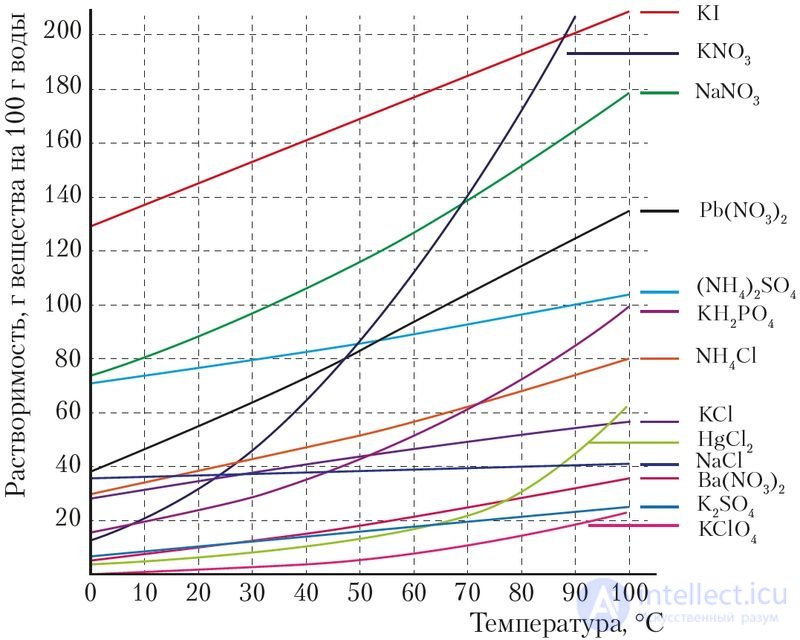
Fig. 51. Dependence of the solubility of solids on temperature
Crystallization plays a huge role in nature: it leads to the formation of many minerals, for example halite (NaCl), sylvite (KCl), stalactites and stalagmites (CaCO3). In industry, the crystallization method is used to grow large crystals of NaCl and LiF for optical instruments, and crystals of SiO2 for ultrasonic generators, microphones, and the like.
The solubility of gases in water depends on their nature, temperature, and pressure (Figs. 52, 53).
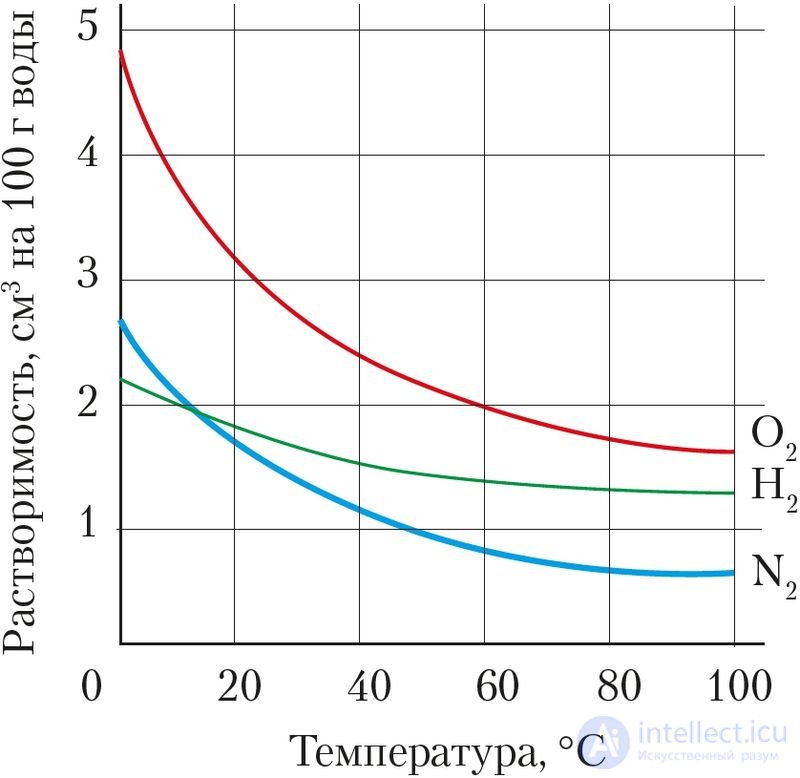
Fig. 52. Dependence of the solubility
of gaseous substances in water
on temperature
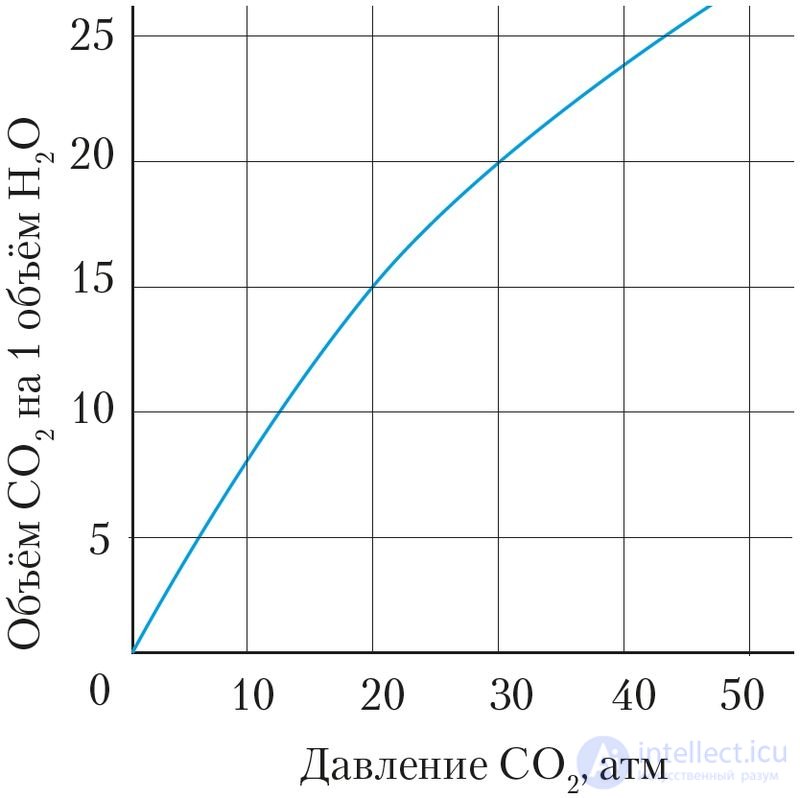
Fig. 53. Dependence of the solubility
of carbon dioxide in water on pressure
Heat is released when gases dissolve. As temperature rises, their solubility decreases. As pressure increases, the solubility of a gas increases. Therefore, when stating the solubility of a gas in water at a given temperature, the solubility at a gas pressure of 1 atm, or 101.325 kPa, is meant.
Some liquids, such as H2SO4, HNO3, HF (tboil = 19.5 °C), CH3COOH, HCOOH, CH3OH, C2H5OH, ethylene glycol, glycerol, and acetone, mix with water in any proportion, so they are said to have unlimited solubility.
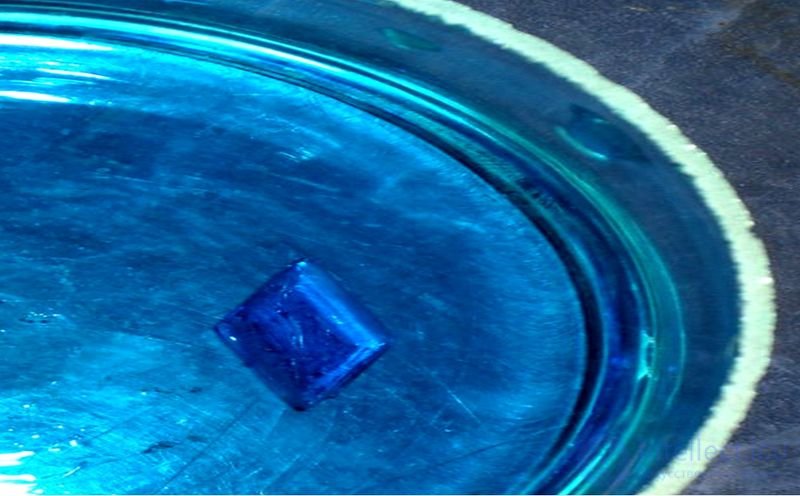
Fig. 53.1. A crystal of copper sulfate CuSO4 · 5H2O in its saturated solution
Various calculations can be carried out using solubility curves, examples of which are shown in Figures 51–53. For instance, one can determine the mass of substance that precipitates out of a saturated solution upon cooling. For example, the solubility curve shows that if a solution of potassium nitrate saturated at 70 °C is prepared in 100 g of water and this solution is then cooled to 30 °C, salt with a mass of 140 – 50 = 90 g will precipitate from it.
The repeated crystallization of compounds from their saturated solution by cooling it or evaporating part of the solvent is called recrystallization and forms the basis of a method for purifying solid substances. During recrystallization, soluble impurities usually remain in solution and do not precipitate, since they form an unsaturated solution.
If a small crystal of a substance is placed in its saturated solution, then, as the solvent evaporates, the dissolved substance will be deposited on the surface of this crystal, and a large, homogeneous crystal will form (Fig. 53.1).
In a number of cases, as a result of the physicochemical interaction of the particles of a dissolved substance with water, compounds called hydrates form. This process is called hydration. In this process the water molecules are not destroyed, but bind to the molecules or ions of the dissolved substance.
Hydrates are products of the addition of water to inorganic and organic substances, in which the water molecule is present as a separate structural unit.
Many hydrates readily decompose, although they can also form stable compounds. In a number of cases, after evaporating the solvent and crystallizing the dissolved compound, crystalline hydrates can be isolated.
Most crystalline hydrates are salts. Crystalline hydrates form when, in the crystal lattice, cations bind to water molecules more strongly than to the anions in crystals of the anhydrous salt. The composition of a crystalline hydrate is expressed by a formula indicating the number of molecules of water of crystallization per structural unit of the substance, for example, washing soda Na2CO3 · 10H2O, gypsum CaSO4 · 2H2O, copper sulfate CuSO4 · 5H2O. You are already familiar with these crystalline hydrates from the 8th- and 9th-grade chemistry courses.
Sometimes crystalline hydrates are formed by acids (oxalic, citric), bases (KOH · 2H2O, NaOH · H2O, Ba(OH)2 · 8H2O), and also some carbohydrates (glucose) and their derivatives (sorbitol).
Crystalline hydrates are crystalline products of the addition of water to inorganic and organic substances, having a definite composition and including water molecules as a separate structural unit. The water contained in crystalline hydrates is called water of crystallization.
Many crystalline hydrates are brightly colored. For example, anhydrous CoCl2 is blue. As a result of hydration it turns into the dark pink crystalline hydrate CoCl2 · 6H2O (Fig. 54, a) and can therefore be used as an indicator of the presence of water. Copper(II) sulfate can play a similar role: anhydrous CuSO4 is pale blue, while the crystalline hydrate CuSO4 · 5H2O is bright blue (Fig. 54, b).
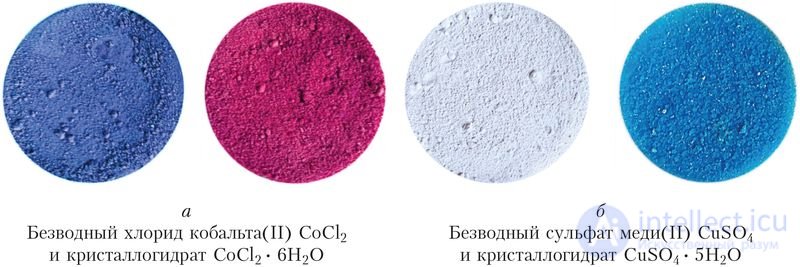
Fig. 54. Anhydrous salts and crystalline hydrates
The process of forming crystalline hydrates is used in construction. For example, cement powder consists mainly of a mixture of the anhydrous crystals 3CaO · SiO2 and 2CaO · SiO2. When cement is mixed with water, processes of hydration and formation of the crystalline hydrates 3CaO · SiO2 · 3H2O and 2CaO · SiO2 · 3H2O take place. As this happens, the plastic cement paste, resembling dough in consistency, hardens and turns into cement stone.
The water molecules in hydrates bind to the molecules or ions of the dissolved substance through donor-acceptor and electrostatic interaction or through the formation of hydrogen bonds.
In hydrates, the molecules or ions of the dissolved substance turn out to be surrounded by water molecules bound to them more or less tightly, and the number of these water molecules can vary.
The hydrate theory of solutions was proposed by D. I. Mendeleev. He wrote: "Solutions are chemical compounds determined by the forces acting between the solvent and the dissolved substance."
The fact that the formation of solutions is to a considerable degree a chemical interaction is confirmed not only by the release or absorption of heat during dissolution, but also by the decrease in the volume of the solution compared with the initial total volume of its components. For example, mixing 50 mL of ethanol with 50 mL of water produces 97 mL of solution. The solution also warms up slightly in the process.
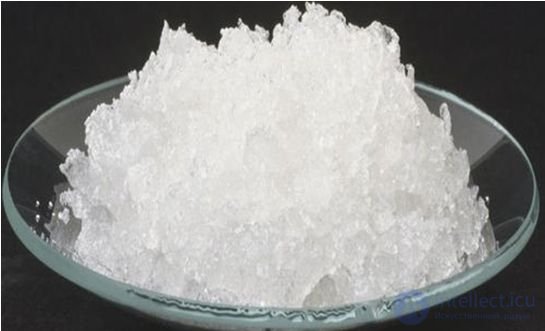
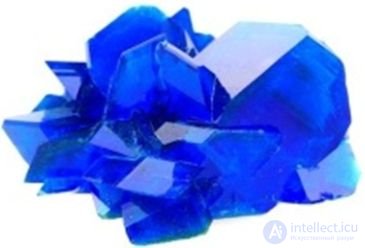
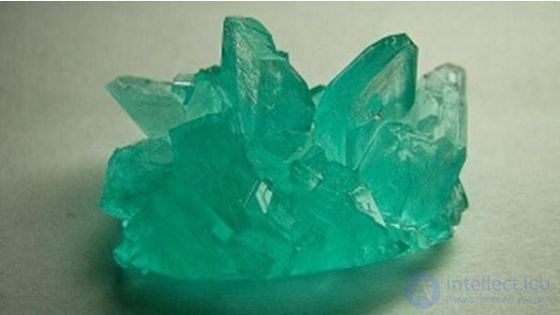
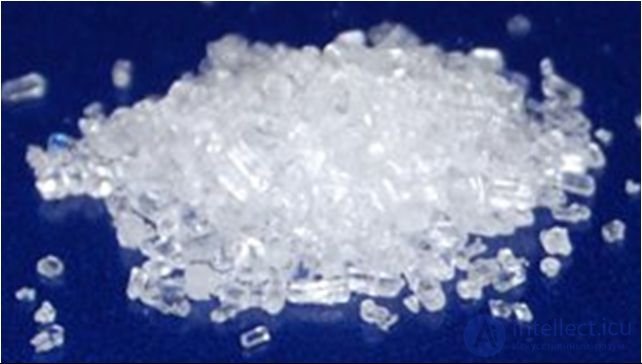
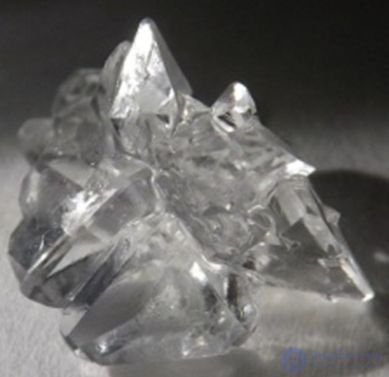
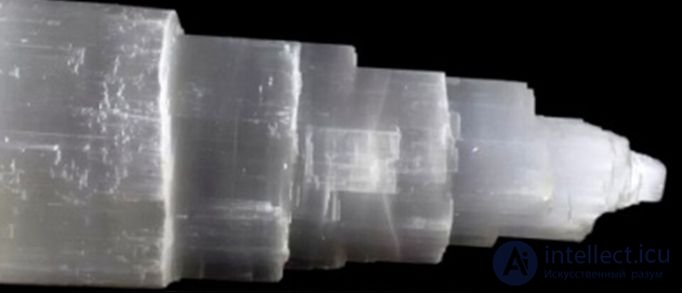
Table 15.1 gives examples of the most common crystalline hydrates.
Table 15.1. Formulas, appearance, and names of crystalline hydrates
| Name of crystalline hydrate | Chemical formula | Appearance |
|---|---|---|
| Washing soda, sodium carbonate decahydrate | Na2CO3 · 10H2O |
|
| Copper sulfate, copper(II) sulfate pentahydrate | CuSO4 · 5H2O |
|
| Iron sulfate, iron(II) sulfate heptahydrate | FeSO4 · 7H2O |
|
| Zinc sulfate, zinc(II) sulfate heptahydrate | ZnSO4 · 7H2O |
|
| Glauber's salt, sodium sulfate decahydrate | Na2SO4 · 10H2O |
|
| Gypsum, calcium sulfate dihydrate | CaSO4 · 2H2O |
|
Solutions are homogeneous stable systems of variable composition, consisting of several components.
Dissolution is a physicochemical process accompanied by the release or absorption of heat.
The solubility of substances depends on their nature and temperature. The solubility of gases is affected by pressure.
Crystalline hydrates are crystalline products of the addition of water to inorganic and organic substances, having a definite composition and including water molecules as a separate structural unit.
1. Give examples of solid, liquid, and gaseous solutions. Indicate the areas of application of solid solutions.
2. Indicate the main differences between a solution and a mechanical mixture of substances.
3. Using the data of the solubility table on the textbook's endpaper, give two examples each of:
Write their formulas.
4. The following compounds are given: hydrogen chloride, potassium nitrate, potassium chloride, sodium chloride, sulfur(IV) oxide, ammonia. Using the solubility curves (Fig. 51) and your knowledge of the solubility of gases, determine the substances whose solubility in water, as temperature rises:
5. Name the processes of interaction between water molecules and the substance being dissolved during the formation of an aqueous solution.
6. Using the solubility curves (Fig. 51), find the solubility of the salts sodium nitrate, ammonium chloride, and sodium chloride at 20 °C, 50 °C, and 70 °C.
7. The solubility of sodium nitrate NaNO3 at 10 °C is 80 g per 100 g of water. Determine the mass fraction of the salt in the saturated solution at this temperature.
8. The mass fraction of KNO3 in a solution saturated at 20 °C is 24.0%. Determine the solubility of KNO3 at 20 °C (g/100 g of water).
9. Calculate by how many grams the mass of 500 g of anhydrous calcium sulfate differs from the mass of its dihydrate crystalline hydrate (gypsum).
10. The solubility of ammonia at 0 °C is 1153 volumes per 1 volume of water, and at 30 °C it is 532 volumes (at STP) per 1 volume of water. A solution saturated at 0 °C with a mass of 250 g was heated to 30 °C. How did its mass change? What volume (at STP) of ammonia was released upon heating? Confirm your answer with a calculation.
1. The process of dissolving NaCl in water is accompanied by:
2. Sodium sulfate decahydrate corresponds to the formula:
3. The following systems are solutions:
4. The solubility of a gas in water can be increased by:
5. The solubility of potassium nitrate is s10(KNO3) = 60 g/100 g of water. Its solution with a mass fraction of 0.375 is:

Comments