
Lecture
Sulfur, exhibiting oxidation states +4 and +6, forms two stable oxides of composition  — sulfur(IV) oxide, or sulfur dioxide, and
  — sulfur(VI) oxide.
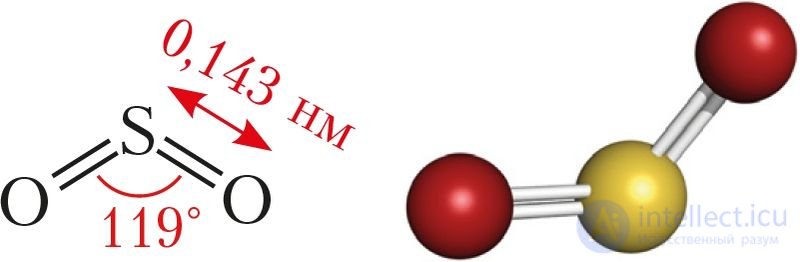
Fig. 79. Structural formula and ball-and-stick model of the sulfur dioxide molecule
Sulfur(IV) oxide  is a substance of molecular structure (Fig. 79).
Physical properties. Under normal conditions, sulfur(IV) oxide is a colorless gas with a characteristic sharp odor — the smell of a struck match. The gas is toxic. About 40 volumes of the gas dissolve in one volume of water at 20 °C, which is much lower than for hydrogen chloride and ammonia.
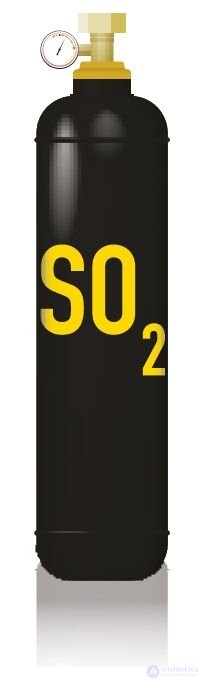
Fig. 80. Storage of liquefied sulfur dioxide (sulfurous anhydride)
Its boiling point is much higher than that of oxygen and equals –10 °C. The gas readily liquefies at room temperature under a moderate pressure, which makes it possible to store and transport the liquefied gas in cylinders (Fig. 80).
Chemical properties. In reactions proceeding without a change in oxidation state, sulfur(IV) oxide should display the properties of an acidic oxide: with water it should form an acid, and with alkalis and basic oxides — salts. Since the lowest oxidation state of sulfur is –2 and the highest is +6, it should be expected that sulfur dioxide is capable of reactions involving both an increase and a decrease in the oxidation state of sulfur.
When the oxidation state increases, sulfur atoms "lose" electrons. This means the oxide displays reducing properties, that is, it reacts with oxidizing agents, for example oxygen or chlorine. When the oxidation state decreases, sulfur atoms gain electrons, and sulfur dioxide acts as an oxidizing agent. This occurs upon reaction with strong reducing agents, for example CO or PH3.
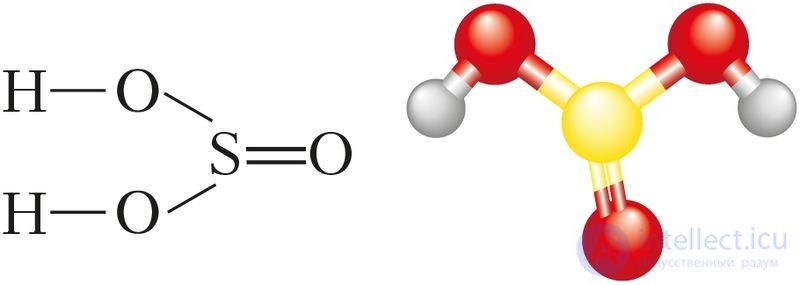
Fig. 81. Structural formula and ball-and-stick model of the sulfurous acid molecule
Let us comment on the above and illustrate it with equations of chemical reactions.
I. Reactions without a change in oxidation state.
1. Reaction with water. When sulfur dioxide is passed through water to which litmus has been added, the color changes from violet to red — sulfurous acid is formed:

The structural formula of sulfurous acid is shown in Figure 81.
Sulfurous acid is weak. Being a dibasic acid, it dissociates in stages:
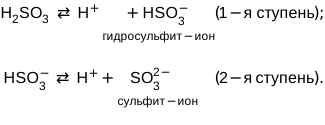
This also means that sulfurous acid forms two series of salts — normal (sulfites) and acid (hydrosulfites).
2. Reaction with alkali solutions leads to the formation of salts. The composition of the products depends on the molar ratio of the reactants:
 2 : 1 or excess alkali |
(sodium sulfite) |
 1 : 1 or excess acidic oxide |
(sodium hydrosulfite) |
3. With basic oxides sulfur dioxide also forms salts:
СаО + SO2 = СаSO3.
II. Reactions with a change in oxidation state.
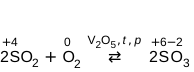
Reactions with oxidizing agents. Reaction with oxygen leads to the formation of sulfur(VI) oxide:
 ,
,
which demonstrates the reducing properties of sulfur(IV) oxide.
The reaction is reversible and proceeds at an appreciable rate only at elevated temperature (above 440 °C) in the presence of catalysts (for example, V2O5).
Reactions with reducing agents. An example of such a reaction is the disposal of sulfur dioxide using carbon. This is how sulfur is obtained from waste gases in the metallurgical industry:
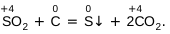
Uses of sulfur(IV) oxide. On an industrial scale, sulfur dioxide is an intermediate product in the production of sulfuric acid. As a food additive (E220) it is used in the food industry as a preservative. Vegetable and fruit storage facilities are fumigated with it for disinfection purposes. It is used for bleaching silk and wool, since chlorine cannot be used in this case.

Sulfur dioxide forms when sulfur is burned and when metal sulfides (for example, pyrite, zinc sulfide) are roasted.
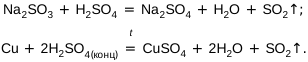
In the laboratory, sulfur(IV) oxide is obtained by the action of sulfuric acid on sulfites or on copper:
It should be noted that sulfur dioxide is one of the pollutants of the atmosphere. Its sources are ferrous and nonferrous metallurgy plants and thermal power stations.
Sulfur(VI) oxide  is the highest oxide of sulfur (Fig. 82).

Sulfur(VI) oxide forms upon oxidation of sulfur dioxide by oxygen or ozone:

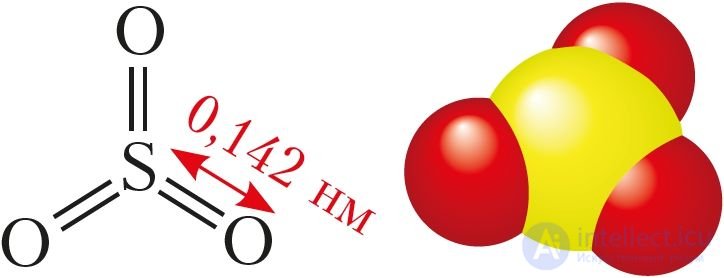
Fig. 82. Structural formula and space-filling model of the sulfur(VI) oxide molecule
Physical properties. Sulfur(VI) oxide is a colorless liquid over a narrow temperature range: from 16.9 °C to 44.9 °C. It has a suffocating odor. Contact with skin causes severe burns.
Chemical properties.  is a typical acidic oxide and a strong oxidizing agent. As an acidic oxide it reacts with water, forming sulfuric acid:
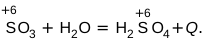
In reactions with alkalis and basic oxides it forms salts:
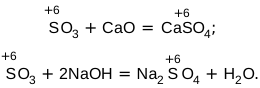
A special property of sulfur(VI) oxide is its ability to dissolve in sulfuric acid.
Such a solution is called oleum. It is a colorless, oily, viscous liquid, or even crystals, that fumes in air.
Oleum is transported in steel tank cars. Dilution of oleum gives sulfuric acid of the required concentration. In this process, the acid is initially diluted with sulfuric acid, since pouring oleum into water causes boiling, producing a toxic sulfuric acid mist.
Besides sulfuric acid, oleum also contains other sulfur(VI) acids, for example disulfuric (or pyrosulfuric) acid:
SO3 + H2SO4 = H2S2O7.

As an oxidizing agent, SO3 reacts with reducing agents. The sulfur atoms in the oxide have the highest oxidation state, +6, and can only decrease it, accepting electrons from reducing agents. An example of the oxidizing properties of sulfur(VI) oxide is its reaction with phosphorus as the reducing agent:

The most important oxygen compounds of sulfur are two acidic oxides — sulfur(IV) oxide, or sulfur dioxide SO2, and sulfur(VI) oxide SO3. As acidic oxides, they form acids on reaction with water and salts in reactions with alkalis and basic oxides.
Sulfur(IV) oxide  displays both oxidizing and reducing properties, while sulfur(VI) oxide
  displays only oxidizing properties.
1. Write the formulas of the sulfur oxides and the corresponding acids, and give their names.
2. Name the areas of use of sulfur dioxide.
3. Sulfur dioxide was passed briefly into a flask of distilled water, after which several drops of indicator were added. Name the color of the flask's contents if the indicator used was:
4. For sulfur dioxide, calculate:
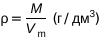 ;
;5. Fill in the table "Chemical properties of sulfur oxides" with the corresponding reaction equations for the reagents H2O, KOH, CaO, O2.
| Reagents | Sulfur(IV) oxide | Sulfur(VI) oxide |
Draw a conclusion about the similarities and differences in the chemical properties of the indicated sulfur oxides.
6. Calculate the volume (at standard conditions) of sulfur(IV) oxide that reacted with a sodium hydroxide solution if this formed 37.8 g of the normal salt.
7. Write the equations of the reactions according to the scheme, and name each of the starting substances:
 ;
; .
.8. Calculate the minimum volume (at standard conditions) of sulfur dioxide that must be passed through a 200 g solution with a sodium hydroxide mass fraction of 2 % in order to obtain only the acid salt.
9. Balance the coefficients using the electron balance method:
 ;
; .
.Indicate whether SO2 is the oxidizing agent or the reducing agent.
10. Calculate the mass fraction of sulfur in a mixture containing 0.5 mol of sodium sulfite and 0.2 mol of sodium hydrosulfite.
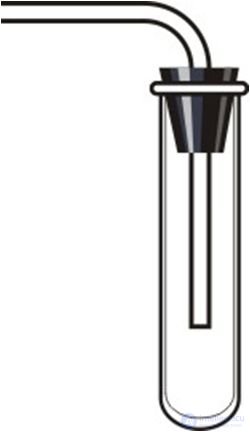
1. A vessel can be filled with sulfur dioxide with the least loss:


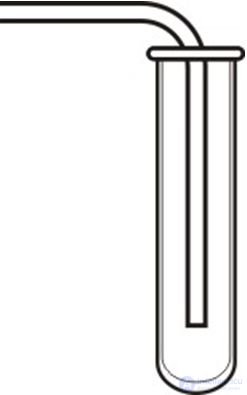
2. Under normal conditions, sulfur(VI) oxide is:
3. Regarding both sulfur oxides (IV, VI), it is true that:
4. Sulfur(VI) oxide displays the properties of an acidic oxide when reacting with:
5. The sum of the coefficients in the equation for the reaction of sulfur dioxide with excess potassium hydroxide, written in full ionic form, equals:

Comments