
Lecture
The periodic law and D. I. Mendeleev's periodic system of chemical elements is the greatest discovery in the history of science (Fig. 23). It marked the beginning of a new era in the development of chemistry. Chemists gained a tool that made it possible to predict the discovery of new elements and to carry out scientific research aimed at creating new substances and materials.
N. Bohr called Mendeleev's periodic system "the guiding thread in developing the theory of the electronic structure of the atom." On the basis of the periodic system, the theory of chemical bonding, the concepts of atomic and ionic radii, electronegativity, and so on were developed. The structure of the "natural system of chemical elements," worked out by D. I. Mendeleev in 1869–1871, proved so perfect that it differs little from the modern one. Naturally, many discoveries in chemistry and physics introduced changes to it, but D. I. Mendeleev's prophetic words came true: "It appears that the periodic law is not threatened with destruction, but only promises superstructure and development."
Characterizing a chemical element by its position in the periodic system and the structure of its atom
From the position of a chemical element in the periodic system, a fairly complete characterization of it can be given. The key role is played by the atomic (ordinal) number, which determines the structure of the atom. The structure of the atom's electron shell, in turn, determines the composition of the simple and complex substances it forms and their properties.
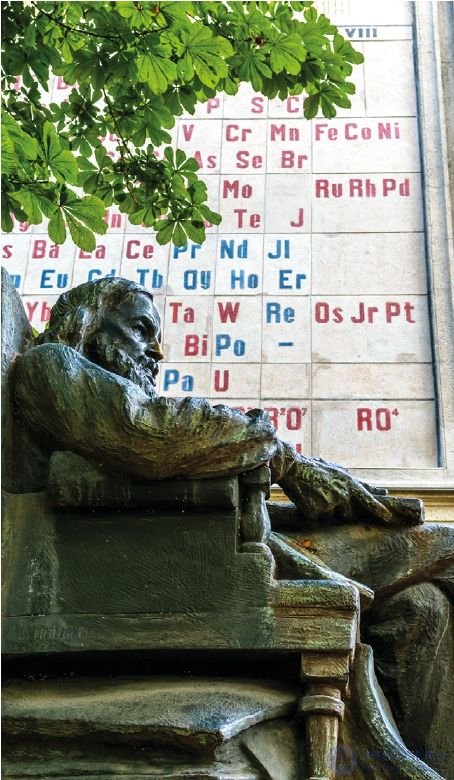
Fig. 23. Monument to
D. I. Mendeleev against the backdrop
of a mosaic panel of the periodic
table (Saint Petersburg)
While studying chemistry in grade 8, you already compiled a characterization of a chemical element. In grade 11, you will make broader use of the knowledge you have acquired about the structure of the atom and the state of electrons in the atom, and describe an element according to the following plan.
1. Position in the periodic system (atomic number, period, group), relative atomic mass.
2. Structure of the atom:
3. Oxidation states of the element's atoms (highest, lowest). Electronegativity.
4. Simple substance: chemical formula, properties of the simple substance (state of aggregation under standard conditions, metal or nonmetal).
5. Compounds of the element: the highest oxide and its corresponding hydroxide, a characterization of their acid-base properties; the formula of the hydrogen compound.
Based on the system of chemical elements he developed, D. I. Mendeleev corrected the values of the atomic masses and valences of a number of elements (Be, In, Mo, Sb, Ce, Te, Y, Th, U, and others), and predicted the existence of 10 as-yet-undiscovered elements (Sc, Ga, Ge, Po, At, Tc, Fr, Pa, Hf, Re). The discovery of these elements later became a triumph of the periodic law.
It should be noted that, in compiling a more detailed characterization, one can compare the electronegativity, metallic or nonmetallic properties of the simple substance, and the acid-base properties of the oxides and hydroxides with the analogous properties of other elements in the group or period. Assumptions about the properties of substances make it quite appropriate to write certain reaction equations. For example, acidic properties can be confirmed by writing equations for reactions with alkalis, basic properties by reactions with acids, and amphoteric properties by reactions with both acids and alkalis. However, you will gain more detailed knowledge of the acid-base and redox properties of elements when studying the sections "Nonmetals" and "Metals".
Example 1. Using the plan given above, compile a characterization of the element nitrogen.
1. The element nitrogen has the chemical symbol N, atomic number Z = 7. Nitrogen is located in the second period, a small period, in group IIA, the main subgroup. The relative atomic mass Ar(N) = 14.
2. Structure of the nitrogen atom:
a) the charge of the nitrogen atom's nucleus is +7. The nucleus of a nitrogen atom contains 7 protons. The most common isotope of nitrogen in nature is the nuclide 14N. The number of neutrons in the nucleus of this nuclide is 14 – 7 = 7;
b) the electron shell of nitrogen atoms contains 7 electrons, distributed over two energy levels; electron shell diagram: 7N 2e–, 5e–;
electron configuration formula: 7N 1s22s22p3;
electron-graphical diagram:
7N 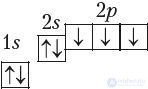
c) configuration of the outer electron layer: 2s22p3, which means nitrogen is a p-element.
3. Oxidation states of the element's atoms: the highest is +5, since there are 5 electrons in the outer energy level of the atom, the lowest is –3. Electronegativity: χ(N) = 3.0.
4. The simple substance nitrogen is a nonmetal, its state of aggregation under standard conditions is a gas, chemical formula N2.
5. Formula of the highest oxide  , nitrogen(V) oxide, acidic;
formula of the hydroxide corresponding to the highest oxide,  , an acidic hydroxide, nitric acid;
hydrogen compound  , volatile, since nitrogen is a nonmetal.
It was precisely his knowledge of these regularities that allowed D. I. Mendeleev not simply to predict the existence of many elements, but also to compile a fairly reliable characterization of their properties. At the time the table was created, only 63 chemical elements were known. For the undiscovered elements, he had to leave empty spaces in the table so as not to disrupt the periodicity. Thus, the element that should follow zinc and be located beneath aluminum he called eka-aluminum. It was not difficult for D. I. Mendeleev to guess that its relative mass would be about 70, since that of zinc is 65, and that of the next known element at the time, arsenic, is 75. Compounds of aluminum with chlorine are volatile at high temperature, which means the analogous compound of eka-aluminum should also be volatile. He ended his description of the properties of eka-aluminum with the words: "One may hope that it will be discovered by spectral analysis, just as the elements following it, indium and thallium, were discovered…" Thus, not only a description of the properties was given, but also a method of detection, setting the direction of the search.
Five years passed, and the French scientist Lecoq de Boisbaudran discovered a new element (gallium) by the spectral method, isolating it from a mineral obtained in the Pyrenees mountains. The scientist was quite surprised when, through the Paris Academy of Sciences, he received a letter from Russia. It stated that everything in the description of gallium's properties was correct except the density — not 4.7, but 5.9. Having subjected the metal to more thorough purification, Boisbaudran became convinced that an error had indeed been made initially: the density was in fact 5.9.
You have probably already guessed that the author of the letter was, of course, D. I. Mendeleev.
From the position of an element in the periodic system, a fairly complete characterization of it can be given, including information about the structure of the atom, its possible oxidation states and electronegativity values, the composition and properties of the compounds formed by atoms of this element, including their acid-base and redox properties.
1. What do you see as the significance of D. I. Mendeleev's periodic law and periodic system for the development of science?
2. Using the plan given in the text of the section, compile a description of the following chemical elements:
3. Describe the position in the periodic system of elements having the following outer electron layer configuration:
4. Write equations for reactions confirming the acidic properties of:
5. Write equations for reactions with hydrochloric acid:
6. Write equations for reactions confirming the amphoteric nature of:
7. In each pair, indicate the element with the greater electronegativity:
8. Based on the position of the elements in the periodic system, compare the acidic properties of the hydroxides of:
9. Before the discovery of the periodic law, the relative atomic mass of beryllium was taken to be 13.8, and the formula of its oxide was written as Be2O3. D. I. Mendeleev placed this element in the same group as magnesium. Determine how the atomic mass of beryllium had to change as a result. Confirm your answer with a calculation.
10. The relative density with respect to hydrogen of a hydrogen compound of composition Н2Э is 17. Determine the element.
1. The element located in group IVA in period 3 is:
2. The chemical element with atomic number 35 corresponds to the following notations:
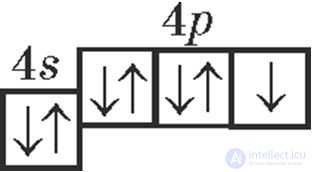 .
.3. The highest hydroxide of composition Н2ЭО4 is formed by the elements:
4. Salts are formed in reactions of acids with the highest oxides of the elements:
5. The formula of the volatile hydrogen compound of an element of period 5 is Н2Э. Identify this element:

Comments