
Lecture
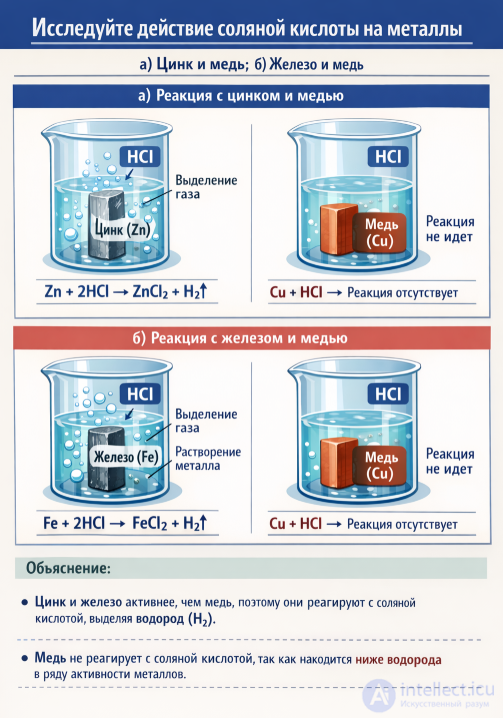
Task 1. Investigate the action of hydrochloric acid on metals:
Explain the observed phenomena.
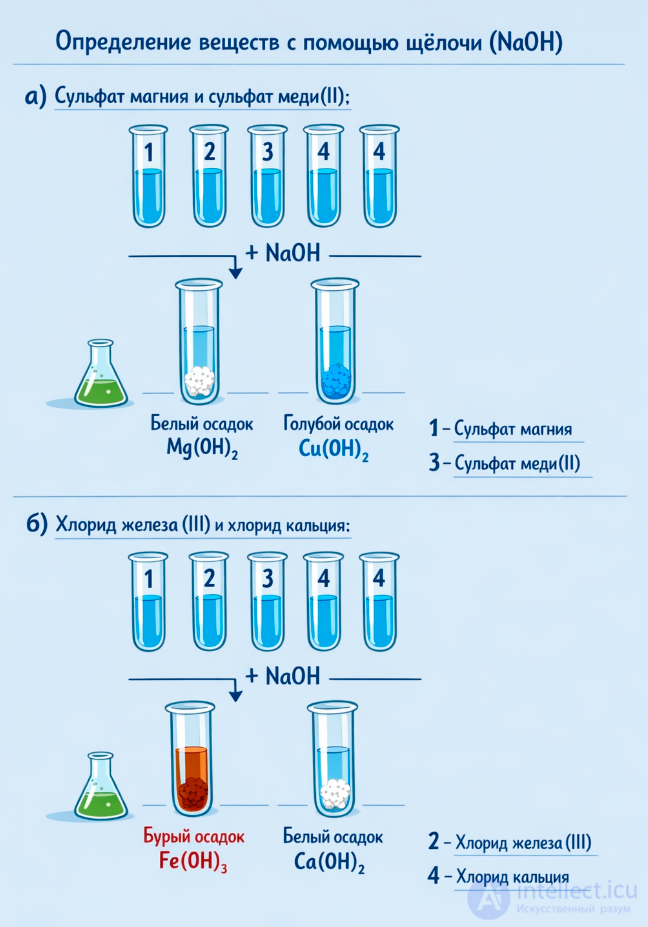
Task 2. Using alkali, determine which of the numbered test tubes provided contains the solution of each substance:
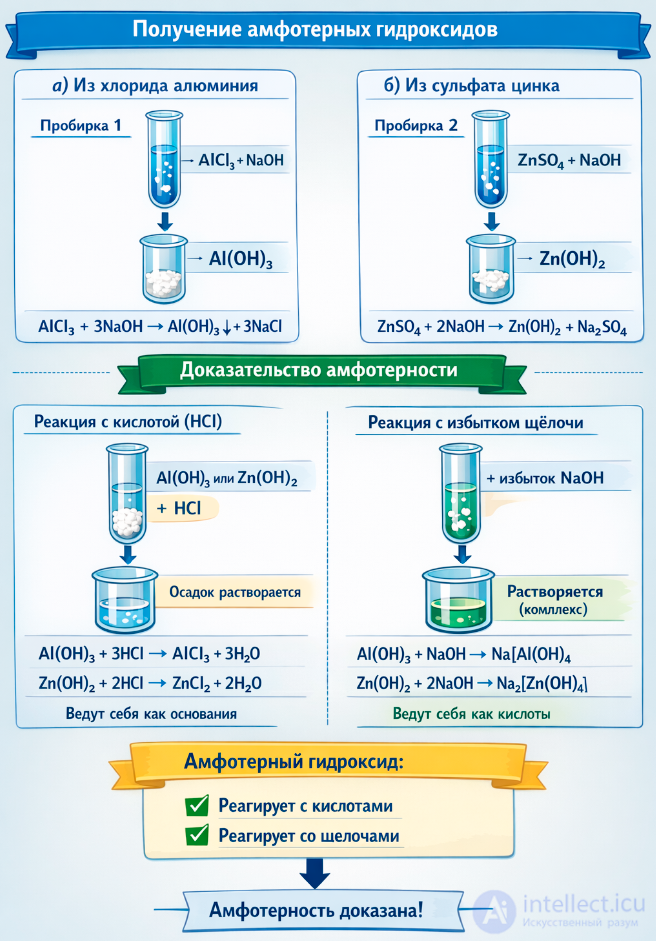
Task 3. By an exchange reaction, obtain an amphoteric hydroxide starting from:
Prove its amphoteric nature.
Task 4. Carry out reactions according to the schemes:
a) Zinc and copper + HCl:
Zinc + hydrochloric acid:
Gas bubbles (hydrogen) are observed evolving, the metal dissolves.
Reaction:
Explanation: Zinc is more active than hydrogen, so it displaces it from the acid.
Copper + hydrochloric acid:
No reaction occurs, the copper does not dissolve.
Explanation: Copper is less active than hydrogen and does not displace it from the acid.
b) Iron and copper + HCl:
Iron + hydrochloric acid:
The reaction proceeds with the evolution of hydrogen, the iron dissolves.
Copper + hydrochloric acid:
No change, as in the previous case.
Let us add alkali (for example, NaOH) to the solutions and identify the substances by the precipitates:
a) Magnesium sulfate and copper(II) sulfate:
MgSO₄ + NaOH:
White precipitate Mg(OH)₂.
CuSO₄ + NaOH:
Light blue (blue) precipitate Cu(OH)₂.
b) Iron(III) chloride and calcium chloride:
FeCl₃ + NaOH:
Brown precipitate Fe(OH)₃.
CaCl₂ + NaOH:
White precipitate Ca(OH)₂.
a) From aluminum chloride:
Reaction with alkali:
AlCl3+3NaOH→Al(OH)3↓+3NaClProof of amphoteric nature:
In excess alkali:
Al(OH)3+NaOH→Na[Al(OH)4]b) From zinc sulfate:
Reaction:
ZnSO4+2NaOH→Zn(OH)2↓+Na2SO4In excess alkali:
Zn(OH)2+2NaOH→Na2[Zn(OH)4]Conclusion: Al(OH)₃ and Zn(OH)₂ are amphoteric hydroxides; they react with both acids and alkalis.
a) Iron → FeCl₂ → Fe(OH)₂ → Fe(OH)₃:
Oxidation in air:
4Fe(OH)2+O2+2H2O→4Fe(OH)3b) CuSO₄ → Cu(OH)₂ → CuCl₂ → Cu:
Reduction:
CuCl2+Zn→Cu↓+ZnCl2
Comments