
Lecture
The occurrence of chemical reactions is always accompanied by the release or absorption of energy.
The thermal effect of a reaction is the amount of heat Q released or absorbed during a transformation, provided that the amounts of reactants (in moles) correspond to the stoichiometric coefficients of the reaction equation.
What does the value of the thermal effect of a chemical reaction depend on?
In the course of a chemical reaction, two processes take place — the breaking of chemical bonds in the starting substances and the formation of new bonds in the reaction products. The breaking of chemical bonds always requires an expenditure of energy, is accompanied by the absorption of heat Q1, and is an endothermic process. The formation of new chemical bonds is an exothermic process, proceeding with the release of heat Q2. The algebraic sum of the thermal effects of these stages represents the overall thermal effect of the reaction Q: Q = Q1 + Q2.
As an example, let us determine the value of the thermal effect of the reaction forming nitrogen(II) oxide from simple substances:
| Reaction equation | N2 | + | O2 | = | 2NO |
| Stoichiometric amount | 1 mol | 1 mol | 2 mol | ||
| Bond energy | 945 kJ/mol ∙ 1 mol | 494 kJ/mol ∙ 1 mol | 632 kJ/mol ∙ 2 mol | ||
| Energy change | Spent on breaking bonds 1443 kJ | Released upon formation of bonds 1264 kJ |
Let us analyze these records.
When breaking the bonds  in 1 mol of nitrogen and the bonds
  in 1 mol of oxygen, 945 kJ and 494 kJ of heat are absorbed respectively, totaling Q1 = –1439 kJ.
On the other hand, when bonds are formed in 1 mol of NO, 632 kJ is released, which amounts to 1264 kJ per two moles of nitrogen(II) oxide, that is, Q2 = 1264 kJ.
The overall thermal effect of the reaction Q equals the sum of the thermal effects Q1 and Q2:
Q = Q1 + Q2 = –1439 kJ + 1264 kJ = –175 kJ.
The negative value of the thermal effect shows that this reaction is endothermic and proceeds according to the thermochemical equation:
N2(g) + O2(g) = 2NO(g) – 175 kJ.
Thermochemical equations are those in which the values of the thermal effects are indicated.

The value of the thermal effect of a reaction depends on the aggregate state of the reactants and products, since melting or vaporization processes consume heat from the environment. When transitioning from liquid to solid state, or from vapor to liquid, heat is, on the contrary, released. Therefore, thermochemical equations must indicate the aggregate state: substance (г) — gas; (ж) — liquid; (тв) or (к) — solid or crystalline. Thus, the thermal effect of the combustion of hydrogen differs by 88 kJ depending on whether water is formed in a liquid or gaseous state, since the heat of vaporization of water is 44 kJ/mol:
2H2(g) + O2(g) = 2H2O(l) + 572 kJ;
2H2(g) + O2(g) = 2H2O(g) + 484 kJ.
Carrying out endothermic reactions requires the continuous supply of energy to the system in the form of heat, electromagnetic radiation (light, ultraviolet radiation), electricity, and so on. Thus, endothermic reactions either proceed at high temperatures (for example, decomposition of carbonates, nitrates, and hydroxides of alkaline earth metals), or require the input of electrical energy (electrolysis, the formation of NO in a lightning discharge) or light energy (the formation of ozone in the atmosphere under the action of ultraviolet radiation). Photosynthesis is an endothermic process in which the energy of sunlight is absorbed and stored as the chemical energy of the products — oxygen and glucose:
6СО2(g) + 6Н2О(l) = С6Н12О6(s) + 6О2(g) – 2803 kJ.
Exothermic reactions either require no heating at all or need only slight heating to begin: for example, hydrogen reacts with fluorine instantaneously, while for hydrogen to react with oxygen the gas mixture must be heated.
The value of the thermal effect of a reaction is determined experimentally in a special instrument — a calorimeter, already familiar to you from physics lessons in 8th grade. Measurement results are brought to certain reference conditions. Usually this means a pressure of 100 kPa and a temperature of 25 °С (298.15 K), which is necessary for comparing and generalizing experimental data.
Let us consider examples of thermochemical calculations.
Example 1. Calculate the amount of heat released as a result of the complete combustion in oxygen of methane with a volume of 6.72 m3 (STP) according to the thermochemical equation:
СH4(g) + 2O2(g) = CO2(g) + 2H2O(g) + 803 kJ.
Given:
V(CH4) = 6.72 m3
Q = ?
Solution
1. Let us calculate the amount (mol) of methane burned, taking into account that 6.72 m3 is 6720 dm3:

2. Based on the thermochemical equation, we have:

from which:

Answer: Q = 240.9 MJ.
Example 2. Calculate the mass of sodium burned in excess oxygen according to the thermochemical equation:

if as a result of the reaction 51 kJ of heat was released.
Given:
Q = 51 kJ
m(Na) = ?
Solution
1. Let us find the amount of sodium using the thermochemical equation of the reaction:
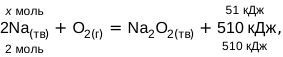
from which:

2. Let us calculate the mass of sodium:

Answer: m(Na) = 4.6 g.
Calorimetry methods are widely used to determine the heating value (heat of combustion) of fuels. Values of the energy value of food (caloric content) are also based on measuring the heat of combustion of a product in a calorimeter, taking into account corrections adopted in dietetics — the science of proper nutrition.
It is common practice to calculate the caloric content of foods approximately. Thus, for carbohydrates and proteins the caloric content is considered to be about 4 kcal/g, and for fats — 9 kcal/g (1 kcal = 4.184 kJ). Using data from several food packages, verify this for yourself (fig. 46).
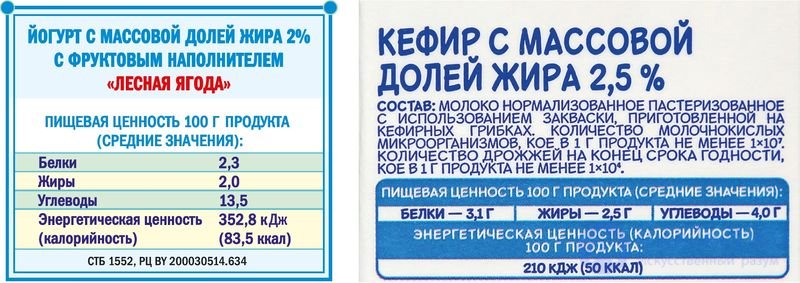
Fig. 46. Labels indicating caloric content
Thermochemical equations allow you to:
Chemical reactions proceed with the release or absorption of heat.
The thermal effect of a chemical reaction is the amount of heat that is released or absorbed as this reaction proceeds.
The thermochemical equation of a reaction indicates the aggregate state of all substances and the value of the thermal effect of the reaction.
Questions, assignments, problems
1. Indicate the equations of exothermic and endothermic reactions:




2. Calculate the amount of heat released in the interaction of CaO in an amount of 0.2 mol with water. The thermochemical equation is:
CaO(s) + Н2O(l) = Ca(OH)2(s) + 65 kJ.
3. The reactions of calcium, strontium, and barium oxides with water are described by the thermochemical equations:
Suppose the mass of each of the oxides is 100 g. In which of the reactions will the greatest amount of heat be released?
4. Calculate the volume (STP) of methane burned in oxygen, according to the thermochemical equation: СН4(g) + 2О2(g) = СО2(g) + 2Н2О(g) + 803 kJ, if 80.3 kJ of heat was released as a result of the reaction.
5. When coal burns to form carbon dioxide, a large amount of heat is released according to the thermochemical equation:
С(s) + O2(g) = СО2(g) + 394 kJ.
Calculate the amount of heat released in obtaining the oxide with a volume of 10 dm3 (STP).
6. Liquid pentane С5Н12 in an amount of 0.1 mol was burned in oxygen, releasing 351 kJ of heat. Calculate the thermal effect of this reaction and write its thermochemical equation, given that the water is obtained in the liquid state.
7. The thermal effect of the reaction of carbon combustion to СО2 is 394 kJ/mol, and the heat of combustion of 1 mol of pentane with the formation of water as vapor is 3245 kJ. Compare the amount of heat released when burning carbon and pentane of the same mass.
8. The isomerization reaction of n-pentane (gas) to 2-methylbutane (gas) proceeds with the release of 7.1 kJ/mol of heat. Write the thermochemical equation of the reaction. Calculate the amount of pentane that reacted, given that 2.0 kJ of heat was released during the experiment.
9. As a result of the complete thermal decomposition of a sample of silver(I) oxide, oxygen with a volume of 6.72 dm3 (STP) was released and 18.6 kJ of heat was absorbed. Calculate the thermal effect of this reaction and write its thermochemical equation.
10. The thermochemical equation of the combustion reaction of propane is:
С3H8(g) + 5O2(g) = 3CO2(g) + 4H2O(l) + 2220 kJ.
How much heat will be released when propane in an amount of 0.1 mol is burned, if the product of the reaction is water vapor? The heat of vaporization of water is 44 kJ/mol.

*Self-check
1. The value of the thermal effect in a thermochemical equation of a reaction depends on:
2. For exothermic reactions, the following statements are true:
3. The interaction of hydrogen and oxygen is expressed by the reaction equations:
2Н2(g) + О2(g) = 2Н2О(g) + 483.6 kJ,
2Н2(g) + О2(g) = 2Н2О(l) + 571.5 kJ.
For both of them it is true that:
4. The oxidation of zinc is characterized by the following thermochemical equation:
2Zn(s) + O2(g) = 2ZnO(s) + 700 kJ.
In this case, 35 kJ of heat will be released if the following enters the reaction:
Gas volumes are given at STP.
5. When burning a hydrocarbon in an amount of 1 mol, the most energy is released in the case of:

Comments