
Lecture
By studying this section, you will expand your knowledge of the world of metals, of the methods for obtaining metals and alloys, and their fields of application; you will learn to predict and explain the physical and chemical properties of metals and their compounds, master methods for detecting the ions of many metals in solutions, and become familiar with the causes of iron corrosion and the ways of preventing it.
The most important concepts of the topic: metals, metal alloys, the activity series of metals, corrosion, electrolysis, basic oxides, bases, amphoteric oxides and hydroxides, qualitative reactions for the cations Ca2+, Ba2+, Fe2+, Fe3+.
Metals are crystalline simple substances with a metallic bond between closely packed atoms.
In the periodic table, metals are located to the left of the conventional stepped line (see Fig. 61). Metals include the s-elements (except H and He), part of the p-elements, and all the d- and f-elements.
The number of electrons in the outer shell of metal atoms is mostly between 1 and 3. The exceptions are just a few metals: Ge, Sn, Pb (4 electrons); Sb, Bi (5 electrons); Po (6 electrons). Within a period, metal atoms have a larger radius than nonmetal atoms, since the Coulomb interaction forces between the electrons and the nucleus are small.

Recall that, in terms of crystal structure and electrophysical properties, germanium and one of the allotropic modifications of tin are semiconductors.
The electron configurations of the outer electron shell of the atoms of the s-elements of the 2nd and 3rd periods, as well as of the p-element Al of the 3rd period, are given in Chapter 2, Table 6, and in Appendix 1. Atoms of the elements of Groups IA and IIA of periods 2–7 have the electron configuration ns1 and ns2, respectively. Metals also include the p-elements of Groups IIIA–VIA of periods 3–7 (Al, Ga, In, Tl, Sn, Pb, Sb, Bi, Po); their electron configurations are ns2np1, ns2np2, ns2np3, ns2np4.
In the periodic table, each period from the 4th to the 7th contains 10 d-elements, whose atoms have five d-orbitals filled sequentially as the atomic number increases.
Note that the energy of the 3d sublevel is higher than that of the 4s sublevel. Therefore, d-electrons can take part in forming chemical bonds, meaning that atoms of d-elements have a greater number of valence electrons compared with atoms of s- and p-elements that belong to metals.
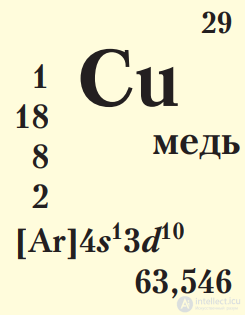
Examples of d-elements familiar to you are Fe (an element of Group VIIIB, 4th period, electron configuration formula 1s22s22p63s23p63d64s2), and also Cu (an element of Group IB, 4th period, electron configuration formula 1s22s22p63s23p63d104s1).
Starting from the 6th period, f-elements appear in the periodic table; they are grouped into families of 14 elements each (owing to similar chemical properties) and bear the special names of lanthanoids and actinoids.
When a metallic bond forms, metal atoms readily share their valence electrons. The electrons no longer belong to individual atoms but are shared by all the atoms and move freely throughout the crystal (see Chapter 3, Fig. 26). The metallic bond is characteristic of metals in both the liquid and solid states.
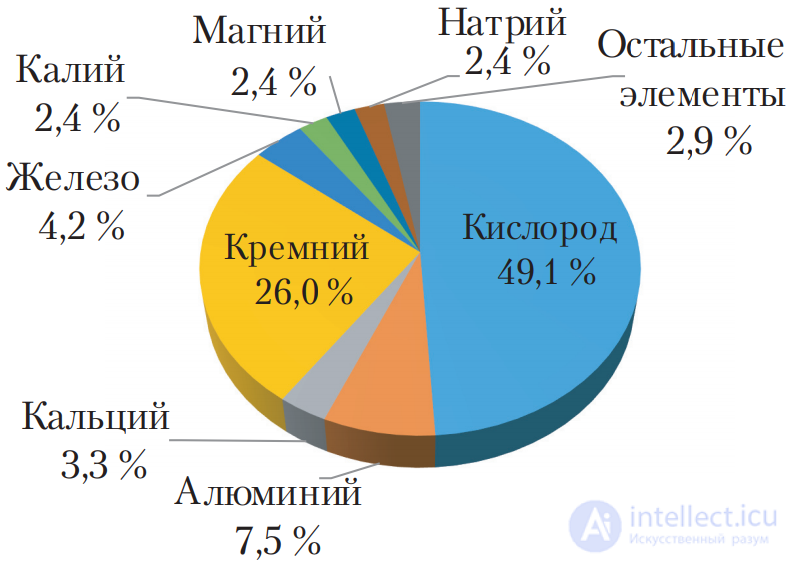
Fig. 102. Abundance of metals in the Earth's crust
Metals make up 25% of the mass of the Earth's crust and 3–5% of the mass of the human body. In the Earth's crust, the most abundant metal is aluminum (Fig. 102).
The forms in which metals occur in nature correspond to the chemical activity of their simple substances. The most active metals generally occur in nature as salts — chlorides, sulfates, carbonates, phosphates, silicates (NaCl, KCl, MgSO4 · 7H2O, CaCO3, Ca3(PO4)2), and aluminosilicates. Metals of medium activity are most often represented in nature by oxides and sulfides (Fe2O3, Fe3O4, ZnS, CuFeS2, PbS, Cr2O3). Metals of low activity (Cu, Ag, Au, Pt) occur in nature in the free state. Many minerals have a complex composition and include cations of two or three different metals along with anions of various acid residues of inorganic acids and hydroxyl groups (Appendix 2).
More than 60 metallic chemical elements have been found in human blood. The human body contains macroelements — potassium, calcium, sodium, magnesium — and, in smaller amounts, microelements — aluminum, iron, manganese, copper, zinc, and others.
Metals are characterized by high thermal and electrical conductivity, ductility (malleability), and metallic luster (§ 11, Table 8). A distinctive feature of the electrical conductivity of metals is its dependence on temperature: as temperature rises, their electrical conductivity decreases. At the same time, it exceeds the electrical conductivity of dielectrics by a factor of 1014 or more. Silver, gold, copper, and aluminum have the highest electrical and thermal conductivity, while mercury and bismuth have the lowest (Fig. 103).
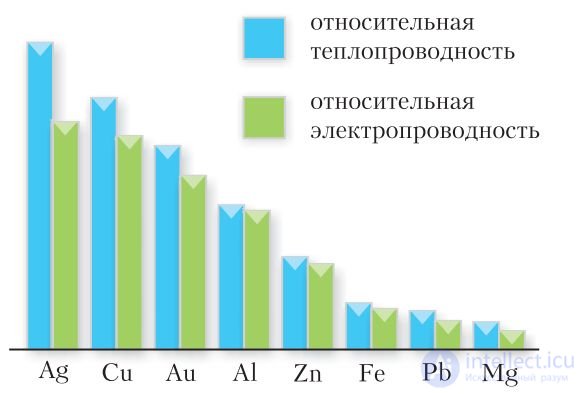
Fig. 103. Thermal and electrical conductivity of metals
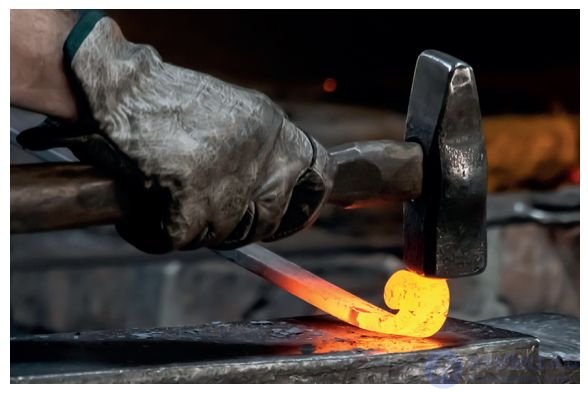
Fig. 104. Forging of a metal as a demonstration of its ductility
The ductility (malleability) of metals is expressed in their ability to change shape under pressure, to be drawn into wire, and to be rolled into thin sheets (Fig. 104). The ductility of metals is explained by the fact that the closely packed layers of metal atoms can slide relative to one another without breaking the chemical bonds that unite them (see § 16, Fig. 39). By ductility, metals are divided into highly ductile (in decreasing order) — Au, Ag, Pb, Cu, Fe, Ti, Sn, Al; ductile — Mg, Zn, Mo, W; and brittle — Cr, Mn, Sb.
In terms of state of aggregation at room temperature, all metals except mercury are solid substances with a crystalline structure. The melting points of metals range from –39 °C (mercury) to 3422 °C (tungsten) (Fig. 105).
By density, metals are divided into heavy and light. Examples of light metals are potassium (ρ = 0.9 g/cm3) and aluminum (ρ = 2.7 g/cm3). Heavy metals include those located in the periodic table after iron, for example lead, mercury, and gold. Heavy metals have a density greater than 7.8 g/cm3. For instance, the density of gold is 19.3 g/cm3.
The hardest metals are tungsten, chromium, titanium, and molybdenum (Fig. 106). The hardness of chromium and tungsten approaches that of corundum (Appendix 2). Soft metals include, for example, sodium and potassium. Their ingots can be cut with a knife.
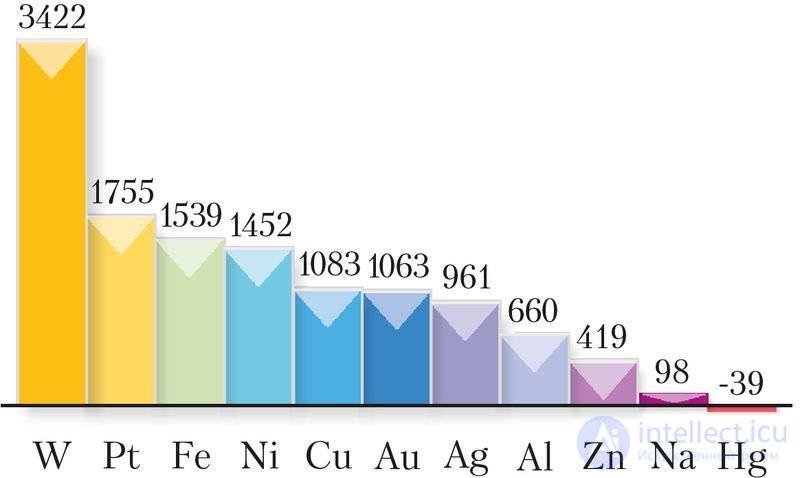
Fig. 105. Melting points of metals
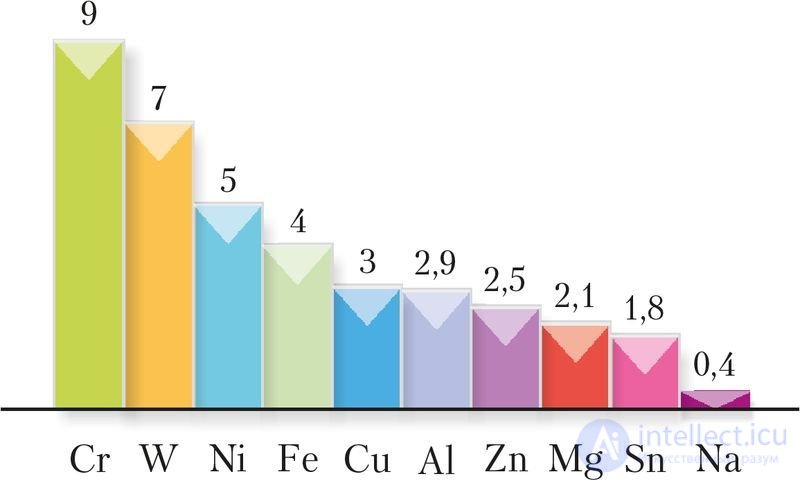
Fig. 106. Relative hardness of metals on the Mohs scale
A polished metal surface has a characteristic metallic luster. Owing to this property, thin layers of silver or aluminum on a smooth surface, such as glass, are used to make mirrors.
Metal Alloys: Composition, Properties, Applications
In engineering and everyday life, it is usually not individual metals that are used but their alloys. Alloys are most often obtained by metallurgical means, by melting mechanical mixtures of two or more metals or mixtures of metals with nonmetals. The resulting melts are held at a certain temperature to allow the components to interact, and are then crystallized.
Metallic alloys are understood to mean materials that have metallic properties and consist of two or more chemical elements, at least one of which is a metal.
The properties of an alloy depend on the nature and quantitative ratio of its components, as well as on the method of production and processing. Let us compare such properties of individual metals and alloys as melting point, hardness, and density.
Alloys often have lower melting points than individual metals. For example, pure lead melts at +327.5 °C, and pure tin at +232 °C. A tin-based alloy containing 36% lead has a melting point of +181 °C. Alloys are usually harder than the pure metal, and their electrical and thermal conductivity is lower. Many alloys have been known to humankind since ancient times. The first metal objects found by archaeologists were made of bronze — an alloy that gave its name to an entire era of human development. The density of alloys usually has a value intermediate between the densities of the individual components of the alloy.
Bronzes are alloys of copper with other metals, for example tin, iron, aluminum, and others, but not zinc or nickel. The most common are tin bronzes — Cu—Sn alloys, in which the tin content reaches several percent, and sometimes even more. An alloy of copper with zinc, with a zinc content that sometimes reaches as high as 50%, is called brass. Owing to their resistance to mechanical abrasion and high corrosion resistance, bronze and brass are used to make machine and instrument parts, various fittings, and pipes. Bronze is used for casting sculptures and monuments. We are all familiar with bronze chandeliers and figurines, brass faucets, samovars, and door handles (Fig. 107).
At the present stage of civilization's development, the most widely used metal is iron, but it is not used in its pure form. The hardness of pure iron is low. In addition, it oxidizes quickly in air, especially in a humid atmosphere, which causes articles made from it to become unusable. For this reason, iron alloys containing carbon and admixtures of other metals are used. When the carbon content is more than 2% by mass, these are cast irons; when it is less than 2%, they are steels.
Owing to its good casting qualities, strength, low coefficient of friction, and many other useful qualities, cast iron is used to make fittings, machine tool bases, bearings, boilers, and many other products in machine building, tractor building, and machine-tool manufacturing. Compared with cast iron, steel is more ductile, stronger, harder, and easier to machine. Some of its grades, containing admixtures of Cr, Ni, Mo, Ti, are more corrosion-resistant. Alloys of iron with nickel, chromium, and other metals (up to a few percent), containing less than 2% carbon, are indispensable in the manufacture of building structures, machine parts, rails, cutting tools, and fittings (Fig. 107).
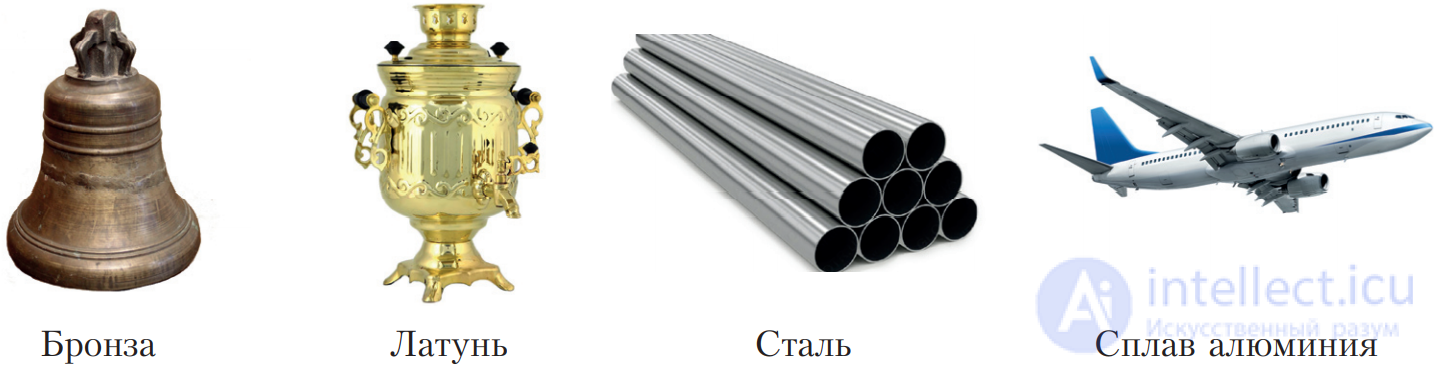
Fig. 107. Articles made of metal alloys
Duralumin — an alloy of aluminum (94%) with copper, magnesium, and manganese — is the main structural material in aviation, space exploration, the production of high-speed trains, automobiles, and other industries for which minimizing the structure's mass is of fundamental importance. This alloy is notable not only for its lightness but also for its strength (see Fig. 107).
An alloy of tungsten with cobalt and carbon (Pobedit/tungsten carbide alloy) approaches diamond in hardness. It is used to make ultra-strong tools for metalworking and drilling into rock, as well as concrete drill bits.
Pure gold is a soft metal, so jewelry uses its harder alloys, for example with copper or nickel. Adding other metals to gold changes not only its mechanical properties but also its color. For example, when the palladium content exceeds 10%, gold takes on a white color with a slight flesh tone.
Metals are crystalline substances with a metallic bond between closely packed atoms.
Metals are characterized by high thermal and electrical conductivity, high ductility (malleability), and metallic luster.
Metallic alloys are materials that have metallic properties and consist of two or more chemical elements, at least one of which is a metal.
| Metals (alloys) | Density, g/cm3 | Metals (alloys) | Density, g/cm3 |
| Aluminum | 2.7 | Copper | 8.96 |
| Steel | 7.6–7.9 | Silver | 10.5 |
| Bronze | 8.7–9.0 | Gold | 19.3 |
| Nickel | 8.9 | Platinum | 21.5 |
1. In the Earth's crust, they exist only in the form of compounds:
2. The most characteristic properties of metals are considered to be:
3. The number of metals exceeds the number of nonmetals in a group if the electron configuration of the atoms of the elements in it is:
4. The correct statements are:
5. The mass fraction of zinc in brass is 45%. To obtain 20 kg of pure brass (without impurities), the following is required:

Comments