
Lecture
Non-metals are chemical elements that generally do not possess the properties of metals. They occupy the upper right corner of Mendeleev's Periodic Table of Elements and are usually separated by a line (a "staircase"). The number of non-metals is 22–23 elements, depending on the classification.
A characteristic feature of non-metals is the greater (compared to metals) number of electrons in the outer energy level of their atoms. This determines their greater ability to add extra electrons and their higher oxidizing activity compared to metals.
Twenty-three elements are considered non-metals. Fourteen elements are almost always recognized as such: hydrogen, oxygen, nitrogen, and sulfur; the corrosion-active halogens: fluorine, chlorine, bromine, and iodine; and the noble gases: helium, neon, argon, krypton, xenon, and radon; as well as carbon, phosphorus, and selenium
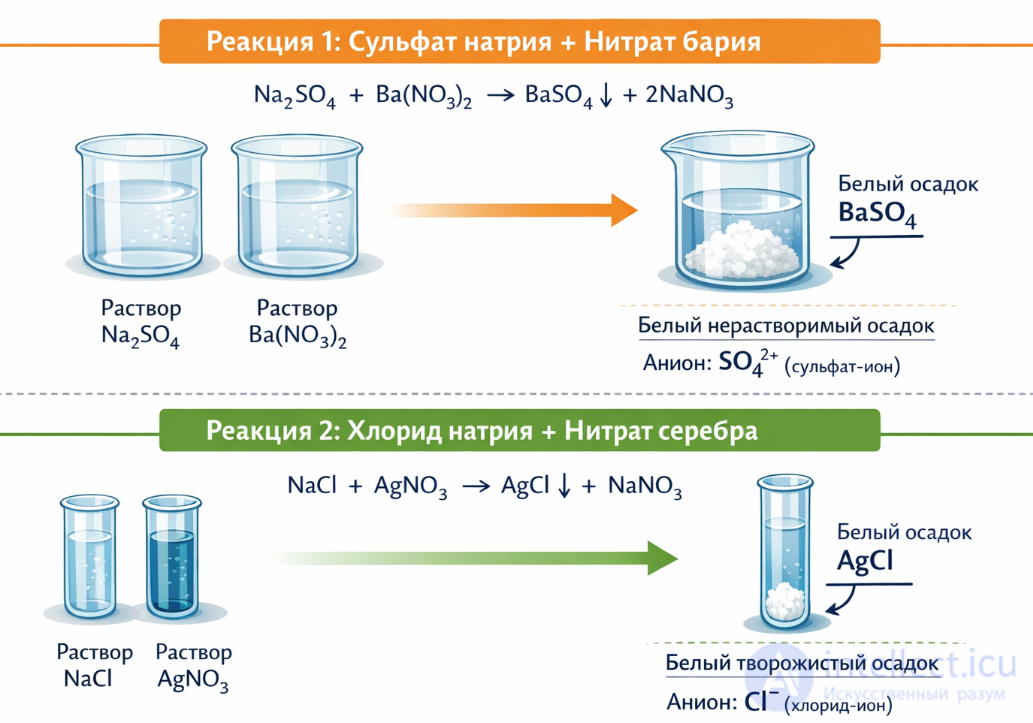
Describe the signs of the reactions. Indicate the anions contained in the resulting precipitates.
Let's work through both reactions step by step.
Reaction equation:
Sign of the reaction:
— a white insoluble precipitate forms.
What this precipitate is:
— barium sulfate
Anion contained in the precipitate:
— (sulfate ion)
Reaction equation:
Sign of the reaction:
— a white curdy precipitate forms (may darken in light).
What this precipitate is:
— silver chloride
Anion contained in the precipitate:
— Cl− (chloride ion)
In the first reaction, the precipitate contains the anion
In the second reaction, the precipitate contains the anion
Here is how to carry out qualitative reactions to determine the composition of substances
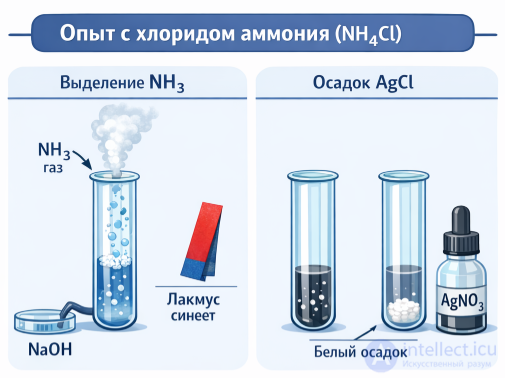
It is necessary to prove the presence of:
the cation NH₄⁺ (ammonium)
the anion Cl⁻ (chloride)
Reaction with alkali (NaOH):
NH₄Cl + NaOH → NH₃↑ + NaCl + H₂O
Signs:
ammonia gas (NH₃) with a pungent odor is released
moist red litmus paper turns blue
Reaction with silver nitrate (AgNO₃):
NH₄Cl + AgNO₃ → AgCl↓ + NH₄NO₃
Signs:
a white precipitate of AgCl (silver chloride) forms
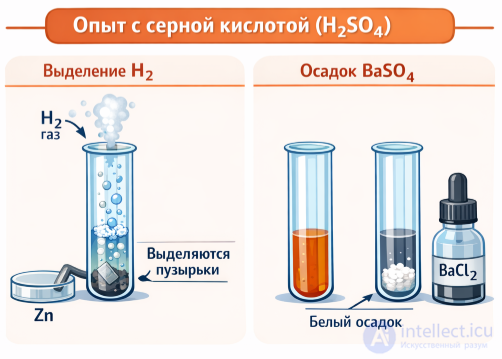
It is necessary to prove the presence of:
the cation H⁺
the anion SO₄²⁻ (sulfate)
Reaction with a metal (for example, Zn):
Zn + H₂SO₄ → ZnSO₄ + H₂↑
Signs:
hydrogen gas (H₂) is released
a "hiss" is heard, gas bubbles appear
Reaction with barium chloride (BaCl₂):
H₂SO₄ + BaCl₂ → BaSO₄↓ + 2HCl
Signs:
a white insoluble precipitate of BaSO₄ (barium sulfate) forms
NH₄Cl → NH₃ (gas) + AgCl (precipitate)
H₂SO₄ → H₂ (gas) + BaSO₄ (precipitate)
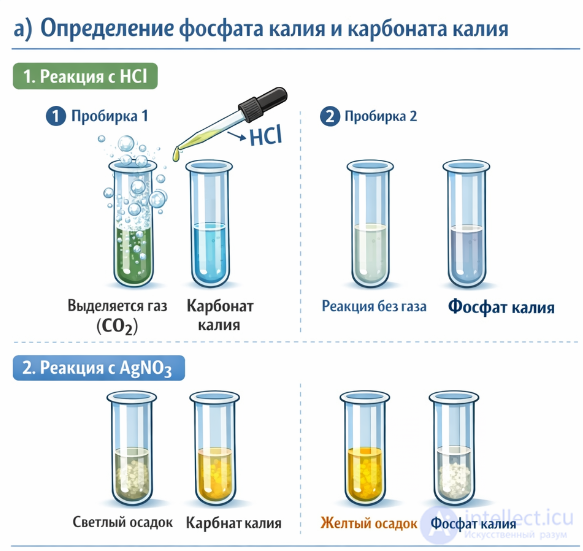
Let's work through the task — how to distinguish the solutions using qualitative reactions.
1. Reaction with an acid (for example, HCl)
Potassium carbonate:
Sign: gas is released (CO₂ bubbles)
Potassium phosphate:
Sign: no gas
Conclusion:
Bubbles present → carbonate
No bubbles → phosphate
2. Additional reaction (with AgNO₃)
Phosphate:
Yellow precipitate
Carbonate:
Light yellow precipitate (less stable)
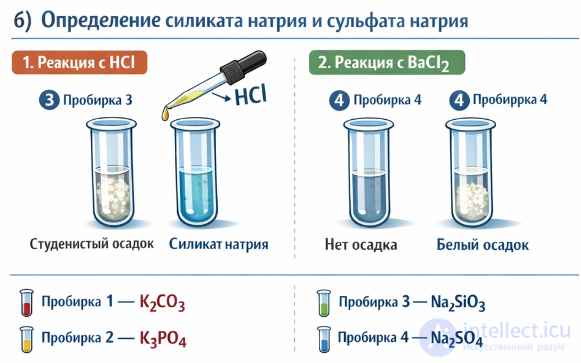
1. Reaction with an acid (HCl)
Sodium silicate:
Na2SiO3+2HCl→H2SiO3↓+2NaCl
Sign: a jelly-like (gel-like) precipitate of silicic acid forms
Sodium sulfate:
Na2SO4+HCl→no precipitate
Sign: no changes
Conclusion:
Gel present → silicate
No changes → sulfate
2. Confirmation (reaction with BaCl₂)
Sulfate:
White insoluble precipitate
Silicate:
White precipitate (but dissolves in acid)
Summary
| Substance | Reaction | Sign |
|---|---|---|
| K₂CO₃ | +HCl | CO₂ gas |
| K₃PO₄ | +HCl | no gas |
| Na₂SiO₃ | +HCl | gel |
| Na₂SO₄ | +BaCl₂ | white precipitate |
Calculate and compare the nutritional value of the given fertilizers.
When compiling the lab report, present the equations of the reactions occurring in the solutions in both molecular and ionic forms.
Solution
Here is how the substances in the test tubes can be identified experimentally
Add alkali (for example, NaOH) and heat gently:
Sign:
a pungent smell of ammonia appears → this is ammonium sulfate
Reaction:
The gas can be checked with moist red litmus paper — it turns blue.
If there is no smell of ammonia, then it is calcium nitrate (Ca(NO₃)₂).
This can additionally be confirmed:
Add a solution of sodium carbonate (Na₂CO₃):
Sign:
a white precipitate of calcium carbonate
(potash = K₂CO₃)
Test for carbonate (CO₃²⁻)
Add an acid (for example, HCl):
Sign:
gas (CO₂) is released, hissing occurs → this is potash
CO₂ can be confirmed:
pass it through limewater → it will turn cloudy
Identifying potassium chloride
If there is no gas, then it is potassium chloride (KCl).
This can additionally be checked:
Add a solution of silver nitrate (AgNO₃):
Sign:
a white precipitate of AgCl
Brief table
| Substance | Reagent | Sign |
|---|---|---|
| (NH₄)₂SO₄ | NaOH + heat | smell of NH₃ |
| Ca(NO₃)₂ | Na₂CO₃ | white precipitate |
| K₂CO₃ | HCl | CO₂ evolution |
| KCl | AgNO₃ | white precipitate |
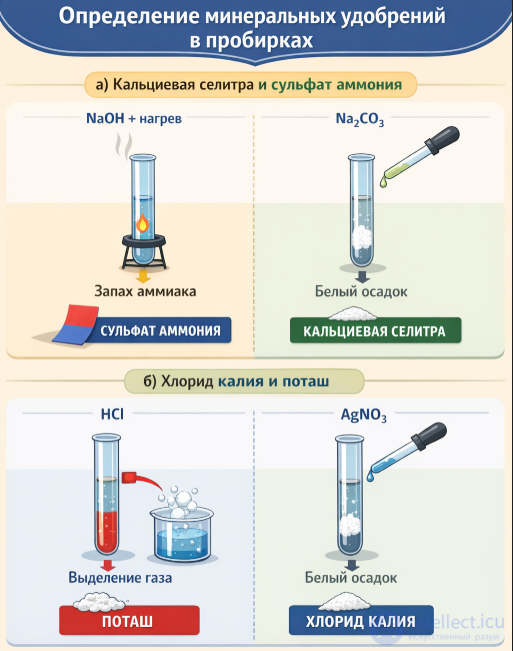
ammonium sulfate → by the smell of ammonia
calcium nitrate → by the CaCO₃ precipitate
potash → by the evolution of CO₂
potassium chloride → by the AgCl precipitate
Nutritional value is determined by the content of the main elements: N (nitrogen), K (potassium), Ca (calcium).
Molar mass:
Ca = 40
N₂ = 28
O₆ = 96
M = 164 g/mol
Nitrogen:
16428⋅100%≈17%
Contains ~17% nitrogen + calcium (Ca)
A very valuable fertilizer (growth + strengthening of plants)
Molar mass:
N₂ = 28
H₈ = 8
S = 32
O₄ = 64
M = 132 g/mol
Nitrogen:
13228⋅100%≈21%
Contains ~21% nitrogen + sulfur (S)
Richer in nitrogen
Molar mass:
K = 39
Cl = 35.5
M ≈ 74.5 g/mol
Potassium:
74.539⋅100%≈52%
~52% potassium
A very concentrated potassium fertilizer
Molar mass:
K₂ = 78
C = 12
O₃ = 48
M = 138 g/mol
Potassium:
13878⋅100%≈56%
~56% potassium
Slightly richer in potassium than KCl
Comparison
| Fertilizer | Main element | Content |
|---|---|---|
| (NH₄)₂SO₄ | N | ~21% |
| Ca(NO₃)₂ | N | ~17% |
| KCl | K | ~52% |
| K₂CO₃ | K | ~56% |
by nitrogen: ammonium sulfate > calcium nitrate
by potassium: potash > potassium chloride
Conclusions of the work

Comments