Reagents: zinc, iron, copper and charcoal; sulfuric and hydrochloric acids; sodium and calcium hydroxides; potassium salts — chloride, sulfate and carbonate; copper(II) salts — sulfate and chloride; phenolphthalein.
Carry out the chemical reactions according to tasks 1–4, write the reaction equations and characterize each of them by the following features:
- 1) the ratio of the number and composition of the starting substances and reaction products;
- 2) the change in the oxidation state of atoms;
- 3) the release or absorption of heat;
- 4) the direction in which the reaction proceeds;
- 5) the involvement of a catalyst;
- 6) the presence of a phase boundary (see § 18).
In the equations of redox reactions, balance the coefficients. Indicate the oxidizing and reducing agents.
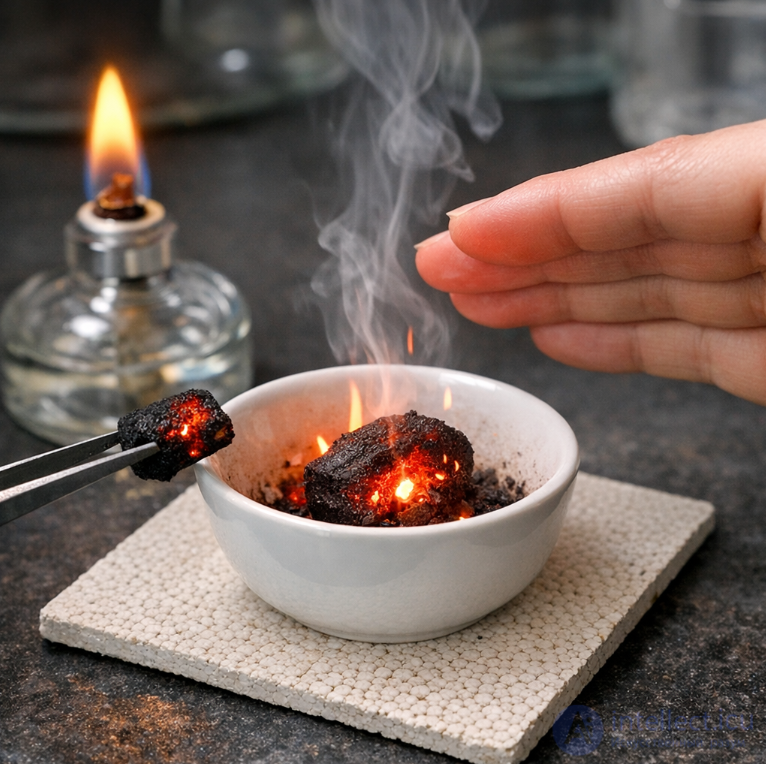
Task 1. Heat a piece of charcoal in the flame of a spirit lamp using tweezers. Place the charcoal in a porcelain dish. After a while, bring your palm close to it and feel the release of heat. Note the signs of the reaction.
Task 2. Neutralize an alkali solution with 1–2 drops of indicator using an acid.
Task 3. Carry out the reaction of a copper(II) salt with an available metal.
Task 4. Carry out any two reactions between the complex substances you have available.
Task 1. Heat a piece of charcoal in the flame of a spirit lamp using tweezers. Place the charcoal in a porcelain dish. After a while, bring your palm close to it and feel the release of heat. Note the signs of the reaction.
Task 1. Heating charcoal (carbon) in air
Observations
- the charcoal becomes red-hot and smolders
- heat is released (felt by hand)
- a faint glow may be observed
- a gas is formed (carbon dioxide, odorless)
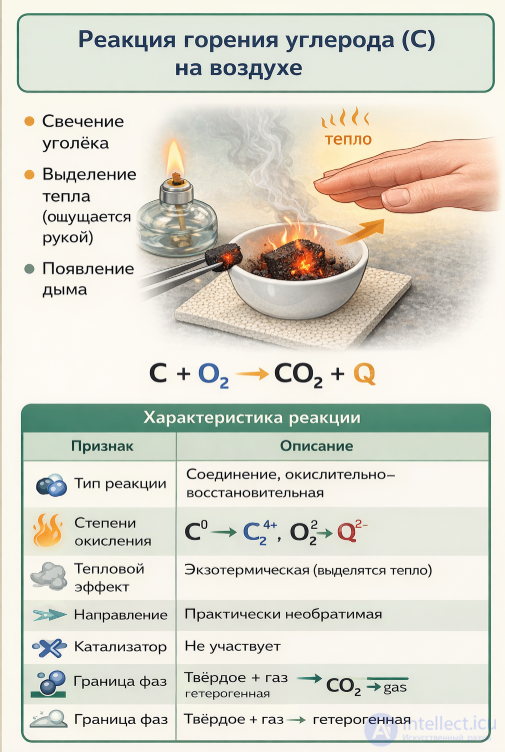
Reaction equation
(Q — release of heat)
Characterization of the reaction by its features
- Ratio of the number and composition of substances
- one substance is formed from two substances
- this is a combination reaction
- Change in oxidation states
- C⁰ → C⁴⁺ (in CO₂) — carbon is oxidized
- O₂⁰ → O²⁻ — oxygen is reduced
the reaction is a redox reaction
Oxidizing agent: O₂
Reducing agent: C
- Heat effect
- heat is released
the reaction is exothermic
- Direction of the reaction
- the reaction is practically irreversible (goes to completion when oxygen is available)
- Catalyst
- Phase boundary
- carbon is a solid substance
- oxygen is a gas
the reaction is heterogeneous (there is a phase boundary)
Summary
This is a combination reaction, redox, exothermic, irreversible, heterogeneous, without a catalyst.
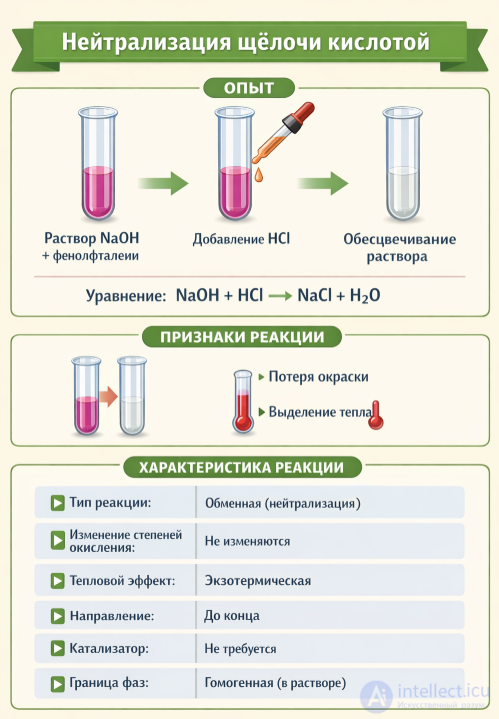
Task 2. Neutralize an alkali solution with 1–2 drops of indicator using an acid.
1–2 drops of indicator (phenolphthalein) are added to an alkali solution (for example, NaOH), then acid (for example, HCl) is added until the color changes.
Reaction equation
Molecular:
Full ionic:
Net ionic:
Characterization of the reaction
1) Ratio of substances
- Two substances → two products
an exchange (double displacement) reaction
2) Oxidation states
- Na: +1 → +1
- Cl: −1 → −1
- H: +1 → +1
- O: −2 → −2
do not change → not a redox reaction
3) Heat effect
The reaction is accompanied by the release of heat
(exothermic)
4) Direction of the reaction
The reaction goes to completion because a weak electrolyte — water — is formed
5) Catalyst
not required
6) Phase boundary
All substances are in solution
homogeneous reaction
Observations (indicator)
- Phenolphthalein:
- in alkali → crimson
- after adding acid → becomes colorless
a sign of neutralization
Conclusion
This is a typical neutralization reaction:
- an exchange reaction
- not a redox reaction
- exothermic
- irreversible
- proceeds in solution
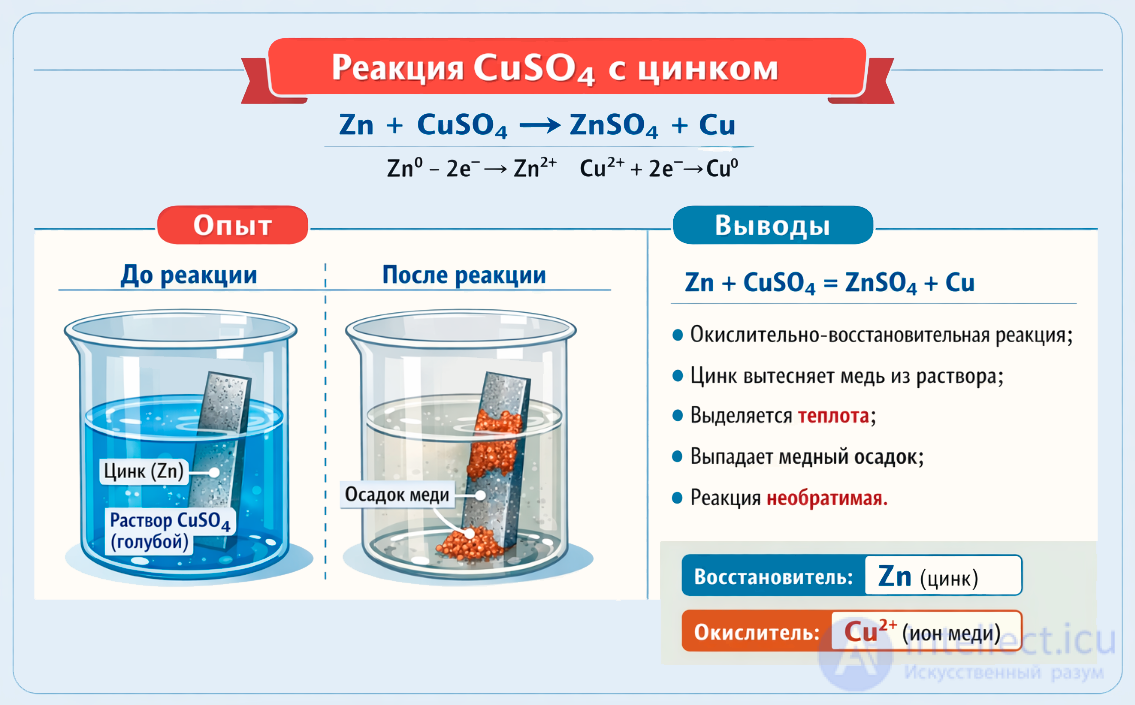
Task 3. Carry out the reaction of a copper(II) salt with an available metal.
For the copper(II) salt, any more active metal from the set can be used: zinc or iron (copper does not react, charcoal reacts only on heating).
Below is an example with zinc (the most illustrative experiment)
Reaction of a copper(II) salt with zinc
(for example, a solution of copper(II) sulfate)
Reaction equation:
Electron balance (redox)
- Zn⁰ − 2e⁻ → Zn²⁺ (oxidation)
- Cu²⁺ + 2e⁻ → Cu⁰ (reduction)
Oxidizing agent: Cu²⁺ (copper ion)
Reducing agent: Zn (zinc)
Characterization of the reaction by its features
1) Ratio of the number and composition of substances
- Displacement reaction
- One metal displaces another from the salt
2) Change in oxidation states
- Zn: 0 → +2 (is oxidized)
- Cu: +2 → 0 (is reduced)
This is a redox reaction
3) Heat effect
- The reaction is exothermic (heat is released)
4) Direction of the reaction
- The reaction is irreversible, goes to completion
- Reason: a more active metal displaces a less active one
5) Involvement of a catalyst
6) Presence of a phase boundary
- The reaction is heterogeneous
- Boundary:
Observations in the experiment
- The blue solution gradually becomes colorless
- A red coating of copper appears on the zinc
- The zinc gradually dissolves
If iron is used
The characterization is similar, except that:
- Fe is the reducing agent
- the solution turns green (FeSO₄)
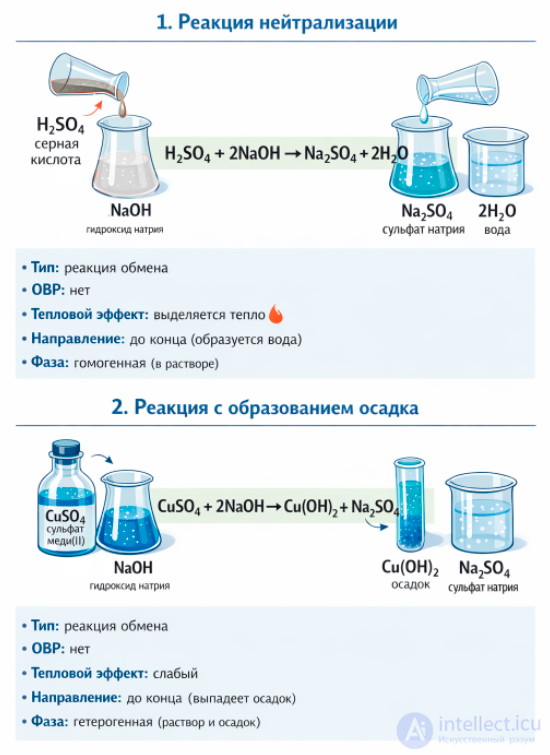
Task 4. Carry out any two reactions between the complex substances you have available.
Two reactions between complex substances (acids, alkalis, salts) need to be chosen and characterized.
Reaction 1 Between an acid and an alkali (neutralization reaction)
Equation:
Characterization of the reaction
- Ratio of the number and composition of substances
Exchange (double displacement) reaction. A salt and water are formed.
- Change in oxidation states
Oxidation states do not change → not a redox reaction.
- Heat effect
The reaction is exothermic (heat is released)
- Direction of the reaction
Goes to completion because a weak electrolyte — water — is formed.
- Catalyst
No catalyst is required.
- Phase boundary
All substances are in solution → the reaction is homogeneous.
Reaction 2 Between a salt and an alkali (formation of a precipitate)
Equation:
(a blue precipitate of copper(II) hydroxide forms)
Characterization of the reaction
- Ratio of the number and composition of substances
Exchange (double displacement) reaction, a precipitate is formed.
- Change in oxidation states
Cu²⁺ → Cu²⁺ (does not change)
There is no redox process.
- Heat effect
A weak heat effect, with practically no noticeable release of heat.
- Direction of the reaction
Goes to completion because an insoluble substance — a precipitate — is formed.
- Catalyst
No catalyst is required.
- Phase boundary
There is a phase boundary: solution + solid precipitate → the reaction is heterogeneous.
Conclusion:
- Both reactions are exchange reactions
- They are not redox reactions
- The first proceeds due to the formation of water
- The second proceeds due to the formation of a precipitate


Comments