
Lecture
In terms of chemical properties, metals are reducing agents, since they readily give up their electrons to nonmetal atoms, turning into positively charged ions — cations.
The ability of metal atoms to give up electrons, and of their cations to accept electrons, can serve as a measure of their chemical activity. Thus, aluminum becomes covered with an oxide film very quickly in air, while no noticeable changes occur with gold. Zinc reacts actively with hydrochloric acid, while silver does not. Therefore, aluminum and zinc can be classified as active metals, while gold and silver are inactive.
The chemical activity of different metals is easy to compare by analyzing their behavior in aqueous solutions of salts and acids. For example, if a zinc plate or an iron nail is placed in a solution of copper(II) sulfate, a reddish coating of copper appears on its surface almost immediately. This shows that zinc and iron displace copper from the solution. These processes can be represented by the following equations:
Zn + CuSО4 = ZnSО4 + Сu↓,
Zn0 + Сu2+ = Zn2+ + Cu0;
Fe + CuSО4 = FeSО4 + Сu↓,
Fe0 + Cu2+ = Fe2+ + Сu0.
In these reactions, zinc and iron give up their electrons to copper ions, that is, they are oxidized. Copper ions accept electrons, so copper is reduced.
If instead a copper plate is placed in a solution of zinc sulfate, no deposition of zinc occurs on it. What is the reason for this?
By experimentally studying the ability of some metals to displace others from aqueous solutions of their salts, the Russian scientist N. N. Beketov arranged the metals in a series. In it, the metals located further to the left are able to reduce the subsequent ones from solutions of their salts. Since this ability of metals is related to their reducing activity, this series is called the activity series of metals.
Li K Ba Sr Cа Na Mg Al Mn Zn Cr Fe Ni Sn Pb (H2) Cu Hg Ag Pd Pt Au
The further to the left a metal is located in this series, the greater its reducing properties in an aqueous solution, that is, the more easily it gives up its electrons to an oxidizing agent and passes into solution as a cation; and the harder it is for a cation of this metal to be reduced. Zinc and iron give up their electrons more easily than copper, and therefore they reduce Cu2+ from solution.
Based on the position of zinc in the activity series, it can be predicted that this metal is able to reduce tin, copper, and silver ions from solution:
Zn0 + Sn2+ = Zn2+ + Sn0;
Zn0 + Сu2+ = Zn2+ + Cu0;
Zn0 + 2Ag+ = Zn2+ + 2Ag0.
At the same time, copper will reduce only silver ions, but will not reduce tin ions:
Cu0 + 2Ag+ = Cu2+ + 2Ag0.
This means that zinc has a greater reducing ability. It gives up electrons more easily than tin, copper, and silver. Therefore, zinc is considered a more active metal than these metals. In turn, copper is a more active metal than silver.
The activity series of metals allows one not only to predict the behavior of metals in reactions with salt solutions, but also to compare their relationship to water, acid solutions, and also to nonmetals and a number of other substances.
Thus, to the left of hydrogen are located the metals that displace hydrogen from water and acids (that is, reduce hydrogen ions Н+). Metals located to the right of hydrogen do not exhibit such reducing activity in reactions with acid solutions. For example, zinc reacts with hydrochloric acid, displacing hydrogen:
Zn + 2НСl = ZnCl2 + Н2↑,
Zn0 + 2Н+ = Zn2+ +  ,
,
while silver does not displace hydrogen.
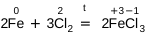
The general chemical properties of metals include their reactions with nonmetals, water, acids, and salts. Some metals are also characterized by reactions with alkali solutions. Some metals enter into reactions with organic substances. Many of the interactions listed are already known to you from previous chapters of this textbook. In addition, you studied the chemical properties of metals in the 9th grade. Therefore, at this stage of study, we will systematize the properties you already know by compiling Table 31.
Table 31. General chemical properties of metals
| Reagents and reaction equations | Features of interaction with metals |
|
Nonmetals
|
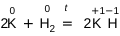
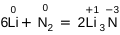
Binary compounds are formed: oxides, hydrides, nitrides, halides. The reactions proceed both under ordinary conditions and upon heating |
|
Water
|
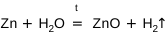
Alkali and alkaline earth (Са, Sr, Ва, Ra) metals form hydrogen and alkali under ordinary conditions. Metals of medium activity, reacting with water vapor, form oxides. They form insoluble bases: magnesium reacts with boiling water; aluminum reacts with water if the oxide film has been removed from its surface, for example if the aluminum is amalgamated |
|
Acids
|
Alkali metals react with the oxidizing acids HNO3(conc), H2SO4(conc) with an explosion. Pb is passivated in dilute HCl, H2SO4. Recall that when metals interact with the oxidizing acids HNO3(conc) and H2SO4(conc), hydrogen is not released, but products of the reduction of nitrogen and sulfur are formed |
|
Salts
|
In aqueous solutions, s-element metals, having strong reducing properties, displace hydrogen from water rather than the ions of less active metals from salts. The other metals react in accordance with their position in the activity series |
|
Alkali solutions
|
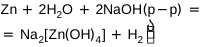
Zinc, aluminum, and beryllium enter into such reactions |
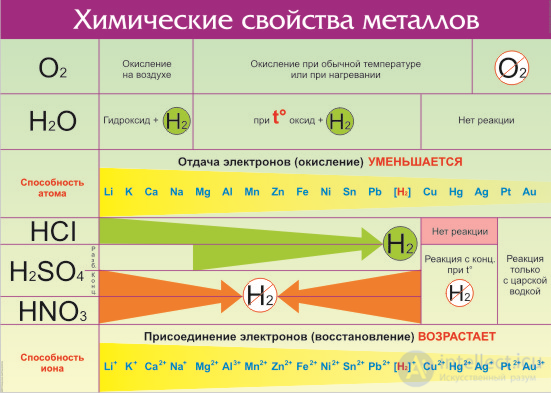
The diagram shows the dependence of the chemical activity of metals on their position in the activity series and their interaction with various substances.
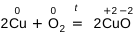
Metals react with oxygen:
Reaction of metals with water:
From more active to less active:
Li → K → Ca → Na → Mg → Al → Mn → Zn → Fe → Ni → Sn → Pb → (H₂) → Cu → Hg → Ag → Pt → Au
Moving from left to right:
Metals standing before hydrogen in the activity series react with hydrochloric acid:
Metals after hydrogen — do not react
With sulfuric acid:
With nitric acid:
Thus, a metal's position in the activity series determines its chemical properties.
Note that under normal conditions, all s-element metals react with water, except beryllium and magnesium. Magnesium reacts with water upon heating. Aluminum interacts with water at room temperature, but only after the aluminum oxide film has been removed from its surface. In this case, metal hydroxides are formed. The other metals from manganese to hydrogen in the activity series interact with water vapor upon heating, usually forming metal oxides. Metals located in the series of standard potentials after hydrogen do not interact with water under any conditions.
Active metals (Na, K) enter into reactions with carboxylic acids, alcohols, and phenols.
A metal's position in the activity series of metals makes it possible to predict its behavior in redox reactions occurring in aqueous solutions.
Metal atoms are reducing agents in all chemical transformations.
Metals are reducing agents in chemical transformations and readily give up their electrons, turning into positively charged ions — cations.
The activity of metals in redox reactions occurring in aqueous solutions is determined by their position in the activity series: the further to the left a metal is located in this series, the greater its reducing properties, and the harder the cations of this metal are to reduce.
More active metals reduce less active metals from solutions of their salts. Metals standing in the series of standard potentials to the left of hydrogen displace it from dilute acids (except nitric acid). The metals of the s-elements, with the exception of beryllium and magnesium, displace hydrogen from water at ordinary temperature.
а) Ag + НСl →; б) Сu + Hg(NО3)2 → ;
в) Mg + H2SО4(dilute) →; г) Ni + NaCl → ;
д) Zn + АgNО3 → ; е) Au + H2O → .
1. In order of increasing reducing activity, the metals are arranged in the series:
2. React with alkali solutions:
3. Reacting with water vapor, they form oxides:
4. The mass of a zinc plate will increase when it is immersed in a solution of:
5. To dissolve 13 g of zinc, a solution containing sodium hydroxide in the following mass (g) is required:










Comments