
Lecture
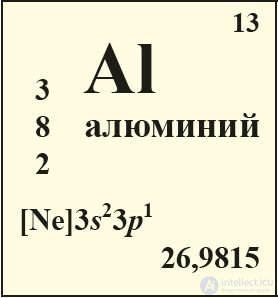
Aluminum is an element of period 3, group IIIA. The electron shell diagram, the electron configuration formula, and the orbital diagram of its atom are as follows:
13Al  or 13Аl 2е–, 8е–, 3е–;
13Аl 1s22s22p63s23p1 or 13Аl [Ne]3s23p1;
13Al 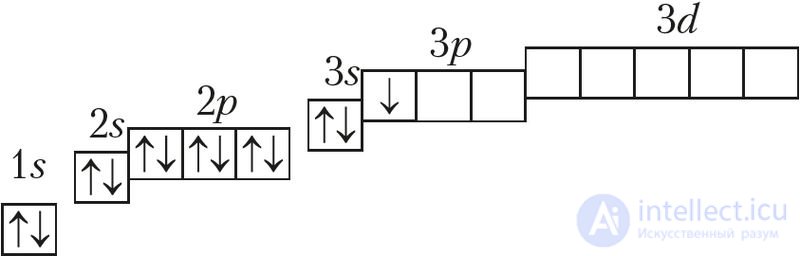
The outer electron shell of aluminum atoms contains 3 electrons, and the valence-shell configuration is 3s23p1, so aluminum belongs to the p-elements. It has a low electronegativity value χ(Al) = 1.6 and exhibits only the +3 oxidation state in its compounds.
Aluminum is the most abundant metal in the Earth's crust (ω(Al) = 7.5 %, (§ 43, Fig. 102)). In nature it occurs as a single nuclide,  .
.
Because of its considerable chemical activity, aluminum occurs in nature mainly in the form of chemical compounds — minerals that are oxides, hydroxides, silicates, or aluminosilicates. For example, clay (kaolinite) is a product of rock weathering, and bauxite, Al2O3 · xH2O, is a product of the further weathering of clay. Bauxite and cryolite, Na3[AlF6], are of the greatest practical importance for obtaining aluminum.
Physical properties. Aluminum is a silvery-white light metal with a density of 2.7 g/cm3, a melting point of +660 °С, and a boiling point of +2500 °С. It is very ductile, is readily rolled into foil and drawn into wire, and conducts electric current well.
The surface of aluminum is always covered with a very thin, dense film of oxide Al2O3.

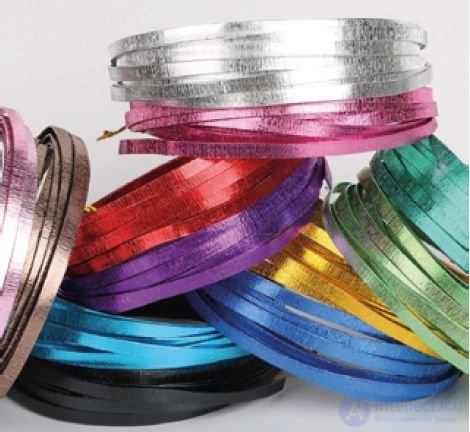
The process of forming oxide films on the surface of metals is called anodizing. The resulting films act not only as an anticorrosion coating but also as a matrix, into whose pores a coloring substance can be deposited to give metal articles decorative properties. The figure shows a strip of anodized aluminum colored in different shades.
Chemical properties. In the activity series, aluminum is located right after the alkaline-earth metals, which indicates its high reactivity. However, at room temperature this activity is often hindered by the dense oxide film. But at elevated temperature the film does not prevent most chemical reactions from proceeding. Let us limit ourselves to a systematic overview of the known transformations of aluminum and its compounds and give brief comments on some of them (Table 34).
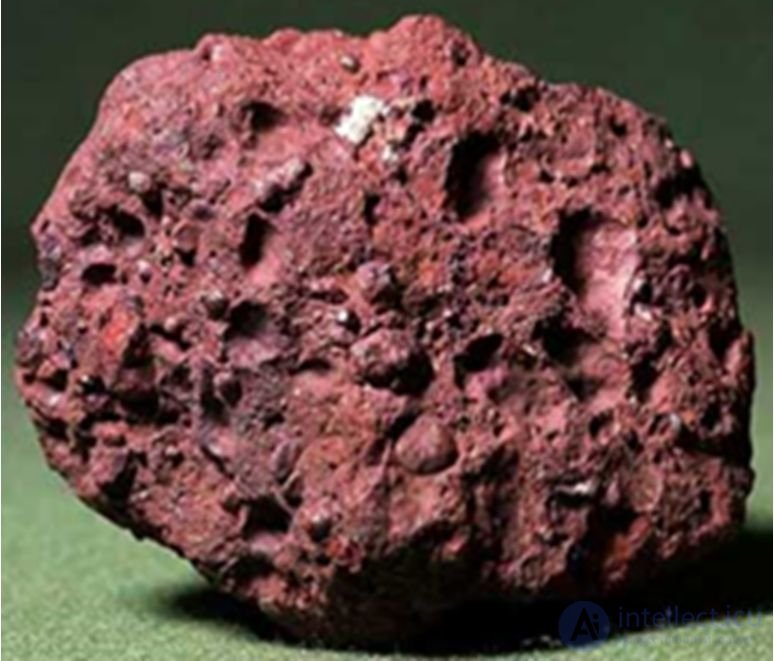
Fig. 112.1. Bauxite
Aluminum oxide is extracted from bauxite — an earthy, clay-like mass consisting of aluminum hydroxide, oxides of iron and other metals, and silicon oxide (Fig. 112.1).
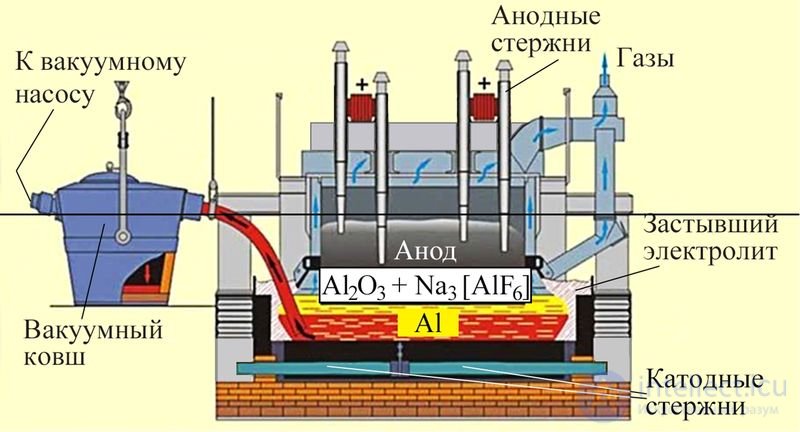
Fig. 112.2. Diagram of an electrolytic cell for producing aluminum
An electrolytic cell for producing aluminum is a bath lined with graphite blocks, to which electric current is supplied (Fig. 112.2). The bath contains a melt of alumina with cryolite at a temperature of 950–970 °С.
At the cathode — the graphite block at the bottom of the bath — reduction of aluminum cations by the electric current releases liquid aluminum, which is periodically drawn off. Oxygen is released at the graphite anode.
In the stream of evolving oxygen, the anode partially burns away, forming CO and CO2, so in industry, to carry out a continuous aluminum production process, problems of anode regeneration, selection of special anode materials, and neutralization of the evolved gases must be solved.
Work is currently under way to replace the traditional aluminum production technology with electrolysis of AlCl3 dissolved in a molten mixture of KCl and NaCl salts. This would save up to 30 % of energy, lower the requirements on raw materials, replace expensive cryolite with cheaper salts, and eliminate the release of harmful fluorine.
A method for obtaining metallic aluminum under laboratory conditions was proposed in 1827 by Friedrich Wöhler. The method consists in reducing aluminum from anhydrous AlCl3 with potassium on heating, without access to air:
AlCl3 + 3K  Al + 3KCl.
Table 34. Chemical properties of aluminum
| Reagents and reaction equations | Reaction conditions and product |
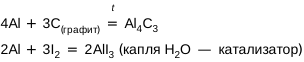
| Nonmetals | Al reacts with strong oxidizers at room temperature, and with less active ones on heating |
 |
|
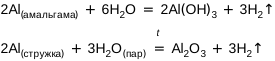
| Water | To carry out the reaction with water at room temperature, the oxide film must first be removed |
 |
|
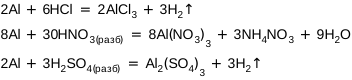
| Acids | Al reacts vigorously with dilute acids. In concentrated sulfuric and nitric acids, Al is passivated |
 |
|
| Alkalis | The reaction produces hydrogen and salts containing hexahydroxoaluminate ions — complex anions |
 |
|
| Salt solutions | The displacement of a less active metal by aluminum proceeds faster if the Al2O3 film is first removed |
 |
|
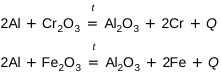
| Oxides of certain metals | To initiate the reaction, the mixture of reagents must be heated. The process then proceeds spontaneously, releasing a large amount of heat |
 |
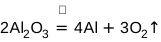
Production of aluminum. In industry, aluminum is obtained by electrolysis of a molten mixture of alumina, Al2О3, and cryolite, Na3[AlF6]:
 .
.
A mixture of aluminum oxide and cryolite melts at a temperature more than 1000 °С lower than pure oxide. This makes production safer and more energy- and cost-efficient.
Amalgamated aluminum can be obtained by immersing the metal for a few seconds in a solution of a mercury(II) salt.
Uses of aluminum. Thanks to aluminum's high electrical conductivity, it is used to make electric wires. Compared with copper wires, aluminum wires are lighter and cheaper.
Because of the oxide film on its surface, aluminum does not react with water, which makes it possible to manufacture kitchenware from aluminum.
Aluminum alloys are widely used. You have already become familiar with the composition and use of duralumin while studying the material of § 43; other alloys are also known. Avial — an alloy of aluminum with magnesium and silicon — is used to make aircraft fuselages, automobile bodies, and mobile phone casings. An alloy of zinc with aluminum and copper — ZAC — is used in the automotive industry, for making bearings and various fittings.
The pronounced reducing properties of aluminum are used in aluminothermy to obtain titanium, boron, chromium, and other metals, and for welding rails and steel castings.
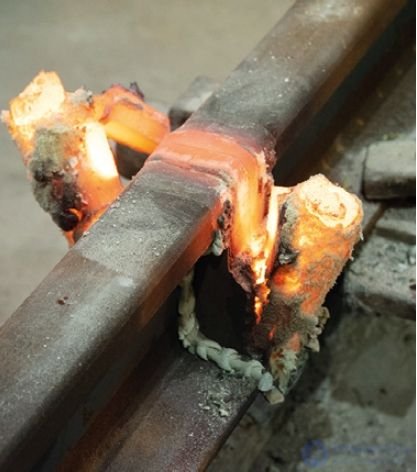
For welding massive metal parts, for example rails on tram and railway tracks, thermite is used — a mixture of Al and Fe3О4 powders. Their reaction releases a huge amount of heat:
 .
.
The temperature rises to 2 800 °С. This melts the reduced iron, which, flowing into the joint between the rails, fills the space between them and welds them together.
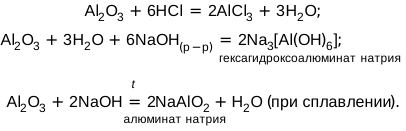
Aluminum oxide, Al2O3, is a typical amphoteric oxide, which reacts with both acids and alkalis:
Aluminum oxide formed under natural conditions occurs as corundum. In hardness it is second only to diamond (Appendix 2). Transparent colored corundum crystals are classed as precious stones — gems: sapphire (Al2O3 with impurities of titanium, vanadium, and iron) is colored blue, and ruby (Al2O3 with impurities of chromium and iron) is colored red. Artificially grown ruby single crystals are used in lasers and in the watchmaking and jewelry industries.
Corundum powder, Al2O3, thanks to its hardness, is used for grinding and polishing various surfaces. The hard, refractory, and chemically inert aluminum oxide is the main component of refractory materials — bricks, ceramics, and porcelain.
Aluminum hydroxide, Al(ОН)3, is a white, loose powder that reacts with both acids and alkalis (both in solution and on fusion):
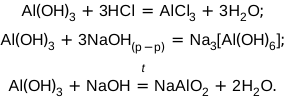
Thus, aluminum hydroxide has amphoteric properties.
On heating, aluminum hydroxide decomposes into the oxide and water:
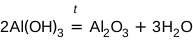 .
.
It can be obtained as a gelatinous precipitate by treating solutions of aluminum salts with an aqueous ammonia solution:
 .
.
In excess ammonia the precipitate does not dissolve. When NaОН and КОН solutions are used to precipitate it, an excess of alkali can cause the resulting Аl(ОН)3 precipitate to dissolve. Therefore, when preparing aluminum hydroxide in the laboratory, the alkali solution is carefully added to the salt solution (but not the other way around!).
Soluble aluminum salts partially react with water, forming basic salts and an acid:
 .
.
Because aluminum salts react with water by an exchange reaction, an insoluble salt of aluminum and a weak acid (for example, aluminum fluoride, sulfide, or carbonate) cannot be obtained in solution.
Uses and biological role of aluminum compounds. Aluminum hydroxide is used as a base for coating and analgesic agents in the treatment of burns and gastrointestinal diseases. Potassium alum — a crystalline hydrate of composition K2SO4 · Al2(SО4)3 · 24Н2О — is used in medical practice as a hemostatic agent, in cosmetics as a component of deodorants, in the textile industry for treating fabrics before dyeing, and in the leather industry for tanning leather.
Excessive intake of aluminum into the human body can lead to brittle bones and memory impairment.
Aluminum is a representative of the p-elements, an active metal, and reduces hydrogen from water and metals from their oxides.
Aluminum, its oxide Al2О3, and its hydroxide Al(ОН)3 react with both acids and alkalis, that is, they display amphoteric properties.
1. Why is aluminum called:
2. Compare the electronic structure of the aluminum atom and its triply charged cation.
3. Give a description of aluminum as a chemical element according to the plan given in § 12.
4. Draw up the electron balance for the reaction of aluminum with dilute nitric acid, whose equation is given in the text of the section. Characterize this reaction according to the plan given in § 18.
5. Calculate the volume of hydrogen released when 13.5 g of aluminum reacts with a concentrated sodium hydroxide solution.
6. Using the electron-balance method, balance the coefficients in the reaction schemes of aluminum with concentrated nitric and sulfuric acids on heating:
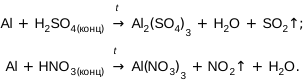
7. A small amount of potassium hydroxide solution was added to a solution of aluminum nitrate. The resulting precipitate was divided into two portions and dissolved in sulfuric acid and alkali (КОН), respectively. Write the equations of the reactions that occurred in molecular and ionic form.
8. Potassium alum, K2SO4 · Al2(SО4)3 · 24Н2О, with a mass of 4.74 g, was dissolved in water (in a volumetric flask) and the volume was brought up to 200 cm3. Calculate the molar concentration of aluminum ions in the solution.
9. An aluminum plate was immersed in a solution containing 0.02 mol of mercury(II) nitrate and removed after all the mercury had been extracted from the solution. Determine:
10. Give the equations of the chemical reactions by which the following transformations can be carried out:
 ;
; .
.Present the equations of reactions occurring in solutions in both molecular and ionic form, and indicate the oxidation states of the atoms in redox reactions.
1. An aluminum atom in the ground state contains:
2. Aluminothermy is:
3. The product of the transformation Al(OH)3 + NaOH → is:
4. Aluminum oxide reacts with:
5. At room temperature, aluminum does not react with:

Comments