
Lecture
Acids are complex substances whose molecules contain hydrogen atoms capable of being replaced by metal atoms, and acid residues.
From the standpoint of the theory of electrolytic dissociation, the basics of which you studied in the 9th grade, acids are electrolytes whose dissociation produces only hydrogen cations H+ as cations.
It is the hydrogen ions that account for the general properties of acids, while the ions of the acid residues determine their specific properties.
Classification of acids
Various criteria may be used to classify acids (Table 1.3).
Table 1.3. Classification of acids
|
Classification criterion |
Classification groups |
Examples |
|
1. By origin |
Mineral (inorganic) |
НCl, H2SO4, HNO3 |
|
Organic (carboxylic) |
HCOOH, CH3COOH, C17H35COOH |
|
|
2. By the presence of oxygen atoms |
Oxygen-containing (hydroxides) |
H3PO4, H2SO4, H2CO3 |
|
Oxygen-free |
HCl, H2S, HF |
|
|
3. By the number of hydrogen atoms capable of being replaced by metal atoms |
Monobasic |
HNO3, HF, НCl, CH3COOH |
|
Polybasic (dibasic, tribasic) |
H2SO4, H2SO3, H2CO3; H3PO4 |
|
|
4. By strength (ability to dissociate into ions in aqueous solution) |
Strong |
H2SO4, HNO3, НCl, HClO4 |
|
Weak |
H2CO3, H2S |
|
|
HF, H3PO4 |
Thus, dividing acids into monobasic and polybasic allows us to say that in polybasic acids one or several hydrogen atoms can be replaced by a metal. This means that polybasic acids can form not only normal salts but also acid salts, for example: Na2CO3 and NaHCO3, K2S and KHS.
The division of acids into strong and weak is based on the fact that strong acids dissociate completely into ions in solution:

Weak acids dissociate into ions only to a small extent, and their dissociation process is reversible:
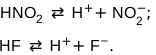
You will become more closely acquainted with the dissociation processes of acids while studying the material of Chapter IV.
Nomenclature of acids
When studying the nomenclature of acids, it is first necessary to distinguish between oxygen-containing and oxygen-free acids. Thus, when forming the name of an oxygen-free acid, the name of the element that is part of the acid residue is added before the words "hydro... acid," for example: HCl — hydrochloric acid, H2S — hydrosulfuric acid.
The name of an oxygen-containing acid is derived from the name of the element, to which the corresponding suffix is added. If the atoms of the element forming the oxygen-containing acid are in the highest oxidation state, the oxygen-containing acid has the suffix -ic, for example,  — sulfuric acid,
  — nitric acid,
  — perchloric acid.

When the atoms of an element can exist in several positive oxidation states, the suffixes change in the following order as the oxidation state decreases: -ic, -ic (with "-ate" root, lower), -ous, -ous (hypo-). For example, — perchloric,  — chloric,
  — chlorous,
  — hypochlorous acid.
Chemical properties of acids
The general properties of acids include those caused by the presence of hydrogen ions in their solutions: interaction with indicators, as well as the formation of salts upon reaction with metals, basic and amphoteric oxides, bases, and salts.
|
Reagent |
Equation of the salt-forming reaction |
|
1. Metal |
Мg + 2HCl = MgCl2 + H2↑ |
|
2. Oxide: a) basic b) amphoteric |
МgO + 2HNO3 = Mg(NO3)2 + H2O ZnO + 2HCl = ZnCl2 + H2O |
|
3. Base |
NaOH + HCl = NaCl + H2O |
|
4. Salt |
2HNO3 + Na2CO3 = 2NaNO3 + H2O + CO2↑ |
Acid solutions change the color of such indicators as litmus and methyl orange to red.
Besides their general properties, acids can display oxidation-reduction properties owing to their acid residues. You are already familiar, for example, with some of these reactions:
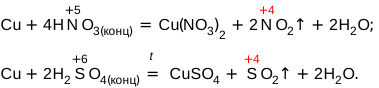
Classifying acids by the presence or absence of oxygen in their composition makes it possible to compare certain methods of obtaining acids.
Thus, many oxygen-free acids can be obtained by the reaction of hydrogen combining with a nonmetal, followed by dissolving the product in water:
H2 + Cl2 = 2HCl;
H2 + S = H2S.
Oxygen-containing acids are obtained by the reaction of the corresponding oxides combining with water:
Н2O + SO3 = H2SO4;
3Н2O + Р2О5 = 2H3PO4.

Since SiO2 does not react with water, to obtain silicic acid a soluble metal salt is first prepared, and only then is the acid obtained by an exchange reaction with a stronger acid:
SiO2 + 2NaOH(conc. soln.)  Na2SiO3 + H2O;
Na2SiO3 + H2SO4 = H2SiO3↓ + Na2SO4.
Both oxygen-containing and oxygen-free acids can often be obtained by an exchange reaction. An exchange reaction can proceed in solution between a salt containing the required acid residue and another acid; the condition for the reaction to proceed is the formation of a weak acid, a volatile acid, or an insoluble salt:
Na2SiO3 + 2HCl = H2SiO3↓ + 2NaCl;
Na2S + 2HCl = 2NaCl + H2S↑;
BaCl2 + H2SO4 = BaSO4↓ + 2HCl.
An exchange reaction is possible when solid salts react with nonvolatile concentrated sulfuric acid upon heating:
NaCl(solid) + H2SO4(conc.) HCl↑ + NaHSO4
or 2NaCl(solid) + H2SO4(conc.) 2HCl↑ + Na2SO4;
NaNO3(solid) + H2SO4(conc.) HNO3↑ + NaHSO4
or 2NaNO3(solid) + H2SO4(conc.) 2HNO3↑ + Na2SO4;
CH3COONa(solid) + H2SO4(1 : 1) CH3COOН↑ + NaHSO4.
It should be noted that in industry the production of acids is often a multi-stage process. For example, one of the industrial methods of obtaining sulfuric acid includes three stages:
FeS2 → SO2 → SO3 → H2SO4.
Acids are complex substances whose molecules contain hydrogen atoms capable of being replaced by metal atoms, and acid residues; upon dissociation of acids, only hydrogen cations H+ are formed as cations.
The general properties of acids are a change in the color of indicators and the formation of salts upon reaction with metals, basic and amphoteric oxides, bases, and other salts.
Acids are obtained by dissolving the corresponding oxides or hydrogen compounds of nonmetals in water, as well as by an exchange reaction between a salt and a stronger acid.
1. List:
2. Indicate the formulas of:
3. Name the acids whose formulas are:
4. Give a characterization according to all classification criteria (Table 1.3) of:
5. Write equations for the reactions of:
6. Suggest two methods for obtaining each of the acids — HCl and H2SO3. Write the equations of the corresponding reactions.
7. The mass fraction of oxygen in a strong acid of composition Н2ЭО4 is equal to 44.14%. Determine the element Э in the composition of the acid.
8. Write equations for the reactions according to the scheme:
 HCl
HCl  MgCl2
MgCl2  MgСО3
MgСО3  MgSO4; CH3COONa CH3COOН
  …
…  …
…9. Every day, about 2 dm3 of gastric juice is produced in the stomach of an adult, with a molar concentration of hydrogen chloride of 16 mmol/dm3. Determine the amount (mol) and mass (g) of НСl in this portion of gastric juice.
10. Determine the volume of vinegar needed to "neutralize" half a teaspoon of baking soda. Use the following data: the mass of NaHCO3 is 2.5 g, the mass fraction of acetic acid is 9%, and the density of vinegar is 1.011 g/cm3.
1. Indicate the formulas of acids:
2. The acid of composition H3PO4 is:
3. Hydrochloric acid reacts with:
4. The sum of the coefficients in the equation of the reaction of calcium carbonate with nitric acid is equal to:
5. The ionic equation H+ + OH– = H2O corresponds to the interaction of aqueous solutions of:

Comments