
Lecture
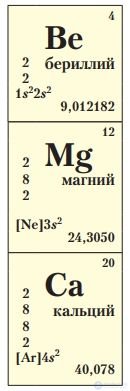 Group IIA of the periodic system contains beryllium Be, magnesium Mg, and the alkaline earth metals calcium Ca, barium Ba, strontium Sr, and radium Ra. The alkaline earth metals got their name because in ancient times "earths" was the term for the refractory oxides of many metals isolated from minerals and rocks. When soluble "earths" reacted with water, they formed an alkaline solution. It is precisely such soluble metal oxides of Group IIA that CaO, BaO, and SrO represent. Be and Mg are similar to the alkaline earth metals in many properties, but their bases are insoluble, so they are not classed among the alkalis.
Table 33 summarizes information on the structure and properties of the atoms of Group IIA metals.
By electronic structure, the elements of Group IIA belong to the s-elements. Their atoms have 2 electrons in the outer electron shell (ns2), and in all their compounds they show a positive oxidation state of +2. Like the alkali metals, Group IIA metals are strong reducing agents. The atomic radii of Group IIA elements are smaller than those of the neighboring alkali metal atoms, and their outer electrons are more strongly bound to the nuclei. Accordingly, the electronegativity of Group IIA metals is higher than that of Group IA metals, so they are somewhat less reactive (see Tables 32 and 33).
As with the alkali metals of Group IA, as the atomic number increases within Group IIA, the atomic radius increases, electronegativity decreases, metallic character strengthens, and the melting point generally decreases. Thus, Tm. (Ca) = 850 °C, Tm. (Sr) = 777 °C,
Table 33. Characteristics of Group IIA metal atoms
| Element | Be | Mg | Ca | Sr | Ba | Ra |
| Electron configuration | [He]2s2 | [Ne]3s2 | [Ar]4s2 | [Kr]5s2 | [Xe]6s2 | [Rn]7s2 |
| Atomic radius, nm | 0.113 | 0.160 | 0.197 | 0.215 | 0.221 | 0.235 |
| Electronegativity | 1.6 | 1.3 | 1.0 | 0.95 | 0.9 | 0.9 |
Tm. (Ba) = 727 °C. Note that the melting points of Group IIA metals are higher than those of their Group IA analogs. This is due to the strengthening of the metallic bond as the number of electrons in the outer electron shell of the atoms increases.
Calcium and magnesium compounds are fairly widespread in nature. The most important of them include magnesite MgCО3, dolomite CaMg(CO3)2, calcite CaCO3, gypsum CaSO4 · 2H2O, fluorite CaF2, and various silicates. Compounds of the other Group IIA elements are less common. Strontium and barium occur in nature as carbonates and sulfates. Radium, being a radioactive element, is present in uranium ores as a product of uranium decay.
The presence of a given metal in a compound can be recognized by the color of the flame. In the presence of calcium compounds, the flame color is brick-red; strontium and radium give a carmine-red color; barium gives a yellowish-green color. Magnesium compounds do not color the flame (Appendix 3).
Group IIA metals are generally obtained by electrolysis of molten chlorides (§ 45, Fig. 108).
The reducing power of Group IIA metals increases with increasing atomic number. When reacting with nonmetals, they form oxides (CaО), hydrides (CaН2), nitrides (Ca3N2), halides (CaСl2), carbides (CaС2), sulfides (CaS), and so on.
The alkaline earth metals react vigorously with water and acids, displacing hydrogen from them.
In compounds of Group IIA metals with nonmetals, the chemical bonds formed are predominantly ionic in character.

Fig. 110. Combustion of magnesium
Beryllium stands apart, since its atoms are considerably smaller in size and therefore more inclined to form covalent bonds.
The chemical activity of the oxides and hydroxides of Group IIA metals increases with increasing atomic number of the metal.
The salts of Group IIA elements have varying solubility, which is related to the differences in atomic size.
Along with the general chemical properties, each of the Group IIA metals and its compounds has its own distinctive features.
Beryllium differs from the other Group IIA elements in many properties. In air, the surface of beryllium becomes covered with a stable oxide film of BeO, which apparently accounts for its low reactivity. Beryllium oxide and hydroxide exhibit amphoteric properties:



Beryllium-based alloys are notable for increased hardness, strength, and corrosion resistance. They are used in nuclear power, for spacecraft cladding, and for making refractory materials.
Beryllium compounds are toxic.
Magnesium is a silvery-white metal. In air, the surface of magnesium becomes covered with an oxide film of MgO, which prevents further oxidation by oxygen. When heated to 300–400 °С, magnesium burns with a dazzlingly bright flame (Fig. 110):

Metallic magnesium reacts very slowly with cold water, but the reaction proceeds more intensely in boiling water:
Mg + 2H2О = Mg(ОH)2↓ + H2↑.
The combination of low density (about 35% less than aluminum) and high strength (almost twice that of aluminum) makes magnesium-based alloys valuable in aircraft, automotive, and instrument manufacturing.
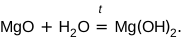
Magnesium oxide MgO is a white powder that is highly refractory. It reacts with water only on boiling, forming an insoluble hydroxide:
Magnesium oxide is obtained by calcining magnesium carbonate:

Magnesium oxide is used in making refractory products (bricks, crucibles, cement, etc.), and also in medicine to reduce the acidity of gastric juice.
Magnesium hydroxide Mg(OH)2, although an insoluble base, still creates an alkaline environment in water (pH > 7, detectable with phenolphthalein), because the negligible amount that does dissolve dissociates:
Mg(ОН)2 → Mg2+ + 2ОН–.
Mg(OH)2, being a base, dissolves in acids:
Mg(OH)2 + 2НСl = MgCl2 + 2Н2О.
It is obtained by the action of alkalis on soluble magnesium salts. A white gelatinous precipitate forms in the process:
MgCl2 + 2КОН = Mg(ОН)2↓ + 2КСl.
Magnesium salts. Soluble magnesium salts are colorless and bitter-tasting, but not poisonous. Of the soluble magnesium salts, the chloride and sulfate are the most important.
MgCl2, contained in seawater, serves as the main resource for obtaining metallic magnesium by electrolysis. MgSО4 · 7Н2О — Epsom salt — is used in plant growing as a micronutrient (a source of magnesium and sulfur), and in medicine (as a component of sedative, anticonvulsant, antispasmodic, and blood-pressure-lowering preparations).
Biological role. Magnesium is part of chlorophylls — the green pigment of plants required for photosynthesis. A deficiency of Mg2+ ions in the human body causes serious cardiac disturbances and increases susceptibility to heart attacks.
Calcium — is a silvery-white light metal. Calcium and the other alkaline earth metals are similar to magnesium in their properties, but are much more chemically reactive.
Calcium oxide is a white, refractory powder with the technical name burnt lime, or quicklime. It is a typical basic oxide: it reacts with water, acids, and acidic oxides.
The process of CaO reacting with water is called slaking: СаО +

This reaction is accompanied by a large release of heat.
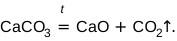
Industrially, calcium oxide is produced by firing limestone or chalk at 900 °С:
Calcium hydroxide Са(ОН)2 is a white powder, sparingly soluble in water (1.56 g per 1 dm3 of water at 20 °С), but it dissociates completely, forming a strongly alkaline solution (pH = 12.6):
Ca(OH)2 → Ca2+ + 2OH–.
As a typical base, calcium hydroxide reacts with acids, acidic oxides, and salt solutions.
When carbon dioxide is passed through limewater, a carbonate precipitate first appears:
Са(ОН)2 + СО2 = СаСО3↓ + Н2О,
which then completely disappears due to the formation of soluble calcium bicarbonate Са(НСО3)2:

Calcium bicarbonate is unstable and exists only in solution. These processes are associated with the formation of caves in limestone massifs, and within them, stalactites and stalagmites.

A solution of calcium hydroxide Са(ОН)2 is called limewater. A suspension of calcium hydroxide is called milk of lime. Solid calcium hydroxide is called slaked lime.
Slaked lime, or "fluff lime," is used in construction, as well as for reducing the temporary hardness of water and reducing soil acidity.
Calcium salts. Calcium carbonate СаСО3 is a white substance, insoluble in water. It makes up chalk, marble, pearls, and mollusk shells (Fig. 111).
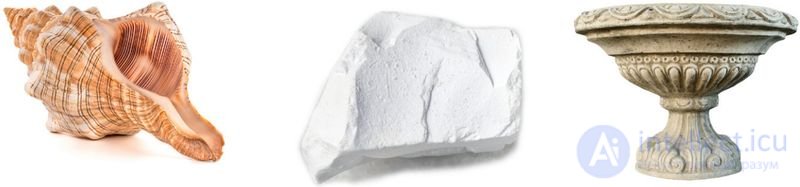
Fig. 111. A shell, a piece of chalk, a marble vase
Calcium sulfate occurs in nature as two minerals — anhydrite (CaSO4) and gypsum (CaSО4 · 2H2О). They are poorly soluble in water. Calcining gypsum produces building gypsum — alabaster ("burnt gypsum") — CaSО4 · 0.5H2О. It is used as a binder in construction for making panels, partitions, dry plaster, bas-reliefs, ornaments, etc., and in medicine for applying plaster casts. Burnt gypsum hardens as a result of a hydration reaction:
CaSО4 · 0.5H2О + 1.5Н2О = CaSО4 · 2H2О + Q.
Calcium chloride CaCl2 in solution form is used as a medicinal agent to make up a deficit of Ca2+ ions in the human body. Са2+ cations take part in regulating heart contractions and blood clotting, as well as in bone tissue formation.
Calcium deficiency reduces soil fertility, causes skeletal diseases in humans and animals, and slows the growth of organisms. Therefore, enriching soils, animal feed, etc. with calcium is of great importance.
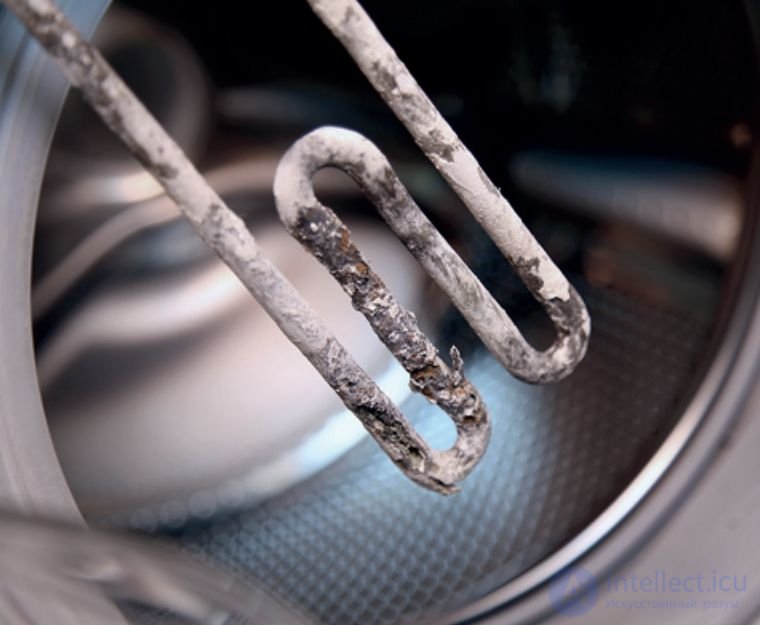
Fig. 112. Scale on the heating element of a washing machine
Compounds of magnesium and calcium are a major component of the rocks that make up the upper part of the Earth's crust. As water passes through these rocks, it becomes saturated with these compounds, becoming "hard." When hard water is heated on washing-machine heaters, in district heating pipes, and on the inner walls of power-plant boilers and kettles, scale forms, consisting of calcium and magnesium carbonates (Fig. 112). Scale has low thermal conductivity and therefore causes overheating of boiler walls. If a piece of scale accidentally separates from a red-hot boiler wall, this can lead to rapid evaporation of water, a rise in pressure inside the boiler, and its explosion. Hard water leaves streaks on dishware and plumbing fixtures. Hard water increases the consumption of detergents.
The process of removing hardness from water before use is called water softening. Any version of it involves removing calcium and magnesium ions from the water. With respect to softening processes, a distinction is made between temporary and permanent hardness.
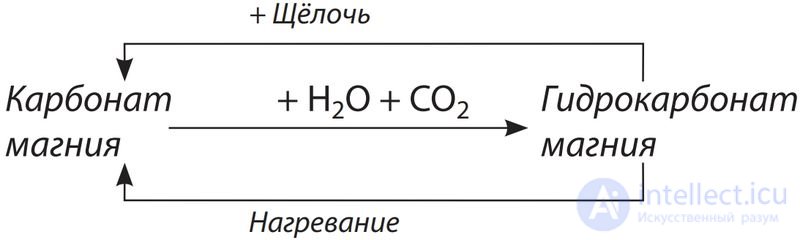
Temporary (carbonate, or boiling-removable) hardness is caused by the presence of calcium and magnesium bicarbonates in the water. It is removed by boiling, during which the bicarbonates decompose completely. They convert into an insoluble state as carbonates:
Са(НСО3)2  СаСО3↓ + СО2↑ + Н2О;
Mg(НСО3)2  MgСО3↓ + СО2↑ + Н2О.
It is precisely such reactions that cause scale to form in a kettle.
Permanent (non-carbonate) hardness is caused by the presence of soluble calcium and magnesium salts (sulfates, chlorides, etc.), which remain in solution upon boiling. In this case, water hardness can be removed by introducing reagents into the solution (Nа2CO3, Na3РO4, Са(ОН)2 etc.) that form precipitates with the dissolved calcium and magnesium salts:



The amount of dissolved salts in water can be reduced by freezing it. As water is gradually frozen, about 10% of the liquid volume is left unfrozen. During ice formation, dissolved salts accumulate in the liquid phase, where their solubility is higher. The remaining water is drained off, and the ice is then melted.
In the laboratory, water is purified using distillation, that is, evaporation of water followed by its condensation. In this process, most of the salts remain in the unevaporated water. The condensed water is called distilled water.
A modern, more economical method is based on the use of ion-exchange resins. When water is passed through a layer of ion-exchange resin (an ion exchanger), calcium, magnesium, and iron ions transfer into the resin, while H+ or Na+ ions pass from the resin into the solution:
Ca2+ + Na2R = 2Na+ + CaR,
where Na2R is the conventional notation for an ion exchanger, a synthetic organic resin bearing Na+ ions on its surface.
Group IIA metals are s-elements with the general valence-shell electron configuration ns2. In compounds with nonmetals they form predominantly ionic chemical bonds and occur in the +2 oxidation state.
They are strong reducing agents, but less reactive than the alkali metals. The oxides and hydroxides of beryllium are amphoteric, while those of the other elements are basic.
Soluble calcium and magnesium salts cause water hardness.
Group IIA metals are obtained by electrolysis of molten salts.

1. The main components of shell rock and gypsum, respectively:
2. In the series of metals Mg—Ca—Ba:
3. Group IIА metals can be obtained by electrolysis of a molten salt:
4. Both beryllium and calcium react with:
5. Water hardness can be reduced by adding:

Comments