
Lecture
The most significant oxygen-containing compounds of phosphorus include phosphorus(V) oxide, phosphoric acid, and its salts.
The interaction of oxygen with phosphorus leads to the formation of oxides, the composition of which depends on the conditions under which the reaction is carried out.
When phosphorus is burned in pure oxygen, as indicated on p. 201, phosphorus(V) oxide P2O5 is obtained, and with a deficiency of oxygen — phosphorus(III) oxide P2O3.

White phosphorus was one of the first smoke-generating substances; when it was burned during military operations, a smoke screen of P2O5 particles was formed. Smoke is a disperse system consisting of solid particles suspended in a gaseous medium.
Phosphorus(V) oxide is considered the most effective desiccant. Moreover, the acid formed in the process is also a desiccant. P2O5 should be handled with extreme caution, since if it gets on the skin the oxide causes severe burns, one reason being the dehydration of tissues.
Phosphorus(V) oxide  — the highest oxide of phosphorus, and it corresponds to the hydroxide
  — phosphoric (or orthophosphoric) acid.
P2O5 is a white solid substance (Tmelt. = 420 °C). It is a typical acidic oxide: it reacts with water (1), basic oxides (2), and alkalis (3), and is widely used in organic synthesis. Let us consider the features of these reactions:
1. The final product of the reaction of phosphorus(V) oxide with water is phosphoric acid H3PO4:
3H2O + P2O5 = 2H3PO4.
Phosphorus(V) oxide not only dissolves in water, but also "greedily" absorbs water vapor from the air, that is, it is hygroscopic, and is used as a desiccant.
2. Interaction with basic and amphoteric oxides leads to the formation of salts:
3CaO + P2O5 = Ca3(PO4)2;
3ZnO + P2O5 = Zn3(PO4)2.
3. When P2O5 dissolves in alkalis, both medium and acid salts can be formed (depending on the ratio of reagents). For example, when reacting with sodium hydroxide, Na3PO4, Na2HPO4, or NaH2PO4 can be formed:
P2O5 + 6NaOH = 2Na3PO4 + 3H2O;
P2O5 + 4NaOH = 2Na2HPO4 + H2O;
P2O5 + 2NaOH + H2O = 2NaH2PO4.
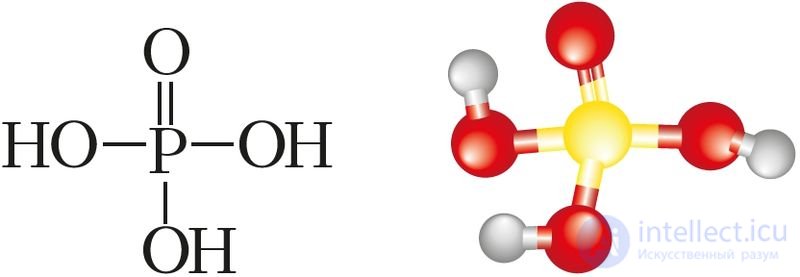
Fig. 96. Structural formula and ball-and-stick model of the phosphoric acid molecule
Chemical and physical properties. Phosphorus forms several acids, but the most stable is phosphoric acid H3PO4 (Fig. 96). From the structural formula of its molecule it is clear that the acid is tribasic. H3PO4 is a substance whose melting point is 42.35 °C. This means that at room temperature phosphoric acid is a solid substance. Phosphoric acid is highly soluble in water. In aqueous solution it dissociates in steps:
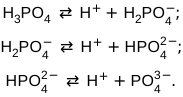
Phosphoric acid is a weak electrolyte, dissociating predominantly at the first step. In solutions it exhibits the general properties of acids: it changes the color of indicators and forms salts in reactions with metals located in the activity series before hydrogen (1), basic and amphoteric oxides (2), metal hydroxides and ammonia (3), and other salts (4); it is not an oxidizing agent because of its anion:
| 1 |
3Mg + 2H3PO4 = Mg3(PO4)2↓ + 3H2↑ metal |
| 2 |
3CaO + 2H3PO4 = Ca3(PO4)2↓ + 3H2O basic oxide 3ZnO + 2H3PO4 = Zn3(PO4)2↓ + 3H2O amphoteric oxide |
| 3 |
3NaOH + H3PO4 = Na3PO4 + 3H2O; base (alkali) 2NH3 + H3PO4 = (NH4)2HPO4 ammonia |
| 4 |
3K2CO3 + 2H3PO4 = 2K3PO4 + 3H2O + 3CO2↑ salt |
Note that phosphoric acid forms both medium salts (phosphates) and acid salts (hydrogen phosphates and dihydrogen phosphates), depending on the ratio of the starting substances. For example:
3KOH + H3PO4 = K3PO4 + 3H2O (potassium phosphate) (3 : 1);
2KOH + H3PO4 = K2HPO4 + 2H2O (potassium hydrogen phosphate) (2 : 1);
KOH + H3PO4 = KH2PO4 + H2O (potassium dihydrogen phosphate) (1 : 1).
When writing equations of reactions in ionic form, phosphoric acid is represented as molecules, as the predominant particles in its solution. For example:
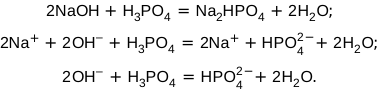
Applications and production. Phosphoric acid is used in the production of fertilizers and feed additives, for forming anticorrosion coatings on metals, and also in the food industry to impart a sour taste to soft drinks and to clarify sugar.
H3PO4 is obtained by the reaction of natural phosphates with sulfuric acid at 60‒80 °C, followed by filtering off the CaSO4 precipitate. In this process, phosphoric acid is formed as a syrupy solution with a mass fraction of substance of 85 %. The second method is burning phosphorus obtained by calcining natural phosphate with sand and coal, and the subsequent dissolution of the oxide in water:
Ca3(PO4)2 → P → P2O5 → H3PO4.
Salts of phosphoric acid. Phosphates are, as a rule, insoluble, with the exception of the salts of sodium, potassium, and ammonium. Acid salts are more soluble than medium salts, and dihydrogen phosphates have greater solubility than hydrogen phosphates. For example, phosphate Ca3(PO4)2 is insoluble, hydrogen phosphate CaHPO4 is slightly soluble, while dihydrogen phosphate Ca(H2PO4)2 is highly soluble in water.
Most phosphates possess high thermal stability — they do not decompose when heated to their melting point. A characteristic feature of phosphates (medium salts) is the formation of a yellow precipitate on treatment with a solution of silver(I) nitrate (Appendix 3):
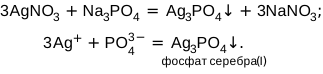
Unlike the light yellow precipitate of silver(I) bromide and the yellow precipitate of silver(I) iodide, silver(I) phosphate dissolves upon the addition of nitric acid.
Applications of the salts of phosphoric acid. Many medium and acid salts of phosphoric acid (Ca3(PO4)2, CaHPO4 · 2H2O, Ca(H2PO4)2 · H2O, NH4H2PO4, (NH4)2HPO4) are used as fertilizers. Phosphates are used in the production of rubber, plastics, and in metallurgy. Sodium phosphate reduces water hardness and improves the washing action of laundry detergents. Nevertheless, many countries now have restrictions on the use of phosphates in laundry detergents. The reason is that after washing, phosphates enter wastewater and then bodies of water, promoting the rapid growth of plankton and algae — bodies of water "age". According to some data, 1 g of phosphate stimulates the growth of 5–10 kg of algae.
Phosphorus(V) oxide is an acidic oxide.
Phosphoric acid, unlike nitric acid, is a solid substance under normal conditions, belongs to the weak acids, and exhibits oxidizing properties only through its hydrogen atoms.
The salts of phosphoric acid — phosphates, hydrogen phosphates, and dihydrogen phosphates — find wide use as fertilizers.
1. Name the classes of substances with which the following react:
2. Write the formulas of:
Write the equations of their electrolytic dissociation, taking into account the detachment of only the metal ions.
3. Write three equations of the successive reactions that occur when a solution is added:
Name the salts formed.
4. Write the equations of reactions taking into account the indicated coefficients:
 ;
; .
.5. Determine the amount of heat released upon combustion of phosphorus of mass 1 kg according to the thermochemical equation of the reaction:
4P(s) + 5O2(g) = 2P2O5(s) + 3010 kJ.
6. Can P2O5 be used as a desiccant for gaseous ammonia? Justify your answer.
7. In three numbered test tubes there are solutions of potassium nitrate, potassium phosphate, and sodium chloride. Propose a plan for identifying the substances. Explain using equations of the reactions in molecular and ionic form.
8. Write the equations of reactions according to the scheme:
 ;
; .
.9. It is necessary to prepare a solution of phosphoric acid of mass 500 g with a mass fraction of substance of 5 %. Calculate the masses of phosphorus(V) oxide and water needed for this purpose.
10. Calculate the volume of air (at STP) needed to burn phosphorus of mass 1 kg. What is the mass of phosphoric acid formed upon dissolution of the resulting phosphorus(V) oxide?
1. Phosphorus oxide P2O5 is:
2. The following statements are true for phosphoric acid:
3. A yellow precipitate with silver(I) nitrate is formed by solutions of:
4. The formulas of the following salts of phosphoric acid are correctly written:
5. At a molar ratio of ammonia to phosphorus(V) oxide of 2 : 1 in an aqueous solution, the product formed is:

Comments