
Lecture
Simple and complex substances
By elemental composition, substances are divided into simple and complex.
Simple substances consist of atoms of one element, complex ones — of atoms of several elements.
From atoms of one and the same element, several simple substances that differ in properties can be formed. Thus, the element phosphorus forms the substances white phosphorus Р4, red Рred, and black Рblack; oxygen forms oxygen itself О2 and ozone О3. Simple substances of the same chemical element are called its allotropic forms (modifications).
The concept of "simple substance" must not be equated with the concept of "chemical element." The properties of a simple substance — density, melting point, boiling point, etc. — pertain to a stable system or collection of particles of the substance. A chemical element has the characteristics of an individual atom — nuclear charge, atomic size, electronegativity, oxidation states, etc. Complex substances consist of atoms of chemical elements, not of simple substances: glucose consists of elements such as hydrogen, oxygen, and carbon.
Recall that both simple substances and individual atoms are, as a rule, named and denoted by symbols the same way as the corresponding chemical element. For example, the simple substance copper, the chemical element copper, and the copper atom are denoted by the symbol Cu; the simple substance nitrogen N2, the element nitrogen N, and the nitrogen atom N.
When allotropic modifications are present, simple substances may have different names. For example, the element carbon С forms simple substances with the names: graphite (Сgraphite), diamond (Сdiamond), fullerene (С60).
The composition of both a simple and a complex substance is reflected by the chemical formula — a conventional notation of the composition of a substance using chemical symbols and numerical indices, showing the qualitative and quantitative composition of the substance. Qualitative composition is determined by the kinds of atoms of the elements forming the given substance, while quantitative composition shows the ratio of elements by number of atoms. For example, the chemical formula of calcium carbonate СaСO3 shows that the substance is complex, consisting of the elements calcium, carbon, and oxygen (qualitative composition), while the ratio of calcium, carbon, and oxygen atoms in the substance, 1 : 1 : 3, indicates the quantitative composition.
The quantitative ratio of atoms in a substance can be established by various methods. Thus, the ratio of carbon and hydrogen atoms in methane is 1 : 4 and its chemical formula is СН4; in benzene this ratio is 1 : 1, but, as you know, its chemical formula is С6Н6. It is fair to ask: why does the chemical formula of benzene have the indices 6 and 6, and not 1 and 1? Why does the chemical formula of the simple substance hydrogen Н2 have the index 2, while the formula of copper Сu contains no index at all? To find answers to these questions, let us review what you already know about the structure of matter.
Substances of molecular and non-molecular structure
Substances of molecular and non-molecular structure are distinguished. Substances of molecular structure consist of molecules, those of non-molecular structure — of ions or atoms.
A molecule is the smallest electrically neutral particle of a substance, consisting of chemically bonded atoms, capable of existing independently and retaining the chemical properties of the whole substance.
The number of atoms in a molecule of each specific substance is strictly constant. Thus, various research methods show that a benzene molecule contains 12 atoms — 6 carbon and 6 hydrogen — hence the chemical formula С6Н6. The chemical formula of a substance of molecular structure is called the molecular formula.
A single molecule exhibits certain chemical properties, that is, it is capable of entering into chemical reactions to form other substances. Molecules of complex substances can break down to form other molecules. For example, from a molecule of ethane С2Н6 two other molecules can be formed — hydrogen Н2 and ethylene С2Н4. But a molecule has no color, melting point, boiling point, or other physical properties of a substance as a stable system of molecules. Substances of molecular structure are, as a rule, distinguished by relatively low melting and boiling points. Substances of molecular structure include all inorganic substances that are gaseous or liquid at room temperature (with the exception of mercury), some solid inorganic substances (for example, iodine I2, phosphoric acid Н3РО4), and the overwhelming majority of organic compounds.
Substances of molecular structure make up more than 90% of the total number of known substances.

It is worth remembering the chemical formulas of simple substances of molecular structure:
Substances of non-molecular structure consist of chemically bonded atoms (diamond, quartz) or charged ions (salts, alkalis). At room temperature they are usually solid, non-volatile substances with high boiling and melting points. In their composition one can conventionally identify a repeating group of atoms or ions corresponding to the simplest formula. It is called the formula unit.
A formula unit is a group of atoms or ions whose composition corresponds to the chemical (simplest) formula of a substance of non-molecular structure.
For example, the chemical formula of calcium chloride CaCl2 — a substance of non-molecular structure — shows both the composition of the formula unit and the simplest ratio of the number of atoms of the chemical elements in the substance as a whole (1 : 2).
The chemical formulas of simple substances of non-molecular structure are expressed by the symbols of the corresponding elements without numerical indices — Fe, Мg, B, C, Si.
We will examine questions of the structure of matter in more detail in the chapter "Chemical bonding and the structure of matter."
Relative molecular (formula) mass
The mass of any molecule is equal to the sum of the masses of the atoms forming it, and hence the relative molecular mass (Mr) is equal to the sum of the relative atomic masses:

The relative formula mass of substances of non-molecular structure is calculated similarly:

The relative molecular (formula) mass of a substance Mr is a dimensionless physical quantity that shows how many times the mass of a molecule (formula unit) is greater than one unit of atomic mass mu.
From the chemical formula one can calculate the mass fractions of the elements in a substance: 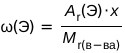 , where x is the number of atoms of element E. For example, the mass fraction of sulfur in pyrite:

Inorganic substances are divided by chemical composition into simple and complex. Substances have either molecular or non-molecular structure. The structural unit of a substance of molecular structure is the molecule, and of non-molecular structure — the formula unit.
Each molecule or formula unit is characterized by its own qualitative and quantitative composition.
The quantitative characteristic of a molecule is the relative molecular mass Mr, and of a formula unit — the relative formula mass Mr.
1. Write out the chemical formulas of the simple substances: H2S, N, N2, CO2, F2, Fe, CaCl2, Cu, H, Br2, I2, СаСО3, НNO3, S8.
2. Indicate whether the statement characterizes qualitative or quantitative composition:
3. Determine whether each of the listed substances has a molecular or non-molecular structure:
4. Calculate the relative molecular (formula) mass of the substances whose chemical formulas are:
5. Describe the qualitative and quantitative composition of calcium phosphate Ca3(PO4)2.
6. Calculate the mass fraction of the metal in the substance whose chemical formula is:
7. Fill in the table, comparing substances of molecular and non-molecular structure by the following parameters:
| Comparison parameters | Substances | |
| of molecular structure | of non-molecular structure | |
8. The relative formula mass of a salt with the composition Э2(SO4)3 is 392. Determine the chemical element and indicate which of the four melting point values corresponds to its simple substance: –259 °С, –85.6 °С, 0 °С, 1890 °С. Explain your choice.
9. Determine the mass fraction of nitrogen in a mixture containing 10 g of urea (NH2)2CO and an equal amount of potassium chloride.
10. An ore contains the minerals FeS2 (mass fraction 92%), FeAsS (mass fraction 6%), and sulfur-free impurities. Calculate the mass of sulfur contained in 1 kg of such ore.
1. Complex substances include:
2. Substances with molecular structure are those for which:
3. Substances of non-molecular structure include those whose chemical formulas are:
4. A relative molecular mass of 30 is possessed by the substances whose formulas are:
5. The relative molecular mass of a mixture, in which there are two molecules of oxygen per one molecule of methane, is:

Comments