
Lecture
The fundamental laws of chemistry make it possible to describe the qualitative and quantitative composition of substances, as well as changes in composition during chemical transformations. Without knowledge of these laws, chemical analysis of the composition of a substance, calculation of the amounts of reagents for carrying out chemical reactions in industry and in the laboratory, and determination of product yield would be impossible.
The law of constant composition of matter
The law of constant composition of matter was established by the French scientist J. Proust in 1801.
In its modern formulation, the law states: any chemically pure substance of molecular structure, regardless of the method of its production, has a constant composition, that is, it consists of the same chemical elements, the atoms of which are present in constant quantitative ratios for a given substance.
Proust's law indicates that the composition of an individual pure substance can be described by a definite chemical formula. For example, no matter how carbon dioxide is obtained (by burning coal, by the action of acid on marble, by the oxidation of methane), the mass fraction of carbon in it is 27.27%, and of oxygen — 72.73%; the masses of carbon and oxygen are in the ratio: 27.27 : 72.73 = 3 : 8. The ratio of their amounts: 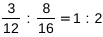 . Consequently, in the substance there are two atoms of oxygen for every one atom of carbon, that is, the chemical formula is CO2.
Let us show how to determine the formula of a substance in more complex cases (example 1).
Example 1. Analysis of an organic substance established that the mass fractions of carbon, hydrogen, and oxygen in it are 44.78%, 7.46%, and 47.76% respectively. Determine the formula of the substance.
Given:
ω(С) = 44.78 %
ω(Н) = 7.46 %
ω(О) = 47.76 %
СxНyOz — ?
Solution
Let the mass of a portion of this substance be 100 g, then the masses of the elements will be:
m(С) = 44.78 g; m(Н) = 7.46 g;
m(O) = 47.76 g, and their amounts:



The indices in a chemical formula show the ratio of both the individual atoms and their amounts. Let us find the ratio of the amounts of atoms:
х : у : z = n(С) : n(Н) : n(O) = 3.73 mol : 7.46 mol : 2.99 mol = 3.73 : 7.46 : 2.99.
Let us determine the indices x, y, and z. To do this, divide each of the numbers found by the smallest of them, that is, by 2.99, and then multiply by 4 to obtain integer values:
x : y : z = 1.25 : 2.5 : 1 = 5 : 10 : 4.
Consequently, the simplest formula of the substance is С5Н10O4.
Answer: С5Н10O4.
Thus, knowledge of the mass fractions of elements in a substance, or of their masses in a given portion of the substance, makes it possible to establish the formula of the substance.
For some substances of non-molecular structure, the law of constant composition holds only approximately. Their composition may vary within certain limits depending on the conditions of synthesis or processing of the substance.

For substances of non-molecular structure there are deviations from the law that could not be detected in the 17th–19th centuries due to the lack of precise analytical methods. Thus, iron(II) oxide has a composition in the range Fe0.89O—Fe0.95O, and titanium(III) oxide — Ti2O2.6—Ti2O3.4. One of the reasons for the violation of constant composition lies in the defects that arise during the formation of crystals of non-molecular substances. Such compounds are called non-stoichiometric, or berthollides, in honor of the French chemist C. Berthollet. In the case of extremely small deviations from constancy of composition, the ratios of atoms in compounds are practically integral, and such compounds themselves are classified as stoichiometric and are called daltonides in honor of J. Dalton, one of the founders of atomic-molecular theory (for example, potassium chloride, calcium oxide).
The law of conservation of mass of substances
The law of conservation of mass of substances makes it possible to calculate the masses of substances entering into a reaction or formed as a result of its occurrence.
Recall that the process of transformation of some substances into others, without change in the total number and nature of the atoms of which these substances are composed, is called a chemical reaction. Substances entering into a chemical reaction are reagents, while substances formed as a result of the chemical reaction are products.
The course of chemical reactions obeys the law of conservation of mass of substances: the mass of the substances entering into a chemical reaction equals the mass of the substances formed.
The action of this law can be shown by the following example. If a closed flask containing a small amount of phosphorus is weighed and then heated, the phosphorus ignites with a bright flame, and the flask fills with white smoke. A repeat weighing shows that the total mass of the flask with its contents has not changed (Fig. 10).
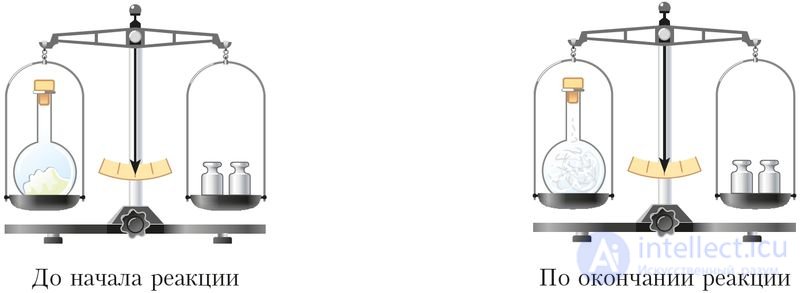
Fig. 10. An experiment illustrating the law of conservation of mass of substances
From the standpoint of atomic-molecular theory, the law can be explained by the fact that in chemical reactions atoms neither disappear nor arise anew; their total number remains unchanged, and consequently the total masses of substances before and after the reaction are the same.

A great contribution to the experimental proof of the law of conservation of mass of substances was made by the experiments of the Russian scientist M. V. Lomonosov and the French chemist A. Lavoisier (2nd half of the 18th century), who measured the mass of the starting substances and the mass of the products obtained from them.
Let us show how the law of conservation of mass of substances can be used for quantitative calculations from reaction equations, using as an example the combustion of methane in oxygen to form water and carbon dioxide.
The scheme of this reaction:

Let us place coefficients before the formulas, which must equalize the number of atoms of the reagents and products:

This equation shows that the formation of one molecule of carbon dioxide and two molecules of water occurs when one molecule of methane reacts with two molecules of oxygen. The coefficients show in what molar ratio the substances react and the products are formed. Thus, it follows from the reaction equation drawn up that if 1 mol of methane enters into the reaction, then 2 mol of oxygen is consumed to burn it, and as a result 2 mol of water and 1 mol of carbon dioxide are formed.
Taking these quantitative ratios into account, one can calculate the mass (amount, volume) of reagents needed to obtain a certain amount of products, and conversely — the products from the starting substances.
Example 2. Determine the mass of aluminum sulfate formed by the complete dissolution of aluminum with a mass of 13.5 g in dilute sulfuric acid.
Given:
m(Аl) = 13.5 g
m(Al2(SО4)3) — ?
Solution
M(Al) = 27 g/mol; M(Al2(SO4)3) = 342 g/mol.
The amount of aluminum that entered into the chemical reaction:

Taking into account the coefficients in the reaction equation, we have:
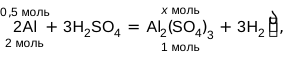
whence
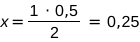 , that is, n(Al2(SO4)3) = 0.25 mol.
The mass of the salt:
m(Al2(SO4)3) = n(Al2(SO4)3) ∙ M(Al2(SO4)3) = 0.25 mol ∙ 342 g/mol = 85.5 g.
Answer: m(Al2(SO4)3) = 85.5 g.
Example 3. When magnesium with a mass of 1.2 g was burned, its oxide with a mass of 2 g was formed. Determine the volume of oxygen (at STP) consumed in the combustion of the magnesium.
Such a problem can be solved either using the reaction equation or without it. Let us consider the second method.
Given:
m(Mg) = 1.2 g
m(MgO) = 2 g
V(O2) — ?
Solution
According to the law of conservation of mass of substances, the mass of the substances formed equals the mass of the substances that entered into the chemical reaction:

Therefore the mass of oxygen equals:

and its amount is:

The volume of oxygen equals:

Answer: V(O2) = 0.56 dm3.
Any chemically pure substance of molecular structure, regardless of the method of its production, has a constant composition.
Substances of non-molecular structure do not always have a constant composition.
The mass of the substances entering into a chemical reaction equals the mass of the substances formed.
Questions, tasks, problems
1. State the basic laws of chemistry that describe the qualitative and quantitative composition of substances, as well as changes in this composition during chemical transformations.
2. As a result of the decomposition reaction of calcium carbonate during its calcination, the mass of the solid substance decreased. What, besides the mass of the solid product, needs to be measured to confirm the law of conservation of mass of substances?
3. How and why does the mass of a portion of iron filings change when stored in air?
4. Balance the coefficients in the reaction schemes:
5. Two beakers containing baking soda and hydrochloric acid were placed on an electronic balance. Then, after removing the beakers from the balance, the soda powder was carefully poured into the beaker with the acid, after which both beakers were placed on the balance again. How did the reading on the balance display change?
6. Determine the mass of iron(III) chloride formed when iron with a mass of 2.8 g burns in chlorine.
7. Determine the volume of air (at STP) needed to roast pyrite FeS2 with a mass of 1.2 kg. The roasting of pyrite in air proceeds according to the scheme: FeS2 + О2 → Fe2О3 + SO2↑.
8. What is the mass of the salt obtained by the interaction of a solution containing 10 g of sodium hydroxide with a solution containing 10 g of hydrogen chloride?
9. Determine the chemical formula of a substance in which:
10. A mixture of magnesium and calcium oxides with a mass of 1.04 g was dissolved in nitric acid. This formed a mixture of nitrates with a mass of 3.2 g. Calculate the mass of each of the oxides.

*Self-check
1. The law of conservation of mass of substances in chemical reactions is used:
2. The coefficients are correctly balanced in the reaction equations:
3. Name the substances whose mass increases when calcined in an open vessel:
4. The mass fractions of the elements in a binary compound are equal. The chemical formula of the compound is:
5. Compounds that can have a non-stoichiometric composition are:

Comments