
Lecture
The diversity of inorganic compounds is most logically reflected by so-called genetic series, which contain compounds of a single element belonging to different classes. As a rule, such a series is represented by the element, its oxide, hydroxide, and the corresponding salt. For example, the genetic series of a typical metal and the genetic series of a nonmetal look like this:
| Metal | → | basic oxide | → | hydroxide (base) | → | salt |
| Са | → | СаО | → | Са(ОН)2 | → | Са(NO3)2 |
| Nonmetal | → | acidic oxide | → | hydroxide (acid) | → | salt |
| S | → | SO2 | → | Н2SO3 | → | Na2SO3 |
The arrow (→) in these schemes means "corresponds to." Thus, a typical metal is matched by a basic oxide, hydroxide, and salt — in particular, Са by the oxide СаО, the hydroxide Са(ОН)2, and the salt Са(NO3)2.
The properties of the compounds of metals and nonmetals are, in essence, opposite, so substances of different genetic series can interact with one another, forming mainly salts. Some variants of such pairwise interactions can be represented by schemes based on genetic series, which show that the products of the interaction of substances from different genetic series are, for the most part, salts (Fig. 6.5, 6.6).
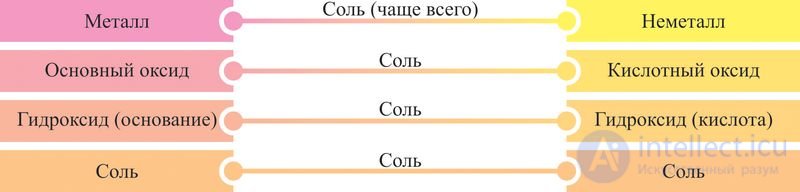
Fig. 6.5. Products of the interaction of substances from different genetic series
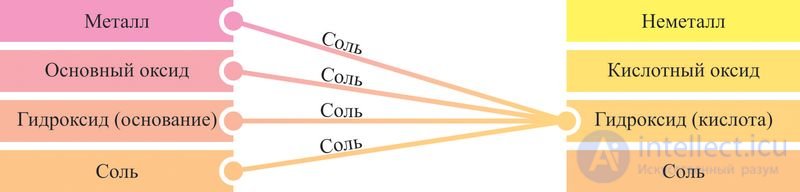
Fig. 6.6. Interaction of substances of the genetic series of a metal with an acid — a representative of the genetic series of a nonmetal

When metals and nonmetals interact, both salts (halides, sulfides — NaCl, Al2S3) are formed, as well as binary compounds that do not belong to the class of salts (nitrides, phosphides, carbides, hydrides, oxides — Li3N, Ca3P2, Al4C3, NaH, CaO).

In organic chemistry, genetic series are formed by compounds containing the same number of carbon atoms:
С3Н8 → С3Н7Сl → С3Н7ОН → C2H5СНО → C2H5СОOH → CH3CH(Cl)СОOH → CH3CH(NH2)СОOH →  NH—CH(CH3)CO
Knowledge of the specifics of each type of interaction is necessary for carrying out various assignments and solving experimental problems. In practical work, chemists obtain new substances from those available to them: for example, sulfuric acid from iron pyrite, ammonia from nitrogen, nitric acid from ammonia, zinc from zinc blende, and so on. In doing so, it is usually necessary to carry out a series of reactions to obtain the desired product. For example, one of the ways of obtaining zinc from the natural mineral ZnS can be represented by the transformation scheme:
ZnS → ZnO → Zn,
for which the following reactions are needed:
1) oxidation of zinc sulfide by oxygen (roasting):
2ZnS + 3O2 = 2ZnO + 2SO2;
2) reduction of the metal from the oxide:
ZnO + С = СО + Zn.
The choice of the transformation pathway and the development of technological processes are influenced by knowledge of the properties of substances, the availability of reagents, the safety of the processes, and many other factors.
As an example, let us consider the transformation of substances of one genetic series — a basic oxide into a hydroxide.
Example 1. Write the equation of the reaction that allows an alkali to be obtained from a basic oxide: СаО → Са(ОН)2.
Solution
Since calcium is an active metal, its oxide reacts with water, forming an alkali:
CaO + H2O = Ca(OH)2 (interaction of an active metal with water).
Example 2. Write the equations of the reactions that allow an insoluble base to be obtained from a basic oxide: FeO → Fe(OH)2.
Solution
Since Fe(OH)2 is an insoluble base, it can only be obtained from a solution of a salt. This means that the starting oxide FeO must first be converted into a soluble salt:
FeO + Н2SO4 = FeSO4 + H2O (dissolution of the oxide in an acid, obtaining a soluble salt).
Then an alkali solution must be added to the salt solution:
FeSO4 + 2NaOH → Fe(OH)2↓ + NaSO4 (obtaining an insoluble base by the interaction of solutions of a salt and an alkali).
Thus, the choice of reagents depends on what the product of the transformation is — a metal hydroxide: an alkali or an insoluble base. To obtain an alkali from an oxide, water alone is sufficient, while an insoluble base can only be obtained from a solution of a salt. Therefore, the oxide must first be converted into a soluble salt, and then an alkali solution must be added.
Questions, assignments, problems
1. Write out the chemical formulas of the substances that form the genetic series of magnesium: МnO, Mn(OH)2, Mg(OH)2, MgO, K2SO4, MgSO4, Mg, Mn, MnSO4.
2. Fill in the table, using the formulas of the substances: Fe(ОН)2, СаО, Н2SO4, SО3, СО2, NaOH, Na2SO4, НСl, Н2SO3, K3PO4, Ba(ОН)2, КСl.
| Oxides | Acids | Bases | Salts |
3. Construct genetic series of metals:
4. Write the equations of the reactions according to Figure 6, using sulfuric acid as an example.
5. Write the equations of the reactions for two transformations:
Why did you need to write a different number of reaction equations in the proposed transformations?
6. Construct the genetic series of sodium and the genetic series of carbon. What is their fundamental difference? Write the equations of the reactions that allow the successive production of the substances in each series.
7. Calculate the mass of zinc obtained as a result of the transformations: ZnS → ZnO → Zn, if the mass of the starting zinc sulfide is 29.1 g and the losses amounted to 5%.
8. Write the equations of the reactions according to the scheme:
 ВаО
ВаО  Вa(OH)2
  ВаСl2
ВаСl2  ВaCO3
ВaCO3  …; СО2 Н2СO3 Na2СO3 CaCO3 ….
9. Determine the simple substance Х in the genetic series and write the equations of the corresponding reactions:
Х Х2О5 Н3ХO4 K3ХO4,
if the mass fraction of oxygen in the compound K3ХO4 is 30.19%.
10. Determine the simple substance Х in the genetic series and write the equations of the corresponding reactions:
ХХО2Н2ХO3NaНХO3,
if the mass fraction of element Х in the compound NaНХO3 is 30.77%.
Self-check
1. Not a compound of the genetic series of magnesium:
2. The action of water can accomplish the transformations:
3. The products of the interaction of a metal and a nonmetal are the compounds:
4. The product of the transformation of SO3  forms salts when reacting with the substances:
5. The mass fraction of oxygen in the sulfate obtained in the transformation Х → ВаО → Ba(ОH)2 → ХSO4 is:

Comments