
Lecture
Reagents: solutions of ammonium chloride (or sulfate), sodium hydroxide, indicator paper.
To a test tube secured in a stand containing a solution of ammonium chloride (sulfate), add 1‒2 cm3 of sodium hydroxide solution (Fig. ).
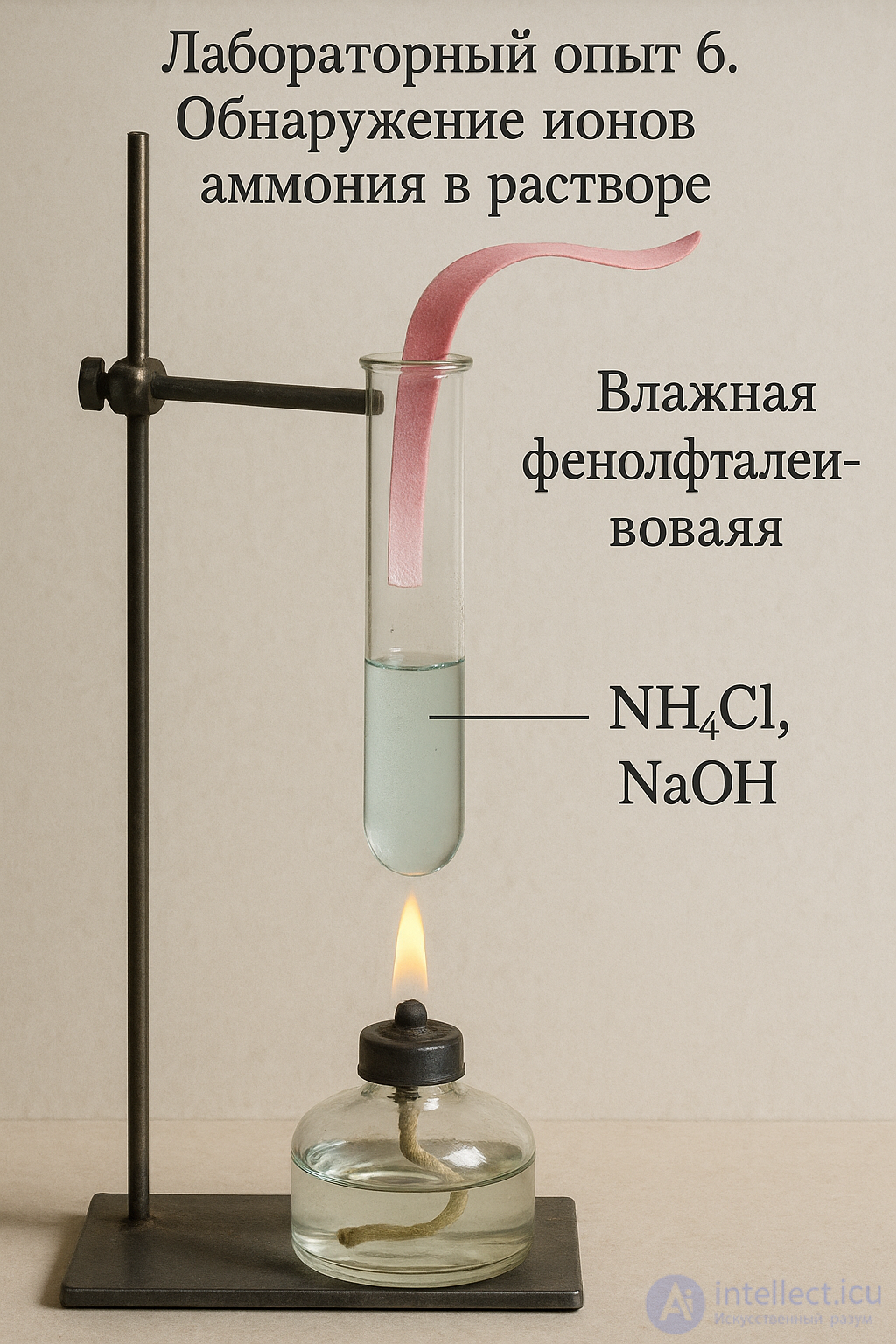
Warm the mixture for a few seconds, holding moist indicator paper near the mouth of the test tube (without touching the walls!). Note the change in color.
Draw a conclusion about how ammonium ions can be detected in a solution.
Aim of the experiment:
To detect the presence of ammonium ions (NH₄⁺) in a solution.
Reagents and equipment:
Ammonium chloride (NH₄Cl) or ammonium sulfate solution
Sodium hydroxide (NaOH) solution
Moist phenolphthalein paper
Test tube, stand, spirit lamp
Procedure:
Into a test tube secured in a stand, pour about 2 cm³ of NH₄Cl solution.
Add 1–2 cm³ of NaOH solution to it.
Carefully heat the test tube over a spirit lamp for a few seconds.
Hold moist phenolphthalein paper near the mouth of the test tube, without touching the walls of the test tube.
Observe the change in color of the paper.
Observation:
The phenolphthalein paper turns crimson. This means that heating releases ammonia (NH₃), which on contact with the moist paper creates an alkaline environment that changes the color of the indicator.
Chemical reaction:

Conclusion:
Ammonium ions can be detected by their reaction with an alkali upon heating. The ammonia released causes a change in the color of the phenolphthalein paper, which indicates the presence of NH₄⁺ in the solution.

Comments