
Lecture
Nomenclature and classification of oxides
Oxides are complex substances consisting of two elements, one of which — is oxygen (ЭхОу). Oxygen in oxides displays an oxidation state of –2: 
Under normal conditions, oxides can be gaseous (CO2, NO), liquid (H2O), and most often solid (fig. 6.2).

The compound OF2 is classified as a fluoride, since in this compound fluorine is the more electronegative element, and the oxidation state of oxygen is +2:  .
.
In addition to oxides, there are several groups of binary oxygen-containing substances — peroxides (Н2О2, Na2O2), superoxides (KO2, RbO2, CsO2), and ozonides (KO3, CsO3). The oxygen atoms in them are connected to each other by a covalent bond. The oxidation state of oxygen in them is different: –1,  . All these substances are strong oxidizing agents.
The names of oxides consist of the word "oxide" and the name of the element, for example: Li2O — lithium oxide. Recall that in the case where the atoms of an element exist in several positive oxidation states, this state is indicated in the names or formulas of oxides, bases, and salts by Roman numerals. They are placed in parentheses after the name of the corresponding element, for example: iron(III) oxide, iron(II) hydroxide, iron(II) chloride.
There are oxides in which the metal atoms are in different oxidation states, for example iron(II, III) oxide Fe3O4, or FeO ∙ Fe2O3.
A distinction is made between salt-forming (basic, amphoteric, acidic) and non-salt-forming oxides.

Fig. 6.2. Oxides: a — calcium, b — copper(II), c — copper(I), d — chromium(III), e — iron(III), f — nitrogen(IV)
Acidic oxides include oxides that correspond to acids: 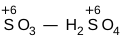 ,
, 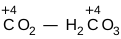 . These are, as a rule, oxides of nonmetals (for example,
  ), oxides of metals with high oxidation state values of +5, +6, +7 (for example,
  ).
).
Acidic oxides are often called acid anhydrides (for example, P2O5 — phosphoric anhydride).
Oxides to which bases correspond are called basic: K2O — KОН, ВаО — Ва(ОН)2. These include exclusively metal oxides.
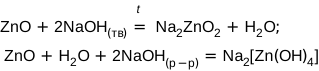
Amphoteric oxides (Al2O3, Cr2O3, ZnO, BeO), depending on conditions, can display the properties of either acidic or basic oxides.
Chemical properties of oxides
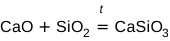
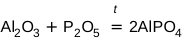
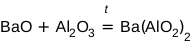
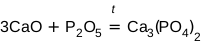
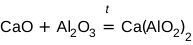
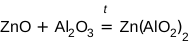
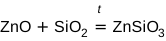
The chemical properties of salt-forming oxides are presented in table 1.1.
Table 1.1. Chemical properties of salt-forming oxides
| Basic (Na2O, СаО, MgO, FeO — metal oxides) |
Amphoteric (Al2O3, Cr2O3, ZnO, BeO — metal oxides) |
Acidic (SO3, CO2, P2O5, CrO3 — oxides of both metals and nonmetals) |
| React: | ||
| with water: | ||
|
Oxides of alkali and alkaline earth metals: CaO + H2O = Ca(OH)2 |
— |
(Except SiO2): SO3 + H2O = H2SO4 |
| with acids: | ||
|
|
|
— |
| with alkalis: | ||
| — |
|
|
| with acidic oxides: | ||
|
|
|
— |
| with basic oxides: | ||
| — |
|
|
| with amphoteric oxides: | ||
|
|
|
|
Non-salt-forming oxides include a small number of nonmetal oxides with low oxidation state values: 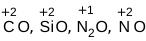 . At room temperature they do not form salts with either acids or alkalis. However, they are characterized by reactions involving a change in the oxidation state of the element forming the oxide.

Redox properties can be displayed not only by non-salt-forming oxides but also by basic, acidic, and amphoteric oxides. As examples, let us cite some practically significant transformations of oxides:
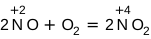 (intermediate stage in the production of nitric acid);
 (production of iron, blast furnace process);
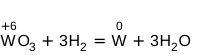 (production of tungsten);
 (production of silicon).
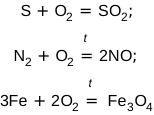
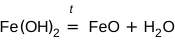
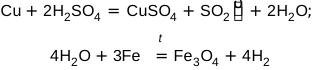
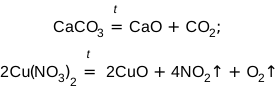
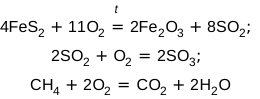
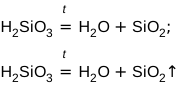
Oxides are obtained by the oxidation with oxygen of simple and complex substances (both inorganic and organic), as well as by thermal decomposition of hydroxides (acids, bases, amphoteric hydroxides) and oxygen-containing salts (table 1.2).
Table 1.2. Methods of obtaining oxides
| Methods of obtaining oxides | ||
|---|---|---|
| Interaction of simple and complex substances with oxygen | Decomposition of complex substances — bases, salts, acids | Other methods |
 |
 |
 |
 |
||
 |
 |
Some metals (Мg, Zn), as well as carbon, form oxides in reactions with water vapor. Additionally, let us note the laboratory method for obtaining carbon(IV) oxide by an exchange reaction, using marble and hydrochloric acid:
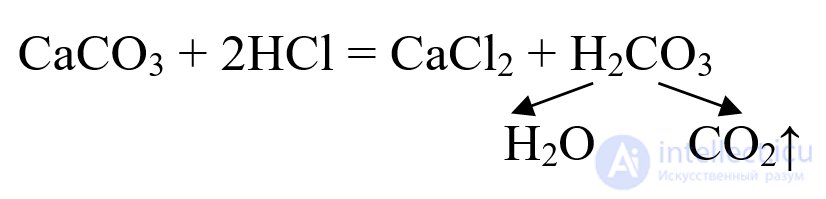
The resulting oxide СО2 can be regarded as a product of the decomposition of carbonic acid.
It should also be remembered that when nitrogen-containing substances (ammonia NH3, amines RNH2, etc.) are oxidized by oxygen, nitrogen is released as the simple substance N2, while nitrogen(II) oxide is formed in the presence of a catalyst.
Oxides are complex substances consisting of two elements, one of which is oxygen. A distinction is made between salt-forming (basic, amphoteric, acidic) and non-salt-forming oxides.
Acidic oxides react with water, basic oxides, and alkalis; basic oxides react with water, acidic oxides, and acids. Amphoteric oxides enter into reactions both with acids and with alkalis, as well as with other salt-forming oxides.
Common methods of obtaining oxides are the interaction of simple and complex substances with oxygen and the thermal decomposition of bases, oxygen-containing salts, or acids.
Questions, assignments, problems
1. Name the oxides:
2. Write the formulas of the oxides:
|
Acid |
|
|
|
|
|
|
|
Acidic oxide |
|
|
|
|
Base |
LiOH |
NaOH |
Ba(OH)2 |
Ca(OH)2 |
Fe(OH)2 |
Sr(OH)2 |
|
Basic oxide |
|
|
|
|
|
|
3. Write equations of reactions characterizing the properties of oxides:
4. Write the equations of reactions of the following substances with oxygen: Сu, Al, ZnS, C2H2, С2Н5NH2, CH3OH.
5. Write equations of reactions according to the schemes:





 .
.6. Given the list of oxides with formulas MgO, ZnO, NO, SiO2, SO3, P2O5, K2O. Which of the listed oxides will react with: a) sodium hydroxide; b) sulfuric acid? Write the equations of the corresponding reactions.
7. Calculate the volume (STP) of sulfur dioxide gas formed during the roasting of pyrite FeS2 with a mass of 10 t, in which the mass fraction of impurities is 6.25 %. Determine the mass of sulfuric acid that could be obtained in the process.
8. About 25 g of vinegar fits in a tablespoon. Determine the volume of carbon dioxide that will be released when this portion of vinegar reacts with baking soda. The mass fraction of acetic acid in table vinegar is 9 %.
9. The molar mass of a mixture of carbon oxides СO and СО2 is 32 g/mol. Determine the volume fraction of carbon(II) oxide in the mixture.
10. A mixture of magnesium and calcium oxides with a mass of 1.52 g was dissolved in nitric acid. Upon careful evaporation and drying, a mixture of salts with a mass of 4.76 g was obtained. Determine the masses of the oxides in the initial mixture.
Self-check
1. Oxides are the substances whose formulas are:
2. Only acidic oxides are listed in the rows:
3. The following statements are correct with respect to barium oxide:
4. Choose the schemes of feasible reactions:
5. The amount of sulfuric acid reacting with iron(II, III) oxide with a mass of 2.32 g is equal to:





Comments