
Lecture
The Italian scientist A. Avogadro formulated a law in 1811, according to which equal volumes of different gases under the same conditions contain the same number of molecules. The explanation for this law lies in the features of the gaseous state of matter. As you know from your physics course, the distances between gas molecules are many times greater than the sizes of the molecules themselves. Therefore, the volume occupied by a given portion of gas depends mainly on these distances, and not on the sizes of the molecules.
The consequences of Avogadro's law are important for solving practical problems.
First consequence. An equal number of molecules of any gas at the same pressure and temperature occupies an equal volume.
Second consequence. The molar volume of gases Vm is a constant quantity at unchanged temperature and pressure.
Mathematically, this is written as follows: 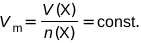
As noted in § 4 (p. 24), under standard conditions the molar volume of any gas equals 22.4 dm3/mol:
Vm = 22.4 dm3/mol.
This equality holds for different gases because a substance amounting to 1 mole always contains 6.02 ∙ 1023 particles.
Third consequence. The masses of equal volumes of two gases under the same conditions are related as their molar masses.
Let us demonstrate this using the example of two arbitrary gases of equal volume V under the same conditions. It is known that  . Since the volumes are equal: V1 = V2, then
 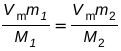 . Cancelling both sides of the equation by Vm, we obtain:
  .
.
The ratio  is called the relative density of the first gas with respect to the second (D):
  .
.
Knowing the relative density of one gas X with respect to another gas Y allows one to determine the molar mass of one of the gases if the molar mass of the other gas is known: M(X) = M(Y) · DY(X).
The relative density of gaseous substances is usually determined with respect to hydrogen or with respect to air.
Example 1. Determine the relative density of sulfur dioxide with respect to hydrogen and to air.
Solution. Since the molar mass of sulfur dioxide M(SO2) = 64 g/mol, its relative density with respect to hydrogen is:

relative density with respect to air (M(air) = 29 g/mol):

Example 2. Determine the molar mass of a gaseous hydrocarbon if its relative density with respect to air equals 2.
Solution. Based on the definition of relative gas density, we write:
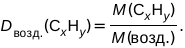
From this relationship it follows:

The relative density of gases D, unlike their densities ρ, is a quantity that does not depend on temperature and pressure.
In chemical reactions the law of conservation of mass is observed, but the volume of the reaction mixture can change substantially if the chemical reaction occurs between gaseous substances or gaseous substances are formed as a result of the reaction. In this case, the volumes of gaseous reactants and products are related to one another as the coefficients in the equation of the corresponding reaction. Let us illustrate this with the example of the oxidation reaction of ammonia NH3 with oxygen to form nitrogen and water:
| Reaction equation | 4NH3(g) + | 3O2(g) = | 2N2(g) + | 6H2O(l) |
| Amount of substance | 4 mol | 3 mol | 2 mol | 6 mol |
| Volume of gaseous substances | 4 ∙ 22.4 dm3 | 3 ∙ 22.4 dm3 | 2 ∙ 22.4 dm3 | |
| Ratio of volumes of substances | 4 | 3 | 2 |
The ratio of the volumes of the gaseous starting materials and products (at s.c.) of the reaction is equal to:
V(NH3) : V(O2) : V(N2) = (4 · 22.4 dm3) : (3 · 22.4 dm3) : (2 · 22.4 dm3) = 4 : 3 : 2.
Thus, the ratio of the volumes of gaseous substances equals the ratio of the coefficients in front of their formulas in the reaction equation. For example, if the volumes of ammonia and oxygen entering the reaction are equal to 4 m3 and 3 m3 respectively, then as a result of the reaction nitrogen with a volume of 2 m3 is formed.
Let us apply the conclusion obtained to solve calculation problems.
Example 3. Determine the volume (at s.c.) of oxygen required for the complete combustion of butane with a volume of 10 m3 (at s.c.).
Given:
V(C4H10) = 10 m3
V(O2) — ?
Solution
Since both butane and oxygen are gaseous substances (at s.c.), the volume ratios of gases can be used to find the volume of oxygen.
This makes it possible to solve the problem without converting gas volumes to amount of substance and without requiring conversion of volume units.
1. Let us write the reaction equation:
2C4H10(g) + 13O2(g) = 8CO2(g) + 10H2O(l).
2. Let us determine the volume ratios of butane and oxygen according to the reaction equation: 13 mol of oxygen is needed for 2 mol of butane, that is, their volume ratio is 2 : 13:
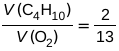 or
or  ,
,
from which we find:
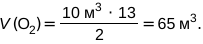
The usual way of setting out the solution is also convenient:
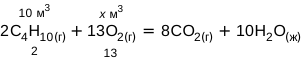 , from which: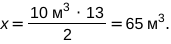
Answer: V(O2) = 65 m3.
Example 4. To completely burn 2 dm3 of a certain hydrocarbon, 9 dm3 of oxygen was required. In doing so, 6 dm3 of carbon dioxide was formed. Determine the molecular formula of the hydrocarbon. The volume measurements were carried out under the same conditions.
Given:
V(CxHy) = 2 dm3
V(O2) = 9 dm3
V(CO2) = 6 dm3
CxHy — ?
Solution
Let us conditionally represent the formula of the hydrocarbon sought as CxHy. Let us write the equation for the combustion reaction of the hydrocarbon, setting the coefficients in accordance with the experimental data on the gas volumes:
2CxHy + 9O2 = 6CO2 + yH2O.
The coefficients in it are related as the volumes of the corresponding gaseous reactants. Taking into account that the number of oxygen atoms entering the reaction is equal to the number of atoms in the reaction products, we have:
9 ∙ 2 = 6 ∙ 2 + y ∙ 1, from which y = 6.
Let us write the reaction equation with all coefficients:
2CxHy + 9O2 = 6CO2 + 6H2O.
Analysis of this equation indicates that x = 3, and the molecular formula of the hydrocarbon is C3H6.
Answer: C3H6.
The fundamental law of chemistry characterizing the gaseous state of matter is Avogadro's law: equal volumes of different gases under the same conditions contain the same number of molecules.
Questions, tasks, problems
1. Explain the essence of Avogadro's law.
2. Why
3. Determine the relative density of the gases:
4. Determine the molar mass of a gas whose relative density with respect to helium equals 7.5. Which of the gases satisfy the condition of the problem: N2, NO, CO2, C2H4, C2H6, CH2O?
5. The relative density of the first gas with respect to the second equals 0.53. Which of the gases has the greater molar mass?
6. What volume of oxygen (at s.c.) is needed for the complete combustion of ethane with a volume of 100 m3? What volume of air (at s.c.) will be required for this purpose? Solve the problem using volume ratios of gases.
7. Determine the volume of air (at s.c.) needed for the complete combustion of butane C4H10 with a mass of 10 kg.
8. 10 m3 of nitrogen and 20 m3 of hydrogen (at s.c.) were mixed. Determine the relative density of the resulting mixture with respect to hydrogen.
9. Establish the chemical formula of a hydrocarbon in which the mass fraction of carbon is 82.76%, and the relative density of the hydrocarbon with respect to air equals 2.
10. When 6.9 g of an organic substance was burned, 13.2 g of carbon(IV) oxide and 8.1 g of water were formed. Determine the molecular formula of the substance if the relative density of its vapor with respect to air equals 1.586.
1. The following statements are true for Avogadro's constant:
2. The same volume at 0 °C and a pressure of 760 mm Hg is occupied by substances taken in an amount of 2 mol:
3. In volume ratios of 1 : 2 the following react:
4. For which of the listed gases is the relative density with respect to helium equal to 7.5:
5. A gas with a volume of 3 dm3 has a mass of 7.767 g. Its molar mass (g/mol) equals:

Comments