
Lecture
The chemical properties of substances (metallic and non-metallic, oxidation-reduction and acid-base) can be explained and predicted using information about the periodic change in the properties of atoms as the charge of their nucleus increases, the most important of which are atomic radius, electronegativity, and oxidation state. Let us analyze how these properties depend on the electronic structure of atoms.
Periodicity of changes in atomic radii of elements
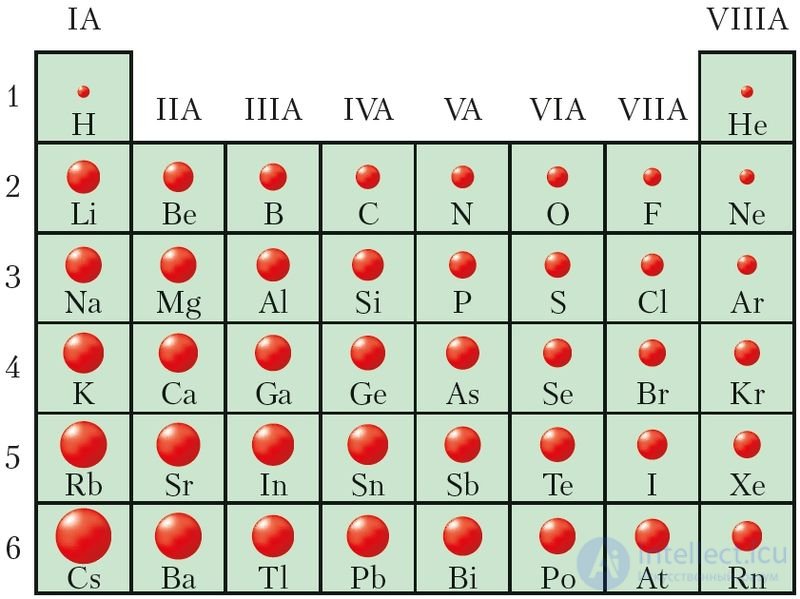
Fig. 21. Relative sizes of atoms
The radius of an atom is determined by the size of its electron shell. From the standpoint of the probability of finding an electron in the space around the nucleus, an atom has no sharp boundaries. Therefore, the atomic radius is a conventional (arbitrary) quantity. We will take the atomic radius to be the distance from the nucleus to the outer electron shell occupied by electrons. As stated in § 9, about 90% of the electron density is concentrated within a sphere of such a radius.
By comparing the pattern of change in atomic radii (Fig. 21) with their electronic structure, the following conclusions can be drawn:
Atomic radius values are an important characteristic of chemical elements, since they determine how strongly the outer, valence, electrons are bound to the atom. The smaller the radius, the more strongly the valence electrons are held by the atom, and vice versa.

The forces of attraction or repulsion of charged particles are determined by Coulomb's law: the force of interaction between two charged bodies is directly proportional to the product of the magnitudes of their charges and inversely proportional to the square of the distance between them: 
Periodicity of changes in the electronegativity of atoms
In 1932, L. Pauling introduced into chemistry the concept of electronegativity as a measure of the ability of a given atom to attract electrons from other atoms chemically bonded to it.
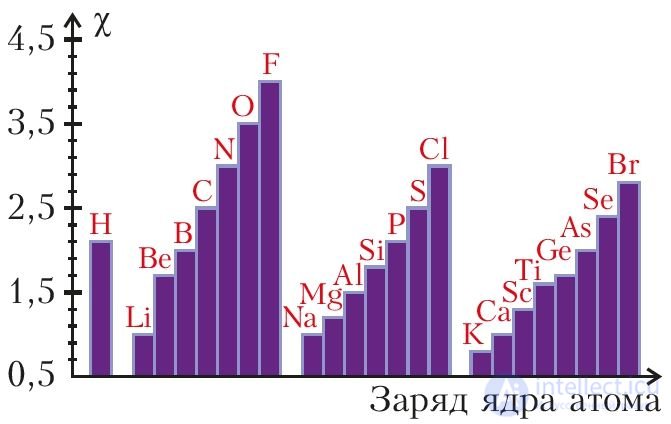
Fig. 22. Change in the electronegativity
of atoms with increasing nuclear charge
Electronegativity values (χ) are given in reference tables (Fig. 22, Table 7). There are several scales and methods for determining electronegativity. We will use the Pauling scale.
Analysis of the data in Figure 22 indicates the periodic nature of the change in electronegativity with increasing atomic number of the element: it increases across a period and decreases down a group. This can be explained by the fact that within a period, as the nuclear charge increases, electrons are attracted more strongly to the nucleus, while within a group, as the number of electron shells increases, the attraction weakens.
The elements with the highest electronegativity are F, O, N, Cl. The most electronegative element is fluorine (χ = 4.0). The lowest electronegativity is found in the alkali metals.
Periodicity of changes in oxidation states
Recall that the oxidation state — is the conventional (formal) charge of an atom in a chemical compound, calculated on the assumption that this compound consists of ions. In determining the oxidation state, it is assumed that the electrons participating in the chemical bond pass completely to the more electronegative atom. The number of electrons gained by an atom indicates the value of the negative oxidation state, and the number given up indicates the value of the positive oxidation state.
Analysis of the highest and lowest oxidation states, whose values are given in Table 7, allows the following conclusions to be drawn:
Table 7. The most characteristic oxidation states and electronegativity of the atoms of elements of periods 1–3
| Group | IA | IIA | IA | IIA | IIIA | IVA | VA | VIA | VIIA | VIIIA | IA | IIA | IIIA | IVA | VA | VIA | VIIA | VIIIA | |
| Elements | H | He | Li | Be | B | C | N | O | F | Ne | Na | Mg | Al | Si | P | S | Cl | Ar | |
| Electronegativity | 2.2 | 1.0 | 1.6 | 2.0 | 2.5 | 3.0 | 3.5 | 4.0 | 0.9 | 1.3 | 1.6 | 1.9 | 2.2 | 2.6 | 3.0 | ||||
| Oxidation states | +7 | +7 | |||||||||||||||||
| +6 | +6 | ||||||||||||||||||
| +5 | +5 | +5 | +5 | ||||||||||||||||
| +4 | +4 | +4 | +4 | +4 | |||||||||||||||
| +3 | +3 | +3 | +3 | +3 | +3 | ||||||||||||||
| +2 | +2 | +2 | +2 | +2 | +2 | ||||||||||||||
| +1 | +1 | +1 | +1 | +1 | +1 | ||||||||||||||
| 0 | 0 | 0 | 0 | 0 | 0 | 0 | 0 | 0 | 0 | 0 | 0 | 0 | 0 | 0 | 0 | 0 | 0 | 0 | |
| –1 | –1 | –1 | –1 | -1 | |||||||||||||||
| –2 | –2 | –2 | -2 | ||||||||||||||||
| –3 | –3 | –3 | |||||||||||||||||
| –4 | –4 | –4 | |||||||||||||||||
| Electron configuration formula of the outer electron layer | 1s1 | 1s2 | 2s1 | 2s2 | 2s22p1 | 2s22p2 | 2s22p3 | 2s22p4 | 2s22p5 | 2s22p6 | 3s1 | 3s2 | 3s23p1 | 3s23p2 | 3s23p3 | 3s23p4 | 3s23p5 | 3s23p6 |
Periodicity in the change of properties of simple and complex substances
When dividing chemical elements into metals and non-metals, criteria related to the properties of the simple and complex substances they form are used (Table 8).
Table 8. Distinguishing features of metals and non-metals
| Structure and properties | Metals | Non-metals |
| Structure and properties of atoms | When interacting with non-metals, they give up their electrons to them | When interacting with metals, they attract their electrons |
| The outer electron layer usually contains 1–3 electrons | The outer electron layer contains 4–8 electrons, except for the atoms of B, He, and H | |
| Have low electronegativity values | Have high electronegativity values | |
| Physical properties of simple substances | High electrical and thermal conductivity of simple substances. Electrical conductivity decreases with increasing temperature | Simple substances have high thermal-insulating properties. Low electrical conductivity |
| Ductility (malleability) of simple substances | Brittleness of simple substances | |
| General properties of compounds | In aqueous salt solutions, they predominantly exist as cations | In aqueous salt solutions, they exist as part of anions |
| Predominantly form basic and amphoteric oxides | Form acidic oxides | |
| Form strong and weak bases | Form strong and weak acids |
The manifestation of metallic properties by simple substances is associated with the ability of atoms with low electronegativity values to lose electrons. Across periods, as the size of atoms decreases, electronegativity increases, and the metallic and reducing properties of simple substances weaken. Periods begin with alkali metals and end with non-metals — noble gases. Down groups, as the atomic radius increases, electronegativity decreases, and the metallic and reducing properties of simple substances strengthen, while, correspondingly, the non-metallic and oxidizing properties weaken.
The weakening of metallic properties across a period is also expressed in the fact that the basic properties of the oxides and hydroxides of the elements gradually weaken and turn into amphoteric properties, and then acidic properties increase (Table 9). Atoms with the highest electronegativity values form acids.
Table 9. Acid-base properties of the oxides and hydroxides of the elements of the third period
| Comparison parameters | Group | ||||||
| I | II | III | IV | V | VI | VII | |
| Highest oxidation state | +1 | +2 | +3 | +4 | +5 | +6 | +7 |
| Highest oxide and its properties | Na2O | MgO | Al2O3 | SiO2 | P2O5 | SO3 | Cl2O7 |
| Basic oxides | Amphoteric oxide | Acidic oxides | |||||
| Hydroxide and its properties | NaOH | Mg(OH)2 | Al(OH)3 | H2SiO3 | H3PO4 | H2SO4 | HClO4 |
| Bases | Amphoteric hydroxide | Very weak acid | Weak acid | Strong acid | Very strong acid | ||
| Hydrogen compounds (hydrides) | NaH | MgH2 | AlH3 | SiH4 | PH3 | H2S | HCl |
| Non-volatile hydrogen compounds of metals | Volatile hydrogen compounds of non-metals |
For the same oxidation state value of atoms, the basic properties of hydroxides (and oxides) increase with increasing atomic size and decreasing electronegativity, since the interaction between metal cations and hydroxide ions weakens. Therefore, the strength of bases increases down the groups of the periodic table.
Within groups, as the radii of the atoms of the elements increase, the acidic properties of oxides and hydroxides gradually weaken (Table 10).
It should be noted that hydrogen compounds of metals are solid substances, while those of non-metals are, as a rule, gaseous substances.
Table 10. Acid-base properties of the oxides and hydroxides of some elements of group IIA
| Period | Group IIA | ||
| Element | Highest oxide and its properties | Hydroxide and its properties | |
| 2 | Be | BeO — amphoteric oxide | Be(OH)2 — amphoteric hydroxide |
| 3 | Mg | MgO — basic oxide | Mg(OH)2 — base |
| 4 | Ca | CaO — basic oxide | Ca(OH)2 — strong base |
| 5 | Sr | SrO — basic oxide | Sr(OH)2 — strong base |
*Dependence of the properties of oxides and hydroxides on the oxidation state value of the element in the compound
The oxidation state of the atoms forming oxides and hydroxides affects the nature of the properties of these substances.
For example, in the series of oxides  , as the oxidation state of the element's atoms increases, a weakening of basic properties and a strengthening of acidic properties occurs. Thus, Li2O exhibits basic properties, BeO already exhibits amphoteric properties, and the remaining oxides exhibit acidic properties, with the strength of the acidic properties increasing with increasing oxidation state in the series
 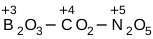 .
.
A similar pattern is observed for the hydroxides corresponding to these oxides: LiOH — strong base; Be(OH)2 — amphoteric hydroxide; H3BO3 (or B(OH)3) and H2CO3 — weak acids; HNO3 — strong acid.
| Oxides |  |
 |
 |
 |
 |
| Hydroxides |  |
 |
 |
 |
 |
| Oxidation state increases, the radius of the element's atom decreases | |||||
 |
|||||
| Acidic properties increase | |||||
 |
|||||
| Basic properties weaken |
The strengthening of the acidic properties of oxides and hydroxides with an increase in the oxidation state value of the element in the compound is also observed for individual elements. Thus, the change in properties in the series of oxygen-containing acids of chlorine can be expressed by the following scheme:
 |
 |
 |
 |
| The oxidation state of the chlorine atom increases | |||
|
|||
| Acidic properties strengthen, the stability of the compounds increases | |||
 |
|||
| Oxidizing ability increases |
Thus, as the oxidation state value of chlorine increases, the stability of its hydroxides (acids) increases, while their oxidizing ability decreases. The strongest oxidizer is hypochlorous acid (HClO), and the weakest is perchloric acid (HClO4).
The same pattern — strengthening of the acidic properties of a hydroxide (and, correspondingly, weakening of its basic properties) — with an increase in the oxidation state of the element is characteristic not only of chlorine but also of other elements. This pattern is most clearly observed in the oxides and hydroxides of chromium and manganese, which we will examine specifically in § 49.1.
Questions, tasks, problems
1. Arrange the elements Cl, N, Si, He, Li, Al in order of increasing atomic radius. Give an explanation.
2. Explain why the atomic radius:
3. Using the patterns of change in atomic radii, explain the change in electronegativity of atoms in the series of elements:
4. You know that the similarity of properties of elements of the same group is explained by the same number of valence electrons. Indicate what causes the difference in properties of elements within the same group.
5. Indicate the maximum and minimum oxidation states of the atoms: Ca, Cl, K, Na, Mg, Si, P.
6. Draw and fill in your notebook the table "Change in properties of atoms and their compounds across periods and groups."
| Properties | Nature of change when moving in the table | |
Across a period  |
Down a group  |
|
| Nuclear charge of the atom | ||
| Number of electron shells in the atom | ||
| Number of electrons in the outer shell of the atom | ||
| Atomic radius | ||
| Electronegativity | ||
| Ability to attract electrons | ||
| Ability to give up electrons | ||
| Metallic properties of simple substances | ||
| Non-metallic properties of simple substances | ||
| Basic properties of the oxides and hydroxides of the elements | ||
| Acidic properties of oxides and hydroxides |
7. From the list of characteristics proposed, select those that change linearly (rather than periodically) with increasing nuclear charge of the atom: electronegativity, number of protons, atomic radius, atomic mass, total number of electrons, number of electrons in the outer shell, oxidation state.
8. Nitrogen is characterized by the following oxidation states: +5, +4, +3, +2, +1, 0, –1, –2, –3. What properties — oxidizing or reducing — are exhibited by nitrogen in each of these oxidation states?
9. Based on the position of the elements N, P, C, Al, S in the periodic table, compare the acidic properties of:
10. The masses of two hydrogen compounds are equal. Compare numerically their volumes at STP, given that both compounds are gaseous and are formed by elements with the configurations [Ne]3s23p5 and [He]2s22p3.
*Self-check
1. The composition of the highest oxides is expressed by the general formula EO3 for the elements:
2. The electronegativity of the elements increases in the series:
3. Basic properties of the substances first increase and then decrease in the series:
4. Metallic properties are more strongly expressed in the first simple substance than in the second, in the pair:
5. Acidic properties are most strongly expressed in the hydroxide:

Comments